Arlington City Council Special Meeting – August 6, 2024
STREAMING COPY IN PREPARATION — RECORDING AVAILABLE FROM THE ORIGINAL SOURCE
Arlington City Council Special Meeting – August 6, 2024
The Arlington City Council convened in a special session on August 6, 2024, at 1:26 p.m. in the Council Briefing Room (101 W. Abram Street, 3rd Floor) after a notice posted on August 2, 2024. The meeting began with an executive session (1:26–2:36 p.m.) covering property acquisitions for the Division Street TxDOT Sidewalk Project and economic development incentives. The open session resumed at 2:42 p.m. and included a detailed FY2025 budget presentation, a comprehensive plan element for housing, and several committee reports. The meeting adjourned at 5:25 p.m. (An evening session followed at 6:30 p.m., but the agenda for that session was not included in the provided materials.)
Discussion Items
FY2025 Budget (3.1)
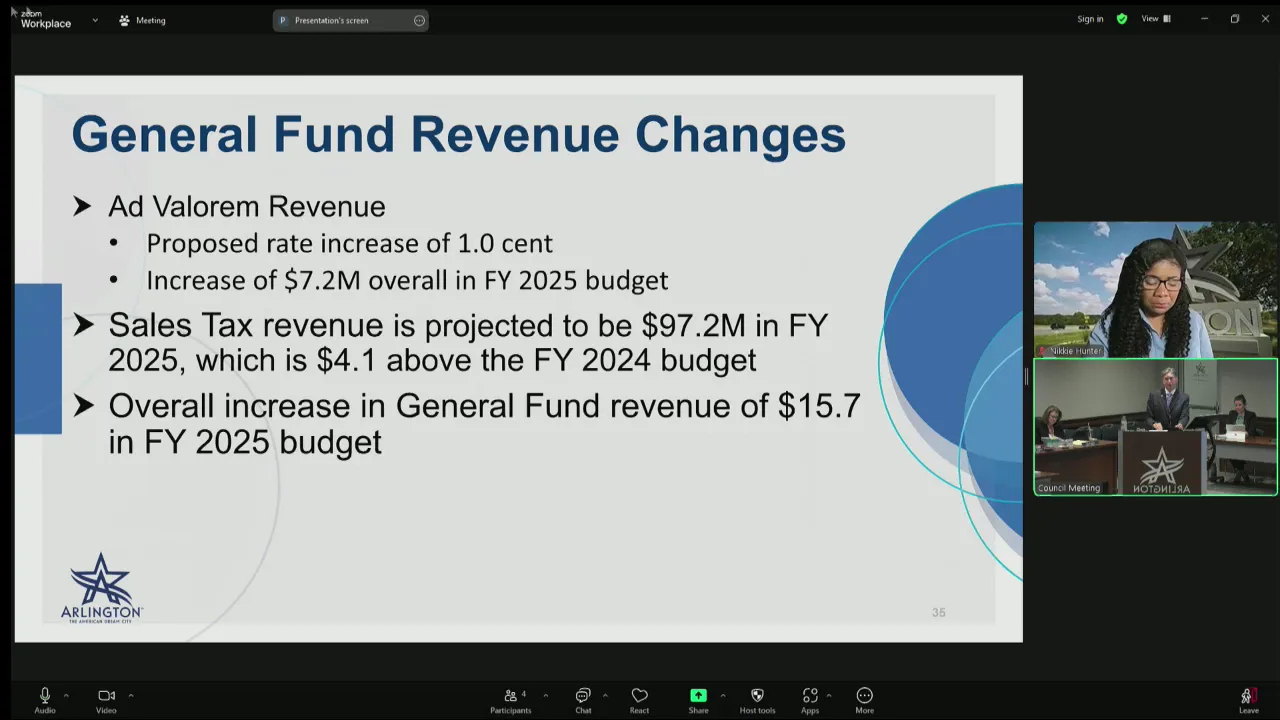
- City Manager Trey Yelverton presented the proposed $722 million operating budget, highlighting a proposed one-cent property tax rate increase from 58.98 to 59.98 cents per $100 valuation (the rate from two years ago). This would generate an estimated $4.1 million in new revenue. The no-new-revenue rate is 57.56 cents; the voter-approval rate is 62.10 cents.
- The budget includes a 2% cost-of-living adjustment for all employees and an additional 2% for police sworn personnel (total $6.7 million). It also funds 22 position eliminations (21 vacant, one filled with a reassignment), $5.8 million in departmental reductions, and a $500,000 “Clean Team” initiative for corridor beautification.
- Key revenue drivers: property tax (45% of general fund), sales tax (projected at $97.2 million, up from $92 million), and a $10 million decline in traffic citation revenues since 2013. Councilmember Piel questioned the cost-effectiveness of the municipal court given the drop in citations.
- Water, stormwater, and garbage rates would increase by about $13/month for the average residential customer. Water rates remain among the lowest in the region.
- The city’s 20% homestead exemption (since 1988) and senior tax freeze (since 2006) collectively exempt $138 million in market value. The one-cent adjustment would bring the rate to the midpoint between the no-new-revenue and voter-approval rates.
- Councilmember Odom-Wesley requested a deeper dive on the impact of eliminated positions. Councilmember Gonzalez requested a “one-pager” showing what would be cut if taxes were not increased.
Comprehensive Plan Element: HUD 5-Year Consolidated Plan/Housing Needs Assessment (3.2)
- Grants Manager Nikky Lewis presented the city’s plan to develop a housing needs assessment and update the five-year consolidated plan for HUD funds (CDBG, HOME, ESG – approximately $5 million annually).
- A consultant will conduct a community survey, focus groups, and data analysis, with a final report expected by October 2024. The consolidated plan is due to HUD by May 15, 2025.
The assessment will evaluate housing supply and demand across all income levels, not just affordable housing.
Mowing Schedules and Guidelines for TxDOT Roadways (4.1)
- Parks and Recreation Director James Orloski clarified that TxDOT provides three mowing cycles per year on state highways. Arlington supplements this with its own mowing (self-performed) but does not receive reimbursement, unlike some cities (e.g., Grand Prairie). Council discussed pursuing legislative changes in the upcoming session to improve the arrangement.
International Corridor Implementation Steering Committee (4.2)
- Planning Principal Cynthia Cruz provided an update on the steering committee’s work; no questions were raised by council.
2025 Neighborhood Matching Grant Program Call for Projects (4.3)
- The program opens August 6, 2024, with $150,000 available; grants range from $10,000 to $25,000. Applications are due November 24, 2024. The city will offer coaching sessions to help neighborhoods form associations and apply.
Infrastructure Investment and Jobs Act Update (4.4)
- No discussion.
Municipal Policy – Tree Preservation and Mitigation (4.5)
- Councilmember Odom-Wesley, chair of the Municipal Policy Committee, reported on proposed changes to the tree preservation ordinance:
- Increase the unauthorized tree removal penalty from $200 to $600 per caliper inch (or more), with developers’ support.
- Add a purpose statement for the ordinance.
- Adjust the point system for preserving trees to avoid loopholes (e.g., saving a single cluster to meet the 35% requirement while removing most trees).
- Propose a 10–25% preservation standard for commercial, multifamily, and mixed-use developments (currently none).
- Allow developers to redeem points through deviations from UDC standards (e.g., parking, setbacks) rather than only replanting.
- Define “heritage trees” (100+ years old, large caliper) that should never be removed.
- Staff will research comparable cities’ practices and return to the committee.
Community and Neighborhood Development – 2025 Neighborhood Matching Grant Program Overview (4.6)
- Councilmember Boxall, chair, reported that the program opens August 6, 2024, with six information sessions. The city will provide social media flyers to council members.
Economic Development – 2024 SCORE Cohort Selection (4.7)
- Councilmember Piel, chair, reported that all items were discussed in executive session and no further action was taken in open session.
Appointments to Boards and Commissions (4.8)
- Council discussed the appointment of Melody Morris to the Library Board (appointed by Councilmember Pham). Mayor Ross opposed the appointment, citing Morris’s prior public calls for the library director’s termination. Councilmember Pham argued that Morris had apologized and should be given a chance. Several councilmembers expressed support for Morris (Boxall, Hogg, Gonzalez) while others (Odom-Wesley, Piel) opposed. The appointment was left for the evening session, and no vote was taken in the afternoon session.
- Two other appointments were noted: Elizabeth “Betsy” UD to the Arlington Convention and Visitors Bureau and Sandra Smith (Place 5) to the Library Board.
Future Agenda Items (4.11)
- Councilmember Gonzalez requested a future agenda item on Sister Cities.
Key Outcomes
- The FY2025 budget discussion will continue; a public hearing on the proposed tax rate is scheduled for the next council meeting (August 13, 2024). Council must set the proposed tax rate by that date.
- Staff will prepare additional analyses requested by council (impact of position cuts, options for a no-tax-increase budget, municipal court efficiency, etc.).
- The tree preservation ordinance revisions will be brought back to the Municipal Policy Committee after staff research.
- The Neighborhood Matching Grant Program opened; staff will share promotional materials.
- The Library Board appointment of Melody Morris was not resolved in the afternoon session; the evening session (not covered in these materials) may have taken a vote.
Meeting Transcript
We have the individual mindsets that we have currently are other youths of different generations coming together. I know we can do it 35 or more years. Young rope. Continue to keep the dream alive. We'll be able to draw an handle right for the right girl and the freaking girl. This presentation is going to show you how to use the water sprinkler gauges that you receive from the city of Arlington. The first step is to place your gauges evenly in the lawn and within the space pattern of your sprinkler zone. If you need more cages, tuna cans work great. Or anything that has a flat bottom. Just use a ruler and a permanent marker to put your own measuring lines on the inside of the cans. The second step is to run your sprinklers for 10 minutes and record the amount of water that was collected in each cage. The last step is to calculate the sprinklers precipitation rate by taking the average in depth. You will take the average, which is all the gauges amounts added together and divided by the number of gauges used in inches of water divided by the runtime in minutes, then multiplied by 60. Here's an example of the calculations. If you have three gauges, you will record the amount of water that was collected. One of them being 0.25, the other one being 0.23, and the last one being 0.27. You will then add up those numbers and divide by three, which you will get a result of 0.25. After getting the average, you will divide the average by the runtime, which is 10. You will get the result of 0.025. Then you will multiply.025 by 60 and get the result of 1.5 inches per hour. Now that you know the precipitation rate for your sprinkler zone, you can use this information to determine how long to run your sprinklers for to give your lawn the correct amount of water. Don't forget to use the cycle and soak method setting on your sprinklers when watering. Visit W W dotwater is awesome.com and sign up to have weekly watering advice for your home address sent to your mobile phone or email account. Find more tips at WWW dot savearlingtonwater.com. Welcome to Paleteria Wasis. What started as a small paleteria has now become the favorite place for many families who want to try Mexican snacks. And if you are hungry, they have options for you. They started incorporating ceviche. Um and it's fresh. And vegetables and stuff. Customer satisfaction is their priority. Well, that's the same my mom and my dad always tried to do put more variety in the shop so that um yeah, so people wouldn't when people come, they have something to pay to choose. What are you doing on I thirty? Are you out there making sure that though that grass is a little bit more than a little bit of a little bit? Okay. Well, let's go ahead and call this afternoon session to order. Uh, we are going to what time is it here? It is one twenty six PM on August the sixth of twenty twenty-four. We'll now go into a closed session in accordance with the following sections of ETCA government code, chapter five, five, one point zero seven one, zero seven, two, zero seven, four, and zero eight seven. All right, we're gonna call City Council session back to order and we'll move on to the budget and business plan stuff. Trey. Thanks, Mayor. Members of the council. Um today starts kind of the next uh month and a half or so of discussion regarding the upcoming um twenty twenty-five fiscal year uh budget and business plan. So I want to take uh a little bit of time to highlight kind of where I think things are are headed and uh start the process of getting uh y'all's feedback relative to to everything. You all know we start with kind of your priorities and how we're focused because while we can do anything, uh we can't do everything, and so we try to prioritize the things that make a meaningful difference to you all in supporting youth and families, championing great neighborhoods, leveraging technology, building our economy, uh, et cetera. We talk um routinely uh, you know, several times a year about how things were doing financially, and we did uh the latest version of these just uh at the end of June, where we talked about kind of how things were starting to shape up. And so when we looked at that at that time, uh, we did a lot of our benchmarking. Uh, we talked about favorable tax policy, which I'm gonna highlight a little bit. We talked about some of the budget drivers that we're dealing with, as well as kind of how we're looking at things from a budget development and compensation market perspective, and so I'm gonna sprinkle some of that out and then kind of uh lead you to where I think uh where we can have further uh meaningful conversations about all of this.
openpublica.com