Arlington City Council Special Meeting – December 17, 2024
STREAMING COPY IN PREPARATION — RECORDING AVAILABLE FROM THE ORIGINAL SOURCE
Arlington City Council Special Meeting – December 17, 2024
The Arlington City Council convened in a special session on December 17, 2024, starting at 11:49 a.m. with an executive session, then reconvening in open session at 2:00 p.m. until adjournment at 5:01 p.m. The meeting included a Tarrant Appraisal District (TAD) update, the 2025 Citizens’ Bond Committee recommendation, a form-based code pilot area selection, and several informal staff reports. Council members expressed significant frustration over TAD decisions leading to an estimated $21 million budget deficit for Arlington.
Tarrant Appraisal District Update
- April Nixon (CFO) introduced Joe Don Bobbitt (Chief Appraiser) and William Durham (Deputy Chief Appraiser) from TAD. Bobbitt presented changes including a plan to reappraise residential properties only every two years (2025 and 2026 values carried over from 2024), a new appraisal software (True Prodigy), enhanced cybersecurity, and a homestead audit process.
- Council members (notably Councilmember Boxall, Hogg, Pham, Gonzalez, and Odom-Wesley) voiced strong criticism. They argued that TAD’s settlement practices and the board’s decision to delay residential reappraisals have caused a $21 million budget shortfall for Arlington, potentially forcing service cuts or tax increases. They urged TAD to be more aggressive in defending commercial property valuations and to better communicate with local taxing entities.
- Bobbitt responded that litigation settlement percentages (9–16% aggregate reduction) have been consistent historically, and that more aggressive litigation would significantly increase TAD’s budget. He offered to review specific data provided by the city.
2025 Citizens’ Bond Committee Recommendation
- Lemuel Randolph (Deputy City Manager) and Mary Phillips (Committee Chair) presented the committee’s recommendation of 26 projects totaling $198 million, reduced from an initial $400 million list. The package includes:
- Public Safety: $48.93 million (training facility design, fire station #5, equipment replacements, dispatch radios)
- Libraries: $2.425 million (improvements at five branches)
- City Hall: $3.1 million (functional improvements)
- Parks: $6.545 million (Dottie Lynn Recreation Center, infrastructure upgrades)
- Streets: $136.995 million (Randall Mill Road, Pleasant Ridge, South Collins, plus street reclamation, signals, and annual programs)
- Staff proposed a modification: shift $4.3 million from public safety training facility design (reducing it to $5.7 million) to purchase 600 police radios (increasing police/fire equipment to $8.2 million), keeping total at $198 million.
- Council discussed project specifics, including Randall Mill Road scope and cost differences for lane configurations. No vote was taken; a final decision is scheduled for February 4, 2025.
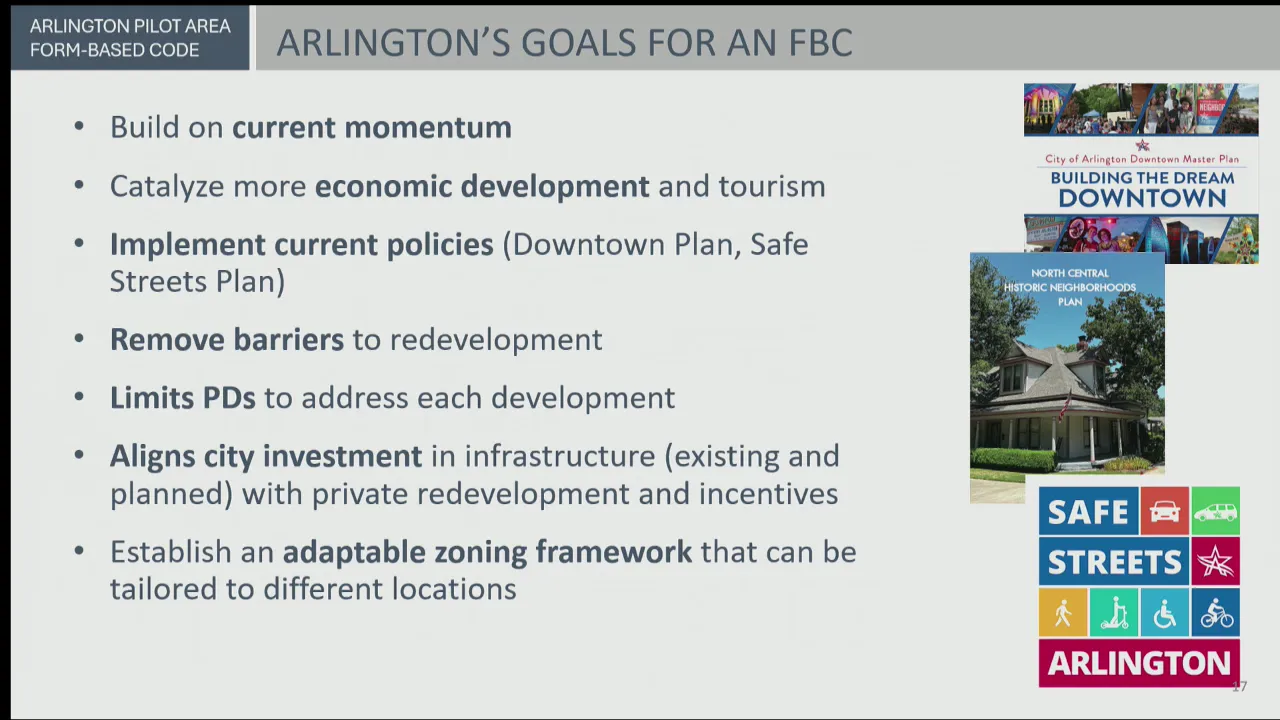
Arlington Pilot Area Form-Based Code: Pilot Area Selection
- Tharani Devi Palma and consultant Jay Narayana presented an analysis recommending downtown (Area 4B, approximately 675 acres) as the pilot area, citing its existing street grid, public anchors, and opportunity to consolidate multiple zoning districts.
- Council debated between a smaller pilot (Division Street, Area 3) and the larger downtown area. Councilmember Boxall raised concerns about Downtown’s size and entrenched interests, while Councilmember Galante supported a broader scope. No final decision was made; next steps include stakeholder engagement and a design charrette in early 2025.
Infrastructure Investment and Jobs Act Update and Reporting Transition
- Natalie Raulston and Nikky Lewis presented the final installment of the IIJA update. The Grants Management Department introduced a new online portal (Grants Resource Allocation Portfolio) to track grant applications and awards citywide. The portal includes dashboards for each department, win rates, and alignment with council priorities.
- Council praised the tool and the department’s work.
Discussion of Issues Session Items
- 4.1 CIPAC Semi-Annual Report: Richard Gertson reported the city is in compliance with Chapter 395 requirements.
- 4.2 FY2025 Support Our Youth and Families Newsletter: Jennifer Wichmann presented the newsletter; Dr. Odom-Wesley inquired about aggregating after-school resources.
- 4.3 Community and Neighborhood Development: Councilmember Boxall reported the committee did not meet.
- 4.4 Economic Development: Councilmember Piel noted all matters were considered in executive session.
- 4.5 Appointments to Boards and Commissions: Seven appointments were listed for the evening agenda.
- 4.6 Charter Amendments: No discussion.
- 4.7 Evening Agenda Items: Council discussed items 8.4 (veterinarian contract for Animal Services), 8.12/8.13 (e-discovery contract rejection and award), 8.28 (on-demand ride share contract), 8.29 (citizens bond committee membership diversity), and 12.1 (permit fee waiver). Item 8.29 was pulled for further discussion.
- 4.8 Issues Relative to City and TxDOT Projects: No discussion.
- 4.9 Future Agenda Items: No discussion.
Key Outcomes
- No formal votes were taken during the afternoon session. Key decisions deferred to future meetings:
- The 2025 bond package will be finalized by February 4, 2025.
- The form-based code pilot area selection will be determined after further stakeholder input.
- Council directed TAD to provide additional data on commercial property value reductions and urged the TAD board to reconsider its reappraisal plan.
- The IIJA reporting transition was accepted; future grant reporting will be handled through the new Grants Management portal.
- The meeting adjourned at 5:01 p.m.
Meeting Transcript
Okay. We're gonna go ahead and call the afternoon session to order. It is eleven forty nine AM on December seventeenth, twenty twenty four. Turn my mic on. We'll go ahead and call the afternoon session back to order. Welcome everybody. We're going to move on down the three point one, Miss Nixon. You have a guest you want to introduce us to. Yes, thank you, Mayor. April Nixon CFO. Today we have as a visitor Joe Don Bobbitt, who is the new chief appraiser at the Terrant Appraisal District. He came to us in February of this last year. And so he's new to the system and making lots of changes and that sort of thing. So we thought he could come and brief you on those. And so if there's ever anything that y'all want questions or have answers to, I'm more than happy to come back out and address anything that y'all have questions regarding, whether it be values or anything else. And so we have two new members, and then we'll have three returning. So come January 1st, the new members will have to be appointed and sworn in, and then they'll take office. The reappraisal plan, this is what kind of has made the news most recently. The board of directors has they made motions to direct me to not reappraise for 2025. So the values from 24 will be carried over for residential. Most of the changes they made were directly regarding residential properties. And so the residential values from 2024 will roll forward until 2025 and 26, and then we'll reappraise again in 2027. 2025 is a property value study year for us. And so the state control's office will come in and look at all of our numbers and make sure that we are plus or minus 5%, is what they're looking for. If we get outside of 14 and a half percent, then the schools lose funding or potentially lose funding. The benefits to the plan deal with uh potentially reducing the number of protests. We've gone from you know decades ago is 40,000 protests total to well over 200,000 at this point. A lot of that is more so tied in with as values and taxes increase, the number of protests increase with it. This isn't just a tarrent appraisal district problem, this is across the state. As values have gone up, the number of protests have gone up drastically. We're hoping that by doing the reappraisal plan every two years going forward, people only have to come in and see us once every other year. So it may give people a break on the in the off year that we don't reappraise, is kind of the thought. And so that'll provide additional stability to the taxpayers, and so they won't have to come in and argue with us every year, they'll kind of know what to expect. Um it does have limited impact on staff workload. So one of the the thoughts was that if we had to reappraise every other year, it may reduce our workload, uh, maybe our staff requirements. The the amount of analysis that we do that actually goes into our reappraising is really limited to maybe a two-week to four week period where we actually look at sales, do the analysis, and make all the the final changes to the values. So most of the time of the year, the appraisers are are actually out in the field looking at permits, uh looking at new construction, and they're trying to make sure that what's on the ground actually matches what we have in the system. And so that work will still be done. The other half of the year, we're we're kind of dealing with appeals and protest. So it's limited on how much it'll save us on manpower. On the process change, we are trying to focus more on customer experience. Uh this year we we got the average wait time down to 15 minutes if you came into the office to protest. Prior to that, there were stories of it being two to four hours just on a routine basis. And so the staff had a lot of good ideas on on changes to the process, and they they made a lot of improvements. Uh we did have a higher protest uh settlement rate this year, and so I know some of the staff had brought that up as far as compared to in years past, it looked like we had we had uh lowered the value more during the protest season than we had in past years. Some of that was due to ransomware, not directly because of it because of the timing, kind of compressed our timeline. We wanted to make sure that we certified on time as required by state law, and so the staff were kind of given the directive, be a little more lenient with the taxpayers. If they have a decent argument argument, go ahead and agree with them or get close, but you know, we're not trying to give away the farm, but at the same time, if it's close, don't need to send them to the ARB in a formal hearing. Uh a lot of that had to do. We also wanted to reduce wait times.
openpublica.com