Arlington City Council Special Meeting - January 28, 2025: Budget Gap, Housing Profile, MWBE Report, and Policy Discussions
STREAMING COPY IN PREPARATION — RECORDING AVAILABLE FROM THE ORIGINAL SOURCE
Arlington City Council Special Meeting - January 28, 2025
The Arlington City Council held a special meeting on January 28, 2025, from 12:18 p.m. to 5:03 p.m. (agenda listed 12:15 p.m. start). The meeting began with an executive session (12:18–2:21 p.m.) to discuss real estate leases and economic development incentives, then reconvened in open session at 2:34 p.m. for work session items and issues session items. Key topics included the FY2026 budget update (with a $21.5 million projected gap), the 2024 Multi-Family Housing Profile, the MWBE Report for FY2024, and discussions on pedicab programs, panhandling mitigation, out-of-jurisdiction housing finance corporation activity, and a proposed 2025 bond election.
Executive Session
- 12:18–2:21 p.m. – Council convened in closed session under Texas Government Code Sections 551.071 (attorney consultation), 551.072 (real property deliberation), and 551.087 (economic development negotiations) to discuss:
- Lease of land at 701 Brown Boulevard
- Lease of city-owned property at 1200 Ballpark Way
- Offers of incentives to business prospects
Work Session Items (2:34 p.m. – Open Session)
3.1 FY2026 Budget Update
City Manager Trey Yelverton presented a detailed budget outlook. Key points:
- Revenue trends: Hotel occupancy tax and sales tax growth showed clear inflection points after AT&T Stadium opened (2009) and Globe Life Field (2020). Pre-stadium sales tax growth averaged 2.7% annually; post-stadium it doubled to 5.3%.
- Three main challenges: (1) Expiration of $81 million in ARPA funds (one-time dollars used for recurring expenses); (2) Senior tax freeze (costing $3.5 million in FY2025, up from ~$500,000 in 2015); (3) Structural changes by the Tarrant Appraisal District (protests and litigation causing reduced tax base).
- Budget gap: Initially estimated at $15.5 million in November 2024, now updated to $21.5 million for FY2026.
- Strategies: 22 positions already eliminated; $6–8 million more cuts needed for FY2025 balance. Proposals include: standardizing fleet, consolidating utility locates, converting two city holidays to PTO (saving ~$500,000), reducing library content, closing Action Center on Saturdays, restructuring police command (attrition related), reducing school crossing guard costs (seek 50/50 partnership with school districts), and using $4.1 million from the business continuity reserve (dropping fund balance from 20% to 18.7%).
- Fail-safe options: Eliminating a 3% pay raise ($6.9 million) or a one-cent tax rate increase ($4.3 million) were mentioned as last resorts.
- Economic development: Since 2006, agreements induced $3.3 billion in capital investment with a 1:29 city-to-private ratio, added 15,000 jobs, and generated $60 million in payments to the city.
Councilmember Hogg urged revenue generation through fee adjustments and expressed goal of avoiding layoffs. Councilmember Gonzalez suggested council look at its own budget (travel, etc.). Councilmember Boxall asked about third-party verification for code compliance and potential volatility of a sales tax-based system (City Manager noted sales tax is a leading indicator with more volatility).
3.2 2024 Multi-Family Housing Profile
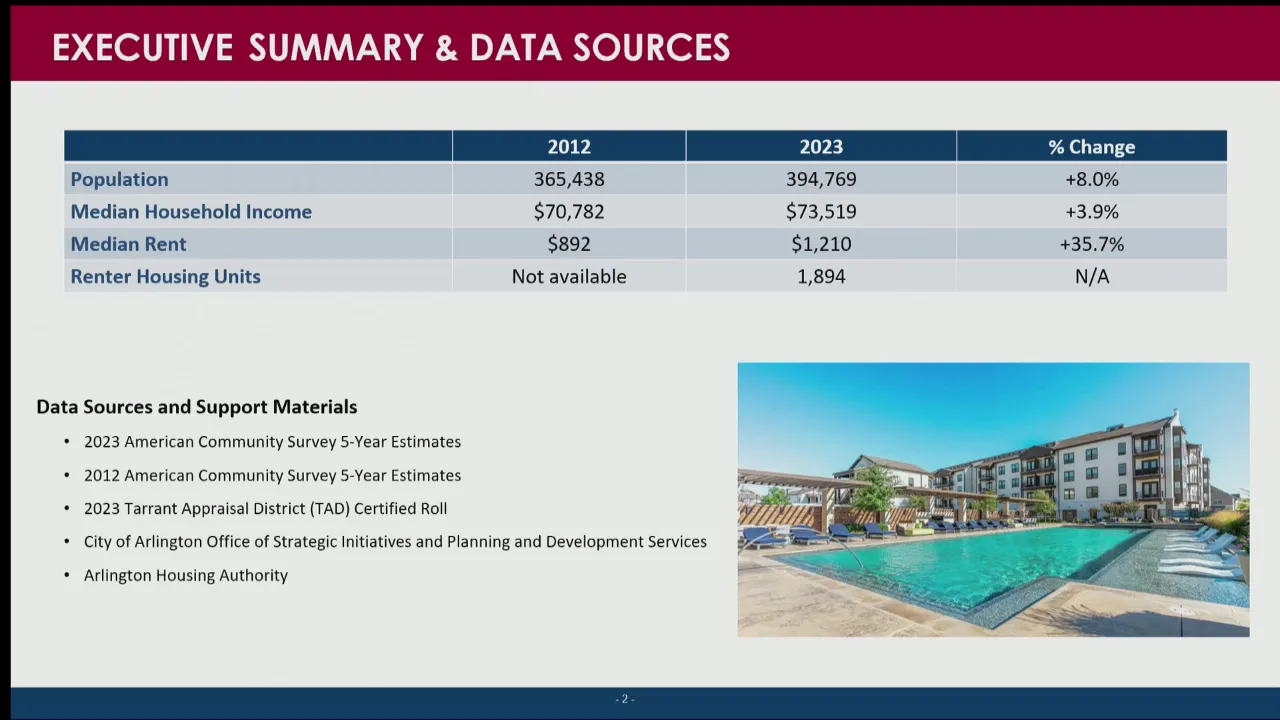
Sarah Stubblefield (Office of Strategic Initiatives) presented data comparing 2012 and 2023 conditions:
- Population increased 8% to ~394,000; median household income rose 4% to $73,519; median rent increased 35.7% from $892 to $1,200 per month.
- Average age of multifamily properties: 43 years; 76% built between 1970 and 1990.
- Rent burden: 57.8% of renter households spent >30% of income on gross rent (up from 51% in 2012).
- Housing Choice Vouchers: 910 distributed in 2023, 630 in multifamily units.
- Development activity: From 2021–2024, 11,000 multi-units approved; only 16 acres of standard multifamily zoning remain (excluding a 55-acre Kinnerdale ISD tract).
Councilmember Odom-Wesley asked if the city has averted a housing crisis – Stubblefield replied it's a policy balance of limited land, income growth, and assistance programs.
3.3 MWBE Report for Fiscal Year 2024
Erica Thompson (MWBE Manager) reported:
- 134 contracts under the program (>$50,000); 51 awarded to MWBE primes (38% of contracts). Ethnicity breakdown: Asian 22%, African American 9%, Hispanic 31%, Native American 0.66%, Women-owned 40%.
- MWBE goal achievement: 35% for FY2024 (up from 27% in FY2022 and 31.64% in FY2023).
- Cumulative MWBE spend (program + non-program) increased to 22% of total city spend (from 14% in FY2022).
- Outreach: 916 new vendors registered; 228 MWBE, 61 Arlington local, 13 Arlington MWBE.
- Business masterclass with Prosperity Bank resulted in three direct city contracts and four MWBE certifications for participants. Second cohort launched January 2025.
- Testimonial video from vendors praised the program.
Councilmember Odom-Wesley asked about impact of state/federal DEI pushback; Thompson responded they will continue their work. Councilmember Gonzalez clarified that women-owned is counted after ethnicity (no double reporting).
Issues Session Items
4.1 Pedicab and NEV-for-Hire Programs
Keith Brooks (Public Works) reported on a request to reauthorize pedicabs in the entertainment district. The city previously terminated the program due to persistent noncompliance (traffic violations, ignoring restricted areas, venue complaints). Staff met with a prospective operator but found no robust plan to prevent past issues. Councilmember Hogg expressed frustration that other cities manage pedicabs successfully and urged continued exploration. Mayor Ross noted the entertainment district partners strongly oppose restarting due to past problems. Councilmember Gonzalez asked about designated corridors – staff confirmed they existed but were ignored. No formal action taken.
4.2 Panhandling Mitigation Update
Jennifer Wichmann (Deputy City Manager) presented results of a pilot program using signs at three intersections directing donations to nonprofits. Panhandling activity decreased at those locations. Seven new intersections were selected for sign installation (moving from 3 to 10 total). Councilmember Gonzalez and Odom-Wesley asked about donation impact – no measurable increase in nonprofit donations yet. Signs to be installed within two weeks.
4.3 Out of Jurisdiction Activity by Housing Finance Corporations
Mindy Cochran (Housing Authority) reported on housing finance corporations (HFCs) from other cities (e.g., Pecos) acquiring properties in Arlington and claiming tax-exempt status, costing Arlington an estimated $400,000 in lost revenue per property. The city sent a letter to Pecos opposing the practice. Councilmembers Hogg and Ross expressed strong opposition and desire for legal action. Mayor Ross noted pending state legislation to restrict this. Councilmember Hogg suggested Texas Municipal League must address it. Council supported aggressive response including possible litigation. City Attorney Shortall is evaluating legal options to protest the tax exemption.
4.4 Community and Neighborhood Development Committee (Councilmember Boxall)
- Reviewed 2025 Neighborhood Matching Grant Program: five applications received; four advanced. Additional questions on one application; committee hopes to make final recommendations within a week.
- Review of Housing Tax Credit Applications: One proposal discussed (360/Pioneer area); further discussion next week.
4.5 Economic Development Committee (Councilmember Odom-Wesley reporting)
- SCORE program: 15 out of 21 participants graduated from six-month small business training; follow-up at 6 and 12 months.
- LiftFund: Two businesses (Sylvia Enterprises and Young & Roo) publicly announced as interest rate buy-down grant recipients; two more selected but not yet public.
- Remaining agenda items discussed in executive session.
4.6 Arlington Housing Finance Corporation Update (Mindy Cochran)
- No action items except approval of minutes.
- Transition of general counsel/bond counsel: David Pereskin retiring in May; Chapman and Cutler to serve as bond counsel; city attorney's office as co-general counsel until May, then consideration of RFQ/bid.
- Board passed resolution opposing out-of-jurisdiction HFC activity (consistent with city council stance).
- Single family bond program: 49 new homebuyers using program.
- Reserve at Mayfield (220-unit senior development) grand opening occurred.
4.7 Appointments to Boards and Commissions
- None.
4.8 2025 Bond Election Consideration
Lemuel Randolph (Deputy City Manager) presented proposed projects for May 2025 bond election. Council to vote on ordinance (first and final) at next Tuesday's meeting (February 4, 2025). Communications materials ready in English, Spanish, and Vietnamese.
4.9 Evening Agenda Items
- No discussion.
4.10 Legislative Update (Natalie Raulston)
- Brief overview of state and federal legislative sessions; monitoring executive orders (e.g., federal grant freeze, which was temporarily blocked by court). Councilmember Gonzalez asked about AI use – Raulston said not yet fully onboarded.
4.11 City Council External Committee and Training Reports
- Regional Transportation Council (Councilmember Gonzalez): Approved grant applications for I-183/Belt Line interchange, railroad grade separations; allocated up to $1 million for external legal assistance regarding potential litigation from Hunt Realty over high-speed rail planning (with $250,000 incremental approval). Also noted new 511 DFW traveler information system.
- U.S. Conference of Mayors (Mayor Ross): Winter meeting focused on housing; Mayor Ross running for second vice president. Also discussed FIFA World Cup naming of AT&T Stadium (pressing for inclusion of "Arlington" in the name) and a proposed veterans leadership program with Medal of Honor Museum and VA.
- National League of Cities (Councilmember Odom-Wesley): Elected to board; orientation held. NLC replaced president after Baton Rouge mayor lost re-election; new president is Steve Patterson (Athens, OH). Odom-Wesley serves on Membership Committee, liaison to Black Caucus, and Human Development Committee. Next meeting March 2025 in D.C.
4.12 Issues Relative to City and TxDOT Projects
- No discussion.
4.13 Future Agenda Items
- Councilmember Gonzalez requested discussion on how the city can assist residential developments with off-site roadway build requests (impact fee waivers or shared costs) citing two stalled projects in South Arlington. City Manager noted staff needs time to prepare; likely at end of February.
Key Outcomes
- No formal votes or approvals occurred during the special meeting. The meeting was primarily informational and directional.
- Clear council position established: Strong opposition to out-of-jurisdiction HFC activity, with direction to explore all legal and legislative remedies.
- Budget gap acknowledged at $21.5 million; staff to return in April with further proposals on fees, cost recovery, and franchise fees. Council supportive of attrition and avoiding layoffs.
- Pedicab program will not be immediately restarted due to past failures and partner opposition, but council expressed openness to future plans with robust compliance measures.
- Panhandling mitigation pilot to expand from 3 to 10 intersections with signs.
- Bond election ordinance to be considered at next regular meeting (February 4, 2025).
- Neighborhood Matching Grants committee recommendation expected within a week.
- Future agenda item on off-site roadway build requests will be scheduled for late February.
Meeting Transcript
Well, hello, everybody. I hope everybody had a good weekend. I would be remiss if before we go into executive session, if I didn't acknowledge the celebrity presence here today. And if you can't see the back says Arlington jail with a lot of rhinestones, and many people propose those are our new jail costumes. We're gonna go ahead and go into a executive close session pursuant to VTCA government code, chapter 551. Okay, we'll go ahead and call the session back to order. We're going to move on down to three point one on a budget update. We've uh got this uh information for you uh uh uploaded into your agenda manager so you can follow it uh and all of that. But um, you know, there's a lot of a lot of challenging news out there, some things that are uh some good news and some challenging news, but we're going to uh need everyone's collected help, your your help, that of the public to kind of help navigate the things that we're uh working through, and you know, as I guess I would uh joke with folks when I go out to the suggestion boxes open, so uh we need uh we need everybody's collective ideas. You know, we started on this challenge uh last November as we kind of had our fall planning retreat. We kind of knew based on how we ended fiscal 24 that there were going to be some challenges. So we started foreshadowing uh that uh and uh we got a few questions from you all during that time. So I want to try to provide a little bit of response, but also kind of uh some follow-up on that. So one of the questions had to do with was uh kind of the venues uh and events and how revenues from venues and events are gonna help us kind of over the over the hump, right? So we've got a few pieces of data here to kind of highlight. Um this is a trend line as it relates or bar chart as it relates to showing hotel occupancy tax revenue history, and it's divided into two pieces. Kind of the the darker blue is the traditional seven percent city tax, and the lighter blue is the two percent that's attributable to stadiums, right? So when you hear a little bit about well, how are the stadiums doing and and kind of what's the you know, how's the performance, etc. You can just really go in here and you can point at a couple things. Uh right here. Let me get a better color. Here is when ATT stadium opened, right? So it was it was starting to kind of improve a little bit in this area, but really flat for the decade before, the 15 years before. Um Globe Life opened in this window, of course, against uh headwinds of COVID, but as that quickly rebounded, you see a new trajectory established not only in the growth of hotel occupancy tax, but in the growth of that that's generated by the venues, right? Which are indications, not of what you know, indie cars worth or what uh FIFA's worth or any of those things, but it's an indication of kind of how how it's working systematically, right? So to me, that was one way to show you all a little bit about how um the uh the clear there's a clear trajectory that has uh changed in that way, and and if that wasn't enough, I thought there's another way to show this. It's also equally as interesting on sales tax receipts. If you will go with me on kind of how this kind of will uncoil a little bit. Similar story, let's look at kind of pre-ATT stadium. And what we're looking here are some lines that are one, three, and five year moving averages over uh a decade, 15, actually, I think uh pending about uh 10 to 15 years in this area. You see a very kind of flat um deal. You're not not a lot of growth here. So then uh what happens? Um well, this is our trajectory, you know, it uh left to our own devices. This is where things were headed, you know, in the pre-ATT stadium kind of world. You can see the trajectory, how the growth is pretty modest. Um then uh in 2009, ATT opens, and you start to see uh kind of a notable inflection point, all right? A little a little climb up from that. You have to remember ATT also opened in a really bad time coming out of the 0809 housing crisis, and there was a lot of serious financial issues, but nonetheless, you can see a really clear um you know increment that's identified in this area that's a change from the trajectory that we were on. But even when you factor that in, you kind of take a look and say, okay, well, now what's our trajectory? You can kind of see how it tilted up. All right. So then we take a look at well, okay. Well, now Globe Life and the new convention center uh and other things going on. How's that helping us? Well, again, that all happened kind of May of 2020, COVID year, and you see the COVID dip, but then you also see a really strong COVID rebound and a really strong economic, you know, performance that are driven uh at least uh anecdotally from the things that are going on in our community. This incremental revenue is is what's being driven by venues and events in town. It's not exclusive, but there are clear inflection points in here that uh that demonstrate that. So when you look at it in summary, kind of before ATT stating, we were averaging around a 2.7% sales tax growth after that since it's about doubled 5.3% annual growth. Those are dollars that we now have to invest and to put back into our economy and in the things that we do.
openpublica.com