Arlington City Council Special Meeting – June 10, 2025: Budget Planning, World Cup, Housing, and Fire Department Reports
STREAMING COPY IN PREPARATION — RECORDING AVAILABLE FROM THE ORIGINAL SOURCE
Arlington City Council Special Meeting – June 10, 2025
On June 10, 2025, the Arlington City Council convened a special meeting starting at 11:45 a.m. in the Council Briefing Room. The meeting included an executive session on real property and economic development, followed by open session discussions on the FY 2026 budget, 2026 FIFA World Cup preparations, the Innovate Arlington comprehensive plan, the Arlington Fire Department annual report, housing programs, technology leverage, boards and commissions, and a legislative update. Council members also reported on external committee meetings. No formal votes were taken; the meeting was informational and directional.
Executive Session (11:45 a.m. – 1:53 p.m.)
- Discussion of a Landfill Lease Agreement (Section 551.072)
- Discussion regarding the possible purchase, exchange, lease, or value of real property for eligible projects of the Arlington Economic Development Corporation (Section 551.072)
- Offers of incentives to business prospects (Section 551.087)
Discussion Items
FY 2026 Budget Planning Update (3.1)
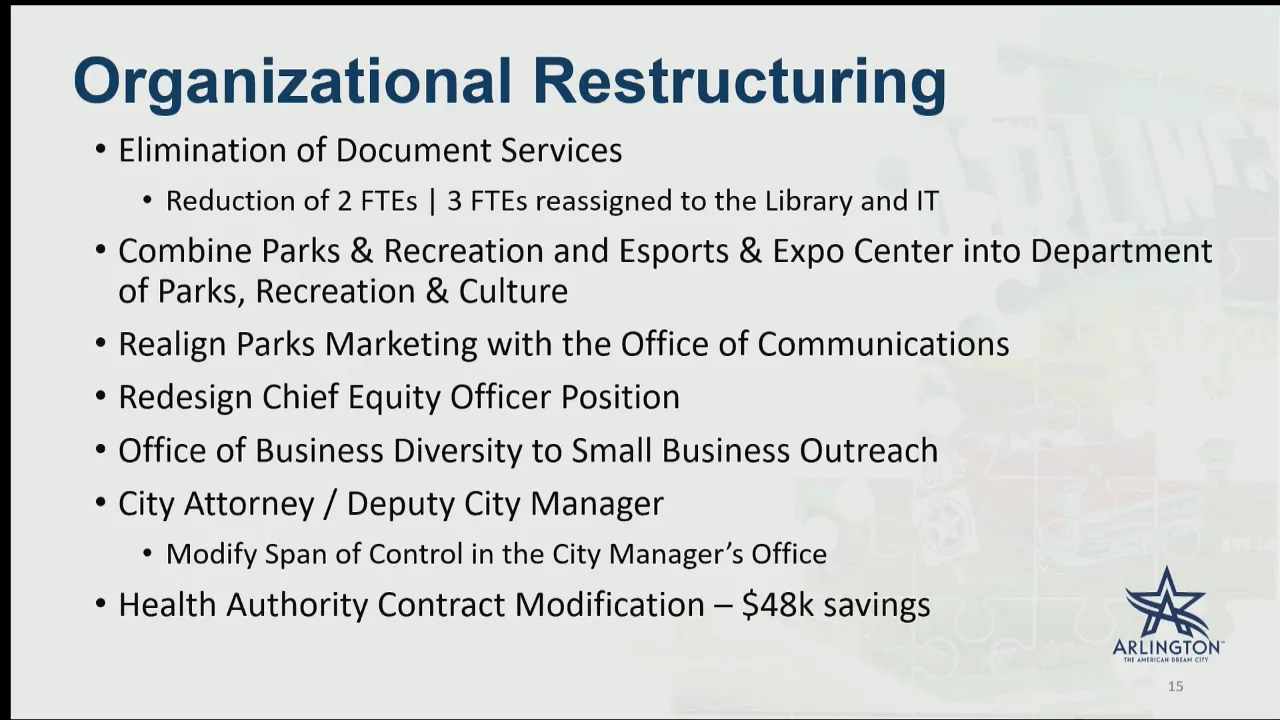
City Manager Trey Yelverton presented a detailed update on balancing a projected $25 million shortfall. Key challenges include the loss of ARPA funds, the senior tax freeze (costing $3.5 million in FY2025), Tarrant Appraisal District’s low protest bar and frozen values, and property tax revenue erosion from the traveling housing finance corporation ($1.7 million lost in FY2026). Yelverton outlined a strategy with six phases, highlighting $18.7 million in identified reductions (including 30 FTE eliminations), $4 million in business continuity reserve use, and a remaining $6.4 million gap. Options to close the gap include: forgoing the 3% employee pay raise ($6.9 million savings), cutting fringe benefits (e.g., insurance shift from 90/10 to 85/15, suspending sick leave sellback, reducing 401k match, etc., totaling $5.4 million), deeper reserve use (requiring 40 additional non-sworn FTE reductions, bringing total to 9.5% of non-sworn general fund employees), or a tax rate increase (1 cent = $4.3 million). He also proposed organizational restructuring, including eliminating document services, merging parks and recreation with the Expo/Esports center, and transitioning the Office of Business Diversity to a small business outreach office. Council members expressed concerns about service reductions. Councilmember Gonzalez supported a combination of benefit cuts and a modest tax increase. Councilmember Boxall opposed cutting Code Compliance and bunker gear. Councilmember Odom-Wesley asked about minimum wage (staff to provide later). Councilmember Hogg opposed forgoing the pay raise and preferred a tax increase. Councilmember Pham inquired about recovering lost revenue from the housing finance corporation. Yelverton plans to bring refinements to the next meeting and a final proposal in August.
2026 FIFA World Cup Update (3.2)
Deputy City Manager Jennifer Wichmann provided an update. Matches will run June 14 – July 14, 2026, with one semifinal. The city’s theme is "Arlington Welcomes the World." Targeted town halls are planned for hotels (June), restaurants (July), and entertainment district businesses (August). The city is finalizing an event agreement with the North Texas FIFA World Cup Organizing Committee, including cost reimbursement and recognition efforts. Councilmember Hogg asked about small business engagement and volunteer opportunities; Wichmann directed to the Dallas FIFA 2026 webpage. The city’s World Cup webpage is pending FIFA approval.
Innovate Arlington Phase I Engagement Report Out (3.3)
John Chapman (Planning Manager) and Robin Williams (J. Williams Group) presented results from community engagement for the comprehensive plan update. Phase I included: 6 workshops (230 attendees), 407 online survey responses, pop-ups at Benton Plaza (90) and UTA Earth Day (215). Key strengths: location, sports/entertainment, parks, arts/culture. Top concerns: traffic congestion, public safety, infrastructure funding. Desired improvements: safer biking/walking, better public transit, neighborhood reinvestment. Survey respondents (72.3% 10+ year residents) also prioritized revitalizing neighborhoods, walkability, and quality parks. Phase II will use a gaming tool for trade-off scenarios.
Arlington Fire Department 2024 Annual Report (3.4)
Fire Chief Bret Stidham reported on operations, staffing, and technology. Highlights: implementation of 4-person staffing on frontline apparatus, hiring 62 new recruits and 15 lateral firefighters, 8% reduction in turnout times via BRICS alert system, dispatch center answered over 92% of calls within 10 seconds (383,179 calls total), 11,253 inspection activities, 208 fire investigations (3 arson arrests). Future plans: quartermaster program for bunker gear (cost savings), nurse navigation to reduce non-emergency 911 calls, and Metro X full-scale regional terrorism exercise in October 2025. Councilmember Boxall raised concerns about confusing warning sirens; Chief will work on messaging.
Housing Annual Report (3.5)
Mindy Cochran (Executive Director) and team presented the Housing Authority’s annual report. The authority serves ~3,200 families via Housing Choice Vouchers (no public housing). 38% of families have earned income; average tenant rent contribution is $437/month. The authority has been a HUD high performer for 20+ years. Programs include family self-sufficiency (Assistance Plus), homeless services (permanent supportive housing, rapid rehousing, homeless diversion), and housing rehab (over 3,100 families assisted since 1976, $28 million invested). New initiatives: a grant for veterans’ home rehab, a mobility planning grant, and funding for critical documents for homeless individuals. Federal budget uncertainties threaten vouchers.
Council Priority – Leverage Technology (3.6)
Deputy City Manager Lemuel Randolph reported on technology projects: FOIA software, permitting system, park Wi-Fi expansion, special events permits, workday talent management, smart meter installation (ahead of schedule), AI and cybersecurity (GovRAMP adoption). The city is the first in Texas to adopt GovRAMP. Councilmember Boxall asked about phasing out the Amanda system; City Manager Yelverton noted a new procurement with AI components is underway.
Boards and Commissions Review (4.1)
Jay Warren presented a review; no council members had questions. Appointments are proceeding on schedule.
Contract for Medical Direction and Health Authority Services (4.2)
No discussion; Chief Stidham later explained a new four-physician team from QuestCare will replace retiring Dr. Simmons, enhancing nurse navigation and social work integration.
Economic Development (4.3)
Councilmember Odom-Wesley reported all matters discussed in executive session.
Appointments to Boards and Commissions (4.4)
No appointments on the evening agenda.
City Council External Committee and Training Reports (4.5)
- Tarrant County Homeless Coalition: Councilmember Odom-Wesley reported concerns about Arlington Life Shelter reducing beds from 120 to 85 and potential closure for inclement weather; staff will engage.
- Tarrant Regional Transportation Coalition: Mayor Ross reported on a new master plan by TxDOT Fort Worth District to address funding disparities; town hall meetings upcoming.
- Tarrant County Mayors Council: Redistricting update and measles outbreak update.
- Texas Municipal League Governance Committee: Legislative update.
- Mayors Alliance to End Childhood Hunger: Discussed impacts of federal cuts to SNAP and CDBG; planning a unity letter.
Legislative Update (4.6)
Natalie Raulston noted HB21 signed, 1893 pending, property tax bill dead, and several other bills. A full wrap-up will be presented on June 24.
Key Outcomes
- No formal votes were taken.
- Staff will refine budget options based on council feedback and present a final proposal in August.
- The city will bring a World Cup event agreement for council approval at the June 24 meeting.
- The Finance and Audit Committee will discuss potential consolidation of branch libraries.
- Councilmember Hogg requested a future agenda item on an updated report of multi-family housing projects approved by council.
- Councilmember Pham requested a future agenda item on parking on TxDOT-owned property.
Meeting Transcript
Okay, we're gonna go ahead and call the afternoon session order. Okay, we will reconvene the City Council afternoon work session. We're expecting the mayor, but in the meantime, we're going to continue with our presentations. Thank you very much. So wanted to give you more of an update. And as you can imagine, as we do more and more work, it gets a little more difficult, right? A little harder and harder. But I want to give you that update and have some chance for us to discuss it hopefully for you guys to give us some feedback on uh on where you think. So we've been working on this for a minute, right? Uh going back all last year. We've got some uh some updates and some next steps we want to talk to you about. Um those discussions that we started on really go back to last November. And in your presentation, and for those kind of watching on the public that have this on their agenda, these are all hyperlinks to those previous uh presentations where we started wading into the the challenges and the things that we were gonna do to correct uh for that back in November. Um we were kind of foreshadowing where we're at today, and things continue to evolve. We talked to you all again in January, made progress, again in April, making more progress, and today uh here again today to talk about more progress. Um we also have provided you with a significant data set as it relates to comparing and contrasting our uh productivity, our tax rates, our workforce, uh head count, et cetera, compared to cities in the region and across the state. Um, because I um continue to tell you that I think we do a uh we do a lot with a lot, but we're highly efficient and productive in what we're doing, and we we don't just say take our words for it, just do the benchmark comparisons uh that we did and take a look for yourself because it's it's a significant workload that our folks are are carrying and uh they're doing good work and we're trying to do as much of that good work on behalf of residents as we can. But uh I want to show everybody what's uh what's out there. So as a big refresh, uh I always get this question what's the problem, Trey? Uh well, this has been a slide that we've consistently used going back to this time last year almost, but certainly is in November, is we've really got at least five things kind of moving around here on us. Um, you know, the ARPA funds, this in 2026 will be our last year of ARPA. And when we made decisions with ARPA, we made some decisions that we had some recurring expenditures built in as we restored um uh positions that had been uh frozen, as we expanded our public safety and police and fire in particular. And with those, those carry ongoing expenses, and you kind of feather that in, feather that in, feather that in. 2026 is our last year to feather that in, and so that will be corrected as part of uh of this, or I say won't be corrected, but the final year of the plan uh is to come to fruition. Um, also the senior tax freeze. Uh we've been pointing that out. We've got a very favorable tax policy environment that you all have created amongst yourselves as well as things that voters have approved. And this is one where I think back in 2025, uh voters approved the senior tax freeze. Last year, for example, in our tax base, that was three and a half million dollars worth of uh revenue loss to the overall budget. So it's grown from literally 100,000 a year in that first year to three and a half million dollars last year. So it's a significant revenue loss. Uh I suspect it's gonna be significant again uh this upcoming year and don't have a real number yet till we get the final rolls from uh the appraisal district, but uh something that we need to manage. And then the last uh three are kind of related, uh all dealing with uh the Terrent Appraisal District as it relates to the conservative value projections that we've seen as we look at Tarrant County compared to other counties in the region. We've shown you those comparisons that we're generally speaking about 10 per 10 percent behind those other counties. We've also showed you the um kind of the low bar to protest um protest uh documentation, if you will. Um, and that has also really led to a marked acceleration, not just a trend, but a marked acceleration in revenue loss uh to uh taxing jurisdictions. So that's an important uh piece. We continue to see that pattern. It continues to grow and accelerate in that area. And then, of course, you all know uh the appraisal district has a requirement to have an appraisal plan and and effectively as it relates to real estate from a from a residential real estate perspective. Their plan is to not have a plan, it's to not reappraise. They froze values last year, and then for a two-year window, they're frozen. They're really not considering uh reappraisals. And so from a from a significant amount of revenue uh derived from revenue on um uh property taxes when it's frozen. That means that uh at best we're flat and it and at worst we're negative because of the other two numbers that I'm talking to you about. Those continue to go down, and uh we want to uh uh pay attention to those. We also are paying attention to statutory updates from the legislative session and how things that changed in Austin might affect not this year. Nothing that was passed down there will impact us this year, but we may very well see some um some relief and/or some things to adjust for next year in the 2027 area. So we've continued our methods. This was a chart that was largely uh same strategy we used back during the COVID difficulties, and we're using it here as it relates to the peeling back the layers of the onion, the prioritization of the areas that we go to for budgetary reductions, and then kind of you know, work it kind of one through six with six being uh last and um and you know, number one being one.
openpublica.com