Arlington City Council Special Meeting: Budget Planning and Legislative Wrap-Up (June 24, 2025)
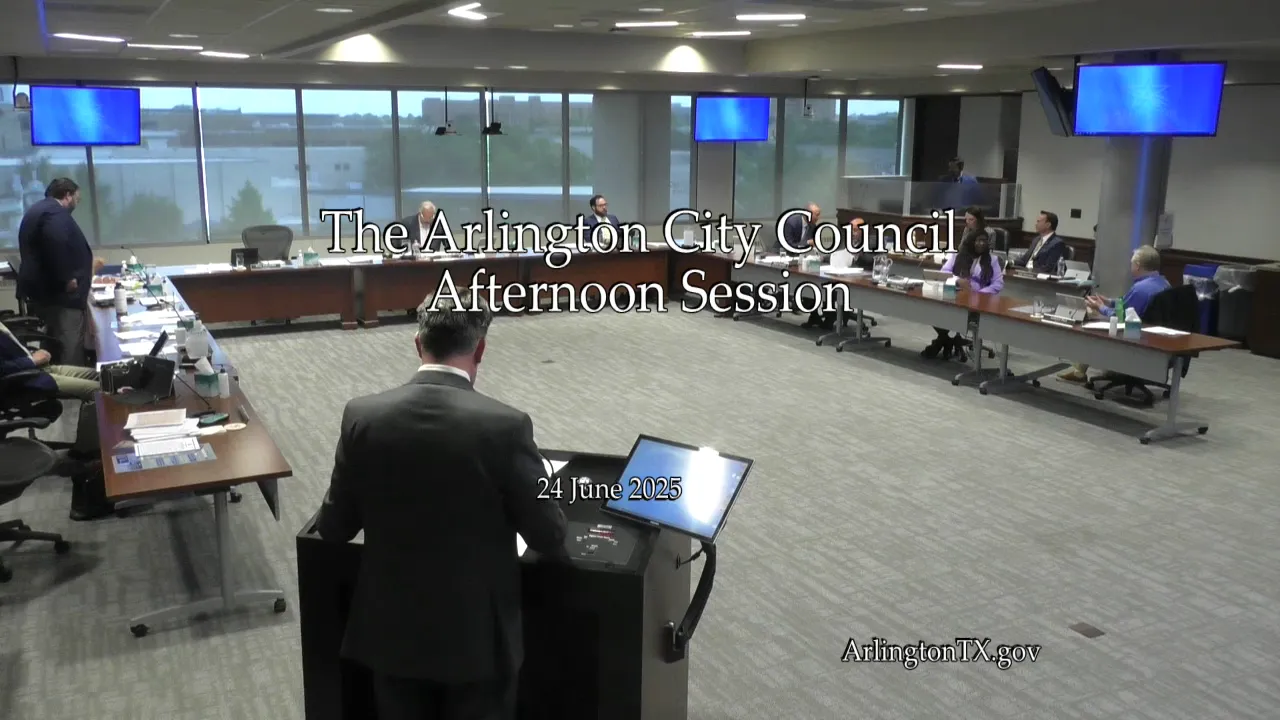
STREAMING COPY IN PREPARATION — RECORDING AVAILABLE FROM THE ORIGINAL SOURCE
Arlington City Council Special Meeting: Budget Planning and Legislative Wrap-Up (June 24, 2025)
The Arlington City Council held a special meeting on June 24, 2025, starting at 12:45 p.m. with an executive session, reconvening in open session at 3:01 p.m. and adjourning at 5:01 p.m. The meeting included a detailed FY 2026 budget planning update, a wrap-up of the 89th Texas Legislative Session, and several informal staff reports on topics such as film production incentives, downtown pedestrian safety, multifamily property inspections, and committee reports. The council discussed various options to close a $6.4 million budget gap, including tax rate adjustments, employee compensation, benefit modifications, and further position reductions. No formal votes were taken, but direction was given for future actions.
FY 2026 Budget Planning Update
- City Manager Trey Yelverton presented the budget update, highlighting a $6.4 million gap remaining after previous reductions totaling $21.8 million from prior meetings. The gap is driven by the end of ARPA funding, appraisal district changes (including a two-year freeze on residential values), and the compounding effect of the senior tax freeze (irrevocable since 2005). The city has already eliminated 52 vacant positions across two fiscal years.
- The senior tax freeze now affects 25,000 accounts (23.7% of all accounts), with $2 billion in assessed value lost, equating to $13.6 million in foregone revenue. The homestead exemption (20%, 40 years) provides $26 million in tax relief annually. Each 1% of homestead exemption equals $1.3 million.
- Council members expressed preferences: Several favored a combination of a tax rate increase (one cent raises $4.3 million) and moderate employee compensation adjustments rather than deep cuts to benefits or additional layoffs. Councilmember Hunter opposed benefit cuts; Councilmember Gonzalez and others supported a tax rate increase as a necessary tool. Councilmember Piel suggested a contingent raise (e.g., 2% now, 1% mid-year if revenue improves). The city manager noted that the tax rate is a flexible lever.
- Key statistics: The city has 109 vacant positions; sales tax revenue is 7% ($4 million) below projections. The city's reserve fund balance is at 20% of operating budget (about $60 million total), and a one-time use of $4 million from the business continuity reserve is proposed to fund a 12-month challenge grant program for affected employees.
89th Texas Legislative Session Wrap Up
- Natalie Raulston, Intergovernmental Relations Manager, reported that of 8,908 bills filed, the city tracked 1,737, with 187 passing. The IGR team made 17 trips to Austin, held 59 meetings, and testified on 8 bills.
- Key bills affecting Arlington: HB 2 (public school funding, $8.5 billion), SB 840 (allows mixed-use in multifamily/residential zones without rezoning), SB 15 (tiny lot bill – lot size minimum 3,000 sq ft on unplatted parcels), SB 1646 (enhanced penalties for copper theft), and HB 1893 (City of Arlington initiative allowing disclosure of license plate data without redaction).
- The city attorney noted that HB 1522 changes open meetings notice requirements from 72 hours to three business days.
- A special session is called for July 21, but items are not expected to impact Arlington directly.
Attracting Creative, Film and Media Productions
- Jay Warren, Marty Wieder, and Jeremy Thomas presented on efforts to attract film and media productions. The city is pursuing a "digital media film-friendly" certification, joining Little Elm and Lubbock as the only three Texas cities. The EDC and communications office will collaborate to recruit productions and explore Media Production Development Zones (MPDZ) for longer-term incentives.
Downtown Pedestrian Safety
- Public Works Director Keith Brooks discussed plans to reduce the speed limit on Mesquite Street from 35 to 30 mph to match other downtown streets. Additional safety improvements include a continuous sidewalk crossing at Center Street and Mesquite near the railroad tracks, and funneling pedestrians to the existing mid-block crossing at the library. Councilmember Boxall requested signage to warn drivers of pedestrian crossings near the railroad.
Multi-Family Annual Property Inspection (API) Program Scoring System
- Nora Coronado and Fire Chief Bret Stidham presented the scoring system. The program rates multifamily properties on a scale; properties consistently scoring below 70 may be considered for dangerous/substandard structures designation. Council discussed enhancing standards beyond life safety, including cameras and crime prevention. Councilmember Boxall requested a deeper dive in committee, and Councilmember Pham supported moving the discussion to the Community and Neighborhood Development Committee.
Committee Reports
- Community and Neighborhood Development (Councilmember Boxall): The committee recommended full funding of two Historic Preservation Fund grant applications: Arlington Baptist University Top of the Hill Terrace ($13,500) and Johnson Station Cemetery ($6,332). These will be considered at the August 5 council meeting.
- Finance and Audit (Councilmember Hunter): Reviewed operational costs and deferred maintenance at Ron Wright, Southwest, and Woodland West libraries.
- Arlington Housing Finance Corporation (Councilmember Hunter): Approved submitting an application to the Texas Bond Review Board for private activity bonds and assigning authority to the Texas Department of Housing and Community Affairs to administer a first-time homebuyer program with below-market rates and down payment assistance.
Appointments to Boards and Commissions
- City Secretary Alex Busken noted 60 appointments to various boards and commissions will be considered on the evening agenda. Councilmember Boxall specifically requested applications for the Landmark Preservation Commission.
External Committee and Training Reports
- Councilmember Gonzalez reported on the Regional Transportation Council (RTC) meeting, including approval of the Mobility 2050 plan (projecting 12 million residents, $217 billion in projects) and selection of safety corridors. The Arlington Convention and Visitors Bureau reported strong growth: hotel bookings from Expedia and Booking.com generated $8.3 million on $72,000 ad spend; Arlington moved from 34th to 29th in North American meeting destinations.
- Mayor Ross reported on the U.S. Conference of Mayors Annual Meeting, noting key issues: housing, homelessness, immigration, tariffs, and executive orders. Crime is down nationally.
Public Display of Restaurant Health Inspection Certificate
- Mayor Ross and City Manager Yelverton discussed requiring restaurants to prominently display their health inspection grade (already posted online). The Arlington Restaurant Alliance supports the idea. The council directed staff to bring back an ordinance to modify the health code to require posting.
Key Outcomes
- The council directed staff to prepare an ordinance requiring restaurant health inspection certificate display.
- The council expressed consensus on a combination approach to close the budget gap, leaning toward a modest tax rate increase and preserving employee benefits and compensation. The city manager will refine proposals for the August 5 budget presentation.
- Historic Preservation Fund grants will be voted on at the August 5 meeting.
- The Housing Finance Corporation resolutions will be forwarded to the full council.
- The multifamily inspection standards discussion will be referred to the Community and Neighborhood Development Committee.
- The 60 board and commission appointments will be considered on the evening agenda.
Meeting Transcript
All right. We'll go ahead and call the afternoon session City Council to Order. It is June twenty fourth of twenty twenty five. And pursuant to VTCA Government Code, Chapter Five Five One. Okay. We'll go ahead and call this afternoon session back to order. We're going to move on down to discuss some of the work session items three point one tray talking about everybody's favorite subject budget. It's uh really everybody's favorite subject right now. I think uh hopefully we're getting into towards the end of this, um, which in some ways is the end, but in other ways the beginning, right? Of what'll happen in the in the fall, but um really trying to give you the least update based on some of the questions you all asked last time, and get any more support that you all might have as far as things you're curious about. So we're gonna hit a few things about our prior discussions, kind of the existing tax policy and some of the next steps. Um, as a quick reminder, embedded in all these presentations is our past discussion. So this dates back to November where we started this discussion because we knew this year was going to be a really difficult year. Um, and so we started making essentially the down payment decisions, if you will, uh, back in November again in January, then again in August, again a couple of weeks ago, and then we're here today. In addition, uh tons of comparative data to show uh the high quality, high service that our that our citizens are receiving from our employees, uh, with very um, you know, uh modest head count, right? There's a lot of hard work, a lot of good work going on by a lot of uh of our uh very capable city employees that are serving, and when you just bear you know, bear in mind all the benchmarking, it's uh the data is really pretty clear. The efficiency and uh the effectiveness that our that our citizens are receiving from all of our employees. But all this data is embedded in in your presentation, just as continued um uh uh deep dive as far as information goes. Of course, also, if we haven't really um uh made our points clear on kind of the challenges, it's really uh boiled down into two or three key things. Um is the ARPA uh funding. This is the last year of the ARPA money. Um, so it is the last year of phase in of a multi-year phase in of restoration of services. We're thankful for the ARPA money. It was a uh just a great help to the city as we came out of COVID. Uh and we had a little bit of a plan to phase things in, but as things changed with some of the appraisal district processes, that last year plan became a little more challenging uh based on the uh changes that have been made, which are identified there in points three, four, and five with the uh appraisal districts modifications, kind of based on how conservative the comparison values are when you look at other cities adjacent to us or other counties adjacent to us. The uh the value uh lost in protest, which is well beyond historical norms. Again, we will never protest people protesting. Uh we uh think that's part of the calibration process. But when the calibration process is so notably different from historical past, it becomes really uh a challenge for us. And then, of course, the the appraisal districts plan to essentially have no reappraisal plan, freezing tax values last year on residential property, and then again uh this year in a two-year plan, no annual uh modification. So uh good when you're a taxpayer, uh bad when you're uh trying to run a city, and as Mr. Peel always reminds me of the natural tension that exists between the service level that people ask us for and yet the the amount that they're willing to pay for it, right? And how that comes uh together. Okay. Well, you remind me of it. So the other thing is uh, of course, the senior tax freeze, and I want to talk uh a little bit more uh about that and how that's uh affecting us as well. But these are the things that are really outlining uh this year's challenges that we've been trying to manage around since um since November. So how we've been trying to challenge around it, we've been trying to do several things, kind of in a um uh peel the onion kind of way. But we've looked at various citywide initiatives that have you know cross cut across the organization. Um, some financial restructurings of various funds that also cut across the organization, uh, a lot of different departmental expenditures that impact different teams and groups uh across the city, some fee and revenue enhancements that are part of the mix, uh utilization, one-time utilization of some of our reserve funds, and then preparing uh should we not make it all the way across the finish line for kind of our furlough and roof procedures as it relates to how we would handle what I'm what I'll call challenge grants, and I'll talk to you all about in that in just another second. Um at your place, I've given you uh kind of a fresh reminder. It's a it's a it's a double-sided sheet that says closing the gap. And this is where we've been over the last um you know uh eight months or so with the list of things that have been identified, and yet to this point, the one that we've changed has been the uh children's alliance that was on there originally that has been removed. Otherwise, all the other items continue to move forward based on um the kind of the lack of feedback that we've gotten and uh kind of the quiet assent that we believe that that is something that you all are um uh okay with us moving forward on, so it's still bait uh baked into what we're talking about. In November, we started with a down payment of $3.8 million worth of reductions, including a deputy city manager job, a vacant police chief, uh deputy police chief job, a fire department hazmat cleanup fee, some restructuring of debt to kind of more streamline it as mentions or examples. Um then we went a little deeper as it relates to the meeting in January to 12.2 million dollars. Uh lots of other changes in here, such as decisions to use the business continuity reserve for one-time expenses, changes in how bunker gear would be handled uh in the fire department, um, PTO conversion days, um, some elimination of various positions, and then when we came in April, we had uh modify the number up to 21.8 million dollars. Again, looking at additional reductions of state uh median maintenance, a couple of eliminations of vacant code officers, elimination of vacant MWBE coordinator, uh eliminate document services and mail clock uh clerk positions, several other items that had had led up to about 30 uh 30 positions on top of the 22 positions from last year. So as we sit here right now, between last year and this year, we've identified about 52 vacant positions for uh elimination as part of the 26 budget. Um and then when we came to you last week, uh we started to get a little more streamlined as it relates to some of the things that we needed to to figure out now, okay, how do we like totally systematically close the gap?
openpublica.com