Baltimore County Council FY27 Budget Overview - April 30, 2026
STREAMING COPY IN PREPARATION — RECORDING AVAILABLE FROM THE ORIGINAL SOURCE
Baltimore County Council Fiscal Year 2027 Budget Overview - April 30, 2026
Auditor Liz Irwin presented an overview of the county executive's proposed fiscal year 2027 operating and capital budgets to the Baltimore County Council, focusing on fiscal sustainability. The presentation covered spending affordability guidelines, revenue trends, expenditure drivers, capital budget details, and pending legislation. Councilmembers asked clarifying questions and requested additional data, particularly on agency-level spending, vacancy information, and tax credits, to inform their upcoming budget deliberations.
Discussion Items
- Auditor Irwin reviewed the Spending Affordability Committee's guidelines for FY27, noting the proposed general fund spending aligns with the guideline and debt service and debt outstanding ratios remain within limits (9.3% vs 10.5% guideline for debt service; 1.6% vs 2.5% for debt outstanding). Key policy principles include maintaining reserves, fully funding ongoing costs, and limiting one-time funding for ongoing expenses.
- General fund budget drivers: Largest increases are for Baltimore County Public Schools (subject to maintenance of effort), compensation-related costs (public safety and general government), retirement, insurance, and debt service. A notable decrease appears in pay-as-you-go capital contributions and Permits, Approvals, and Inspections (due to cost shifts to Metropolitan District Fund). Ongoing retirement obligations constitute a significant share of budget growth.
- Revenue composition: Property and income taxes make up over four-fifths of general fund revenues. The budget anticipates using approximately $69 million in surplus alongside ongoing revenues. Combined reserves are projected at about 22% of revenues. Auditor noted the importance of careful use of one-time resources.
- Staffing: FY27 budget shows 232 fewer authorized positions across all funds compared to FY26. School system positions are down by 376; Councilman Patoka raised concerns about the impact on education and requested vacancy data to assess true reductions.
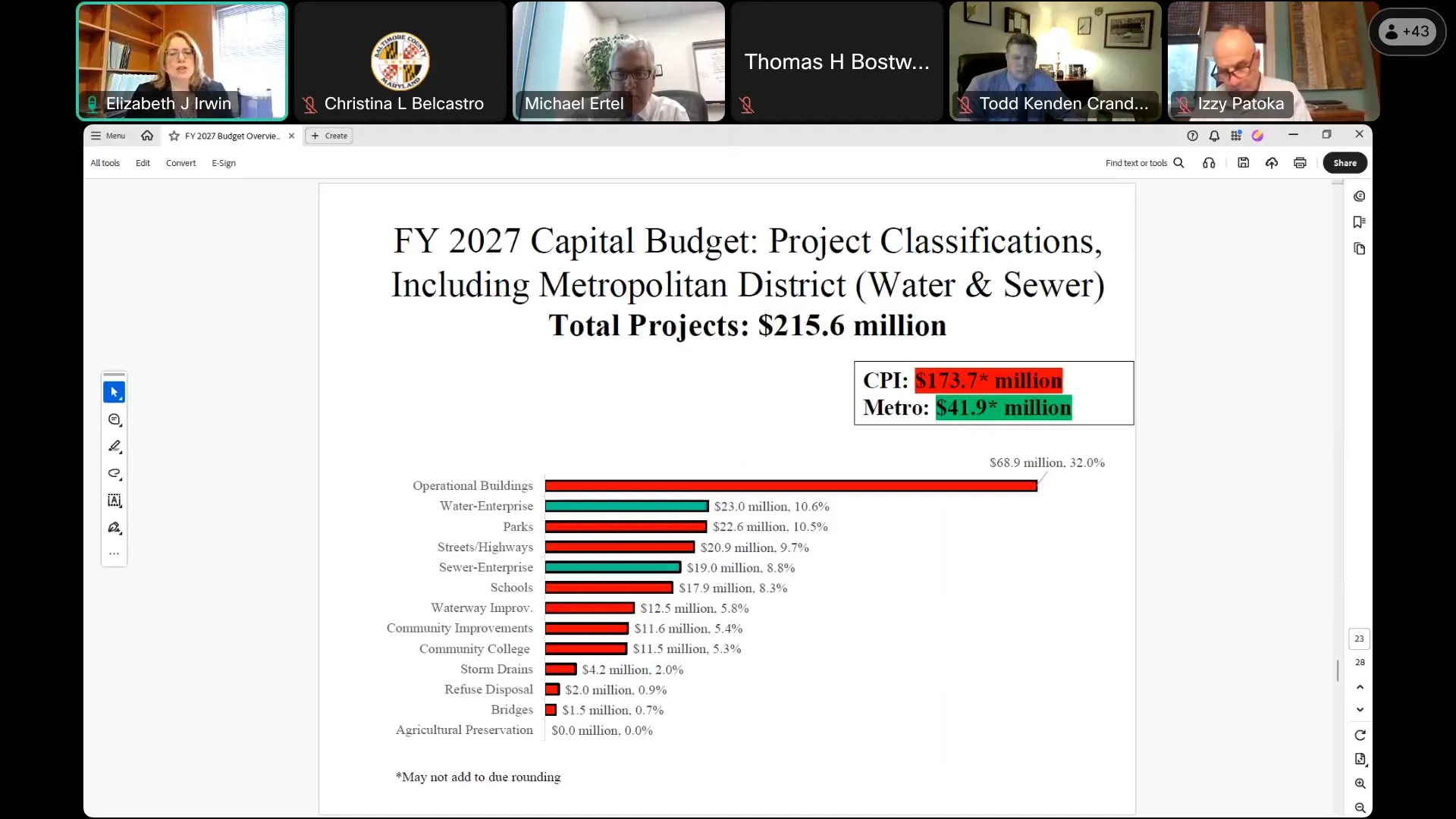
- Capital budget: FY27 capital budget totals about $216 million, with significant concentration in operational building projects, technology, and maintenance. Largest funding source is general fund pay-go. County has over $1.2 billion in authorized but unissued debt.
- Pending legislation: Bills on the May 21st agenda include the property tax bill (rate remains $1.10 per $100 assessed value; homestead cap at 4% reduces revenue by ~$54.9 million; other credits total ~$35.9 million), the personnel bill (cost-of-living adjustments and step/longevity changes costing ~$10 million in salary in FY27 and ~$10.6 million pension impact in FY28), the budget and appropriation ordinance ($5.14 billion excluding enterprise funds), and nine borrowing referendum proposals totaling ~$392 million for the November 2026 ballot.
- Councilman Patoka questioned where the historic preservation tax credit program is funded (Irwin believed it falls within the $35.9 million in other credits, to be confirmed). He also sought agency-by-agency projections of unspent funds to potentially reallocate to education positions, suggesting each million dollars could fund 8-10 teaching positions.
- Councilman Young requested a breakdown of the $69 million in operational capital projects and total expenditure on the disabled service-connected veteran tax credit. Auditor agreed to follow up.
- Councilman Jones noted that the revenue/spending intersection appeared to be flattening; Irwin clarified that actual revenues have been coming in higher than budgeted, so the gap is narrower but still present.
Key Outcomes
- The council will receive additional information from the auditor's office on: (a) agency-by-agency projected year-end unspent funds, (b) vacancy details from Baltimore County Public Schools, (c) detailed breakdown of operational capital expenditures, (d) location of historic preservation tax credit funding, and (e) total cost of the disabled veteran tax credit.
- The council will hold agency budget hearings in the coming weeks to dig deeper into the proposed budget.
- No formal votes were taken during this overview session; the next steps include deliberation on the bills scheduled for May 21st and eventual adoption of the FY27 budget.
Meeting Transcript
I get here. Mr. Petoka's on. Mr. Secretary, did you have something to add there? I just remarked that Mr. Patoka is on. So you have to do that. Oh, good. Okay. All right, great. So good afternoon, everyone. Uh, this public hearing of the Baltimore County Council will now come to order. Wait, Mr. Chairman. Uh this is not the public hearing. This is uh, I'm sorry, that this is um the auditor's budget overview. Oh. Oh, okay. Then I think it's it's really Ms. Irwin's um show. So Miss Irwin, this meeting for you will come to order then. Wonderful. Good afternoon. I'm here to present an overview of the county executive's proposed fiscal year 27 operating and capital budgets to help orient your review in the coming weeks. And I've asked Mr. Mitchell to share his screen. Can everybody see the presentation on their screen? Okay. Members of the auditor's office are also here and will be supporting the council's review through agency analyses and budget hearings. Scott Mitchell is coordinating the agency review process across our office. I appreciate the work our team has done to prepare for this budget season, and I want to recognize Marie Jeng and Ronit Rubin for their work on this overview. The theme of today's presentation is what it always is for our office when it comes to the budget, fiscal sustainability. I'll start with the spending affordability committee's guidelines for fiscal year 2027 and then walk through key areas of the budget through that lens. Our first slide shows the spending affordability committee's general fund spending guideline for fiscal year 27. The guideline is intended to keep growth in ongoing spending aligned with the county's economy. The proposed budget comes in at the guideline. Next, we'll look at the committee's debt service guideline, which is an affordability check within the operating budget that reflects capital decisions. The debt service guideline looks at general fund debt service as a percentage of general fund revenues. The county remains within that guideline. For fiscal year 27, the ratio is about 9.3% compared to the 10.5% guideline. We also look at how that ratio has trended over time. This chart shows that trend and it reflects both underlying changes and some presentation changes in recent years. Next is the committee's debt outstanding guideline, which looks at total debt as a percentage of the county's accessible property values. The county remains within that guideline. The ratio is estimated to be about 1.6% for fiscal year 27 compared to the 2.5% guideline. In our chart, we look at how that ratio is changing over time and what is driving the trend. In recent years, strong assessment growth and cash contributions from the general fund to capital have both pushed the ratio down. In addition to the numerical guidelines, the spending affordability committee also sets out a few key policy principles. These focus on maintaining reserves, fully funding ongoing costs, and limiting the use of one-time funding for ongoing expenses.
openpublica.com