Baltimore County Council FY2027 Budget Hearing: OIT and Police Department - May 12, 2026
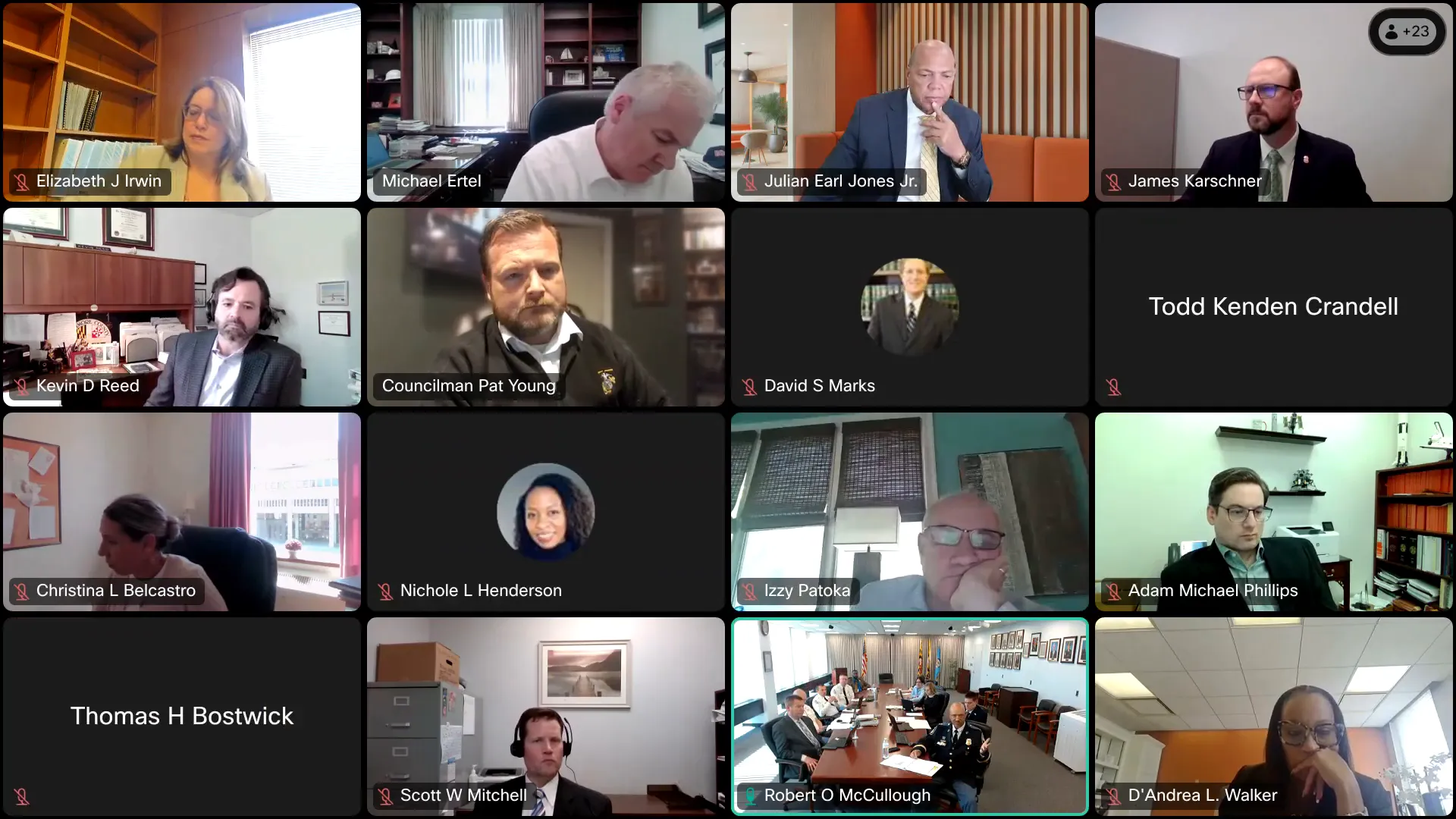
STREAMING COPY IN PREPARATION — RECORDING AVAILABLE FROM THE ORIGINAL SOURCE
Baltimore County Council FY2027 Budget Hearing: OIT and Police Department - May 12, 2026
The Baltimore County Council held a budget hearing on May 12, 2026, to review the proposed FY2027 budgets for the Office of Information Technology (OIT) and the Police Department. The Council heard presentations from county auditors and departmental leadership, followed by discussion on staffing, technology investments, crime statistics, and capital projects. No votes were taken; written responses to council questions were requested prior to deliberations on May 15, 2026.
Discussion Items: Office of Information Technology
- Budget Overview: The proposed FY2027 OIT operating budget totals $15.5 million, an increase of $16.3 million (13.8%) over FY2026. The increase primarily reflects metropolitan distance costs, allocation methodology changes, software service increases, and personnel adjustments. (Note: The stated dollar increase appears inconsistent with the total; likely a transcription error.)
- Capital Budget: The capital budget for FY2027 is included, with prior authorized funding remaining available. No position changes from FY26 to FY27.
- Director Chris Martin presented OIT's strategic shift toward enterprise-wide "pillar applications" (e.g., Workday) and Software as a Service (SaaS), moving away from perpetual licensing. He highlighted rising hardware costs due to AI demand (35% increase this year) and the need for cybersecurity investments. OIT's vacancy rate remains under 4.29%.
- Councilmember Young asked about enterprise-wide consolidation for cost savings and the tech fund. Director Martin noted the tech fund increase (~$1–1.5 million) is largely for cybersecurity and that the fund supports other departments (e.g., permitting, fiber broadband). He mentioned centralized CRM and grant management systems as future goals.
- Councilmember Marks inquired about a road resurfacing dashboard. Director Martin stated data is available via the county's "My Neighborhood" portal and will share links.
- Councilmember Patoka congratulated OIT on an Esri award for redistricting tools. He asked about the Computer-Aided Dispatch (CAD) system complaints. Martin acknowledged growing pains from the 30-year system replacement and outlined improvements: cloud connectivity, iPad use for first responders, and modernized fire station alerting systems. He also asked about projected year-end operating fund surplus (~$200,000–$300,000).
- Councilmember Jones commented on fire station alerting, noting past separate bunk rooms for paramedics.
Discussion Items: Police Department
- Budget Overview: The proposed FY2027 police operating budget totals $322.1 million, an increase of $15.7 million (5.1%) over FY2026. Personnel costs drive the increase, including salary adjustments, overtime, and five new police assistant positions. Non-personnel costs rise for equipment, uniforms, and helicopter maintenance.
- Chief Robert McCullough reported on staffing: sworn vacancies have dropped from 230 to 176 year-over-year; a recent academy class of 55 was the largest since 2008. An additional 120 recruits are in training, with classes scheduled for June, September, and December 2026. Professional staff vacancies reduced from 76 to 47.
- Crime statistics: Homicides dropped 9% from 2024 to 2025 (28 total), with a 92.9% clearance rate (above national average of ~61%). Non-fatal shootings were down 33% from 2023. Auto theft continues to decline (15% decrease year-to-date). Overall crime down 13.3% in 2025.
- Technology initiatives: The Drone as First Responder (DFR) program launched in Towson (290 flights since October 2025). DFR was first on scene 27% of incidents and provided helpful information in over 90% of events. Expansion to Randallstown with four docks, with potential future expansion to Lansdowne, Essex, and Dundalk. Online reporting system handled 837 incidents year-to-date. The MDEX electronic court system eliminated over 8,000 annual calls for service for handling court documents.
- Take-home car program: 218 members participating; an additional 40 vehicles purchased. The program has expanded to sergeants. 226 eligible members on waiting list. Chief McCullough noted the program aids recruitment and retention, extends vehicle lifespan, and acts as a crime deterrent.
- Helicopter program: Three helicopters; one replaced in 2025 at ~$8-9 million. Annual operating cost ~$2.2 million. Replacement schedule: every 2-3 years per aircraft, with 10-12 year lifecycle.
- Councilmember Marks thanked the chief and discussed the take-home car program and partnerships with malls/town centers.
- Councilmember Jones asked about vacancies; Chief McCullough confirmed 176 sworn vacancies, 4 cadet, 47 professional staff. Aiming for 4-5% vacancy rate by first quarter of FY2028.
- Councilmember Young asked about DFR funding (federal asset forfeiture) and ongoing costs. Chief noted the Axon contract is ~$60 million over 10 years and that OBF monitors asset forfeiture fluctuations. Young offered to help educate the public on the drone program.
- Councilmember Patoka inquired about attrition projections; Chief expects minimal retirements over next five years, with a saturated workforce. Patoka also asked about the Parkville-Towson precinct realignment; target date January 1, 2027, pending community input.
- Council Chair questioned helicopter costs and use of drones vs. helicopters for crowd management. Chief acknowledged drones are quieter and can be more effective for youth incidents, citing a recent community complaint handled via drone.
Key Outcomes
- No votes were taken during the hearing.
- Council auditors requested written responses to prepared questions from both OIT and the Police Department, to be addressed prior to budget deliberations on May 15, 2026.
- The next budget hearings were announced for the week of May 12, 2026 (in-person only, Plum Room conference room). Note: The meeting date is May 12, 2026, so the announcement of hearings "next week" beginning Tuesday May 12 appears to be an error in the transcript; likely intended for a later date.
- Director Martin committed to sharing road resurfacing dashboard links with councilmembers.
- Chief McCullough noted ongoing efforts to reclassify low-wage professional staff positions and invited council feedback on precinct realignment.
Meeting Transcript
So we're back. Thank you, Ms. Bel Castro. Ms. Irwin, do you want to kick off? Yes. We're here today for the Office of Information Technology and for the police department. We're starting with the Office of Information Technology, which will be presented by Zach Aymant of my office. Zach, you can take it away. Zach, the floor is yours. Sorry. Good afternoon, everyone. The proposed FY 2027 budget for the Office of Information Technology total of 15.5 million, an increase of 16.3 million or 13.8% over the FY 2026 budget. The increase primarily reflects metropolitan distance costs, allocation changes, software service increases, and personnel related adjustments. The office's operating budget history is reflected in exhibit one on page two, which shows no wrong increase of funding in each year. On page three, the pie chart shows how the proposed funding will be allocated across the programs and expenditures. Infrastructure represents the largest program allocation, while personnel costs represents the largest category of expenditure. At the bottom of page three, the appropriation summary reflects the operating budget and capital budget for FY2027. Please note the capital budget amounts reflects the FY2027 appreciations only and do not include substantial prior authorized funding that remains available. Page three also contains a personnel summary, which reflects no position changes from FY26 to 27. Operating budget highlights begin on page four. Exhibit three on page five shows the budgeting changes with personnel cost changes in blue and non-personnel cost changes in green. As discussed in the analysis, some of these changes reflect the allocation methodology changes and shifts and where costs are budgeted rather than underlying service expansion. Capital budget highlights start at the bottom of page five and continue on page six, which also includes a key considerations. Page seven, the analysis discusses potential budget flexibility and effort to provide operational context regarding areas that may warrant further discussion. Page seven also includes exhibit four, which compares authorized position to field positions. Finally, we have prepared a list of questions for the office and the office of budget and finance, which we request to be addressed in writing prior to deliberations on May 15th. I would like to thank the office and the Office of Budget and Finance for their assistance during the review process. And at this time, I'd like to turn it over for discussion. Thanks, Zach. Any questions from the members. If you have a question, if you just can I I can't see anybody if you have your hand up. Okay. So uh if not, I guess we're on a Mr. Director Martin. Hi, how are hello everybody? Good afternoon. Um afternoon, Council Chair, Council members, and county auditors. Thank you for the opportunity to present the OIT fiscal year 27. So I'm sorry, fiscal year 27 operating and tech fund. I want to begin by thanking the OIT financial team, who includes Kelly Amberman, Dana Walker, Vincent Rossi, Nancy Corona, and Lorraine Black, as well as our deputy director, Moment of Duke here, and the OBF team, uh, as long as as well as the county executive and the chief administrative officer for their support throughout this process. Um just taking a moment on how the budget is formed. The Office of Information Technology is a centralized IT organization serving the offices and departments that make up Baltimore County government, supporting everything from public safety to human resources. We also provide services to several county agencies, uh, including the library system, sheriff's office, council. OIT's budget is built around the structure, beginning with a capital portfolio that operates on an approximate three-year cycle. Requests come in to OIT through our customer relationship managers and are then prioritized by need in collaboration with departments and the administration. The drivers for IT development include replacing and modernizing existing systems, addressing new functional needs, responding to legislation, implementing security upgrades, and reducing technical debt. The capital budget funds the implementation of these new products and initiatives. Once a product is implemented, the operating budget takes over, covering license, maintenance, and other ongoing software costs, as well as supporting the 248 OIT members who keep the county IT operations running. It is important to highlight the rising costs associated with IT and how OIT is managing the rapid and sometimes inconsistent increases.
openpublica.com