Baltimore County Council Budget Hearing for Recreation and Parks and Property Management – May 12, 2026
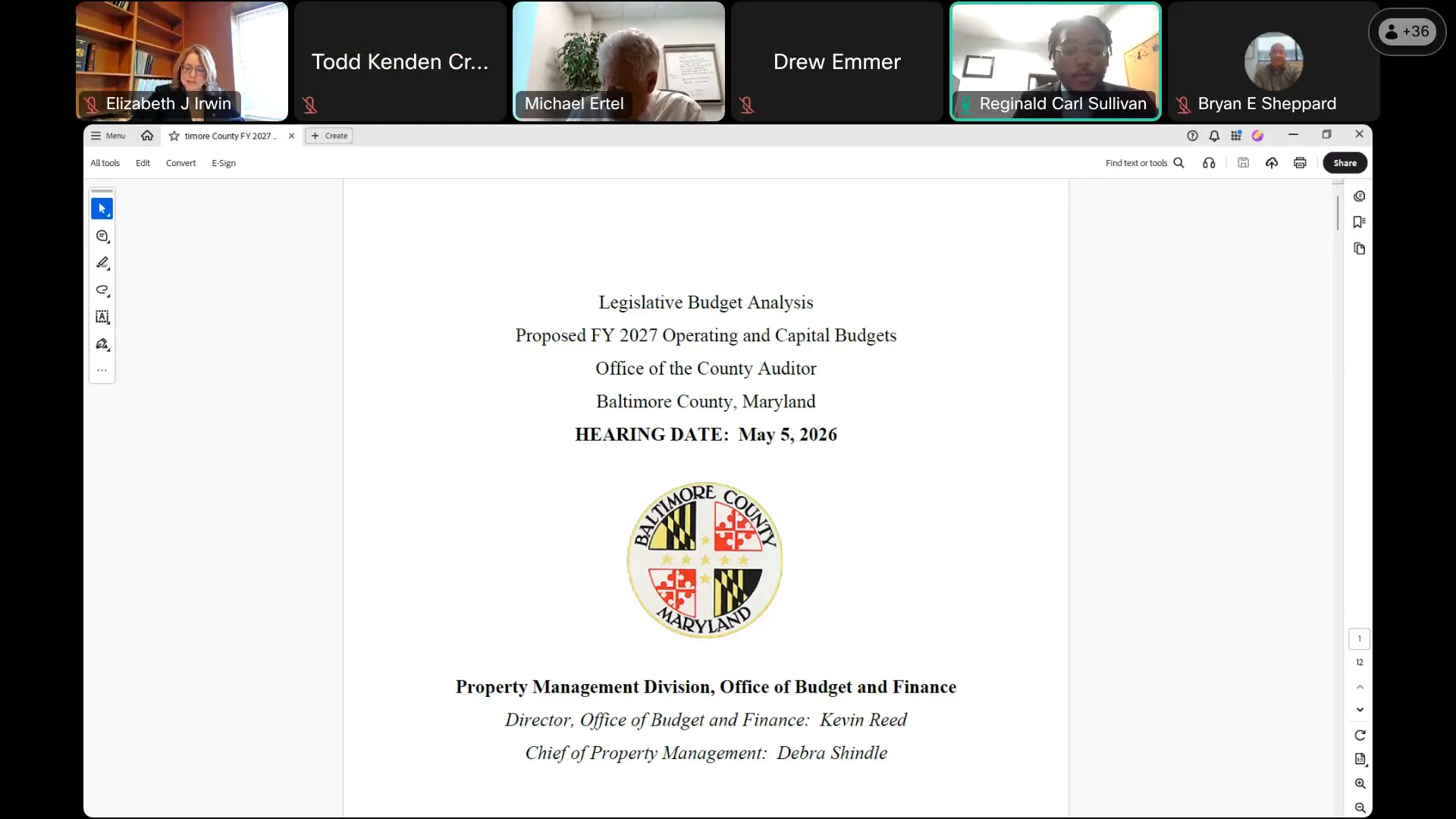
STREAMING COPY IN PREPARATION — RECORDING AVAILABLE FROM THE ORIGINAL SOURCE
Baltimore County Council Budget Hearing for Recreation and Parks and Property Management – May 12, 2026
The Baltimore County Council held a budget hearing on May 12, 2026, to review the fiscal year 2027 operating and capital budgets for the Department of Recreation and Parks and the Division of Property Management. The County Auditor’s Office presented budget analyses, followed by presentations from department directors and extensive council discussion. No public testimony was heard. The council requested written answers to outstanding questions before deliberations on May 15, 2026.
Recreation and Parks Budget Analysis and Discussion
Auditor’s Analysis (Chris Erz Shaffield, County Auditor’s Office):
- The proposed FY27 operating budget for the department totals $24.4 million, a decrease of $172,000 (0.7%) from FY26. The general fund portion is $20 million, an increase of $880,000 (4.6%) driven by personnel costs, including salary scale adjustments.
- Personnel costs remain the largest budget component. Non-personnel changes include increases for furniture, equipment, and building services, offset by decreases in food and drink expenditures (due to absence of prior year one-time SNAP funding) and reductions in building supplies.
- The special fund totals $185,000, a decrease of $164,000 (47.1%) reflecting elimination of certain youth mentoring programs.
- Capital budget highlights and historical trends were provided on exhibits.
- The analysis identified budget flexibility related to personnel (vacancy rates, turnover assumptions) and the enterprise fund (revenue and fee structure sensitivity).
- A list of questions was submitted to the department and Office of Budget and Finance, requesting written responses before May 15.
Director’s Presentation (Acting Director Brian Shepard):
- Shepard thanked staff and introduced leadership. He highlighted successes in FY26: drop-in programs increased 200% (from 30 to 95 programs); therapeutic recreation programming increased six-fold; summer camps sold out with over 2,000 children served across 137 drop-in opportunities; permits increased 33%; and customer service satisfaction rose 25%.
- Capital projects include a new Frisbee golf park at Days Cove, cricket pitch at Cloverland Park, renovations to Win Oak Park, the county’s first splash pad at Northwest Regional Park, and ongoing playground, backstop, and lighting upgrades.
- The department is working on strategic planning, land preservation, and MOU renewals with recreation councils. Social media reach grew 26%, newsletter subscribers doubled.
- Shepard stated the budget is prudent and supports full funding to “build on what we’ve done before.”
Council Discussion and Questions:
- Councilman Toca questioned the vacancy/turnover savings: 33 vacant positions totaling $1.7 million, with $1.6 million budgeted as turnover savings, leaving only about $100,000 available for new hires. He noted the difficulty small agencies face meeting turnover targets.
- Councilman Marks praised Shepard’s “sense of urgency” and progress on playgrounds and the Ghost Road Park project. He asked about communication with Baltimore County Public Schools (BCPS) regarding shared use of facilities (e.g., high school tracks). Shepard acknowledged communication challenges and advocated for revisiting the shared use agreement when BCPS has a new superintendent.
- Councilman Young raised the Arbutus youth little league program, which is not part of the rec council but provides the only baseball in the area. Shepard confirmed a successful partnership was established this year, with permits worked out via the school system, embracing a collaborative model.
- Councilman Crandall asked about fee structure progress. Shepard outlined changes: a new senior active adult flat fee pass (payable in two installments), reduced adult program fees for rec councils (e.g., orchestra groups charges lowered from $25 to $10 per season), half-day pavilion rentals, and a five-hour free window for community group meetings. He acknowledged that some fee issues are about rebuilding relationships, but progress is being made.
- Councilman Jones thanked Shepard for the senior pass and efforts on playgrounds. He inquired about the splash pad at Northwest Regional Park; Shepard said it is expected to open in fiscal year 2028 (summer 2027).
- Council Chair (unidentified) asked about community supervisor responsiveness. Shepard responded that he and Deputy Director Weinstock are working to clarify roles, improve communication with rec councils, and build a “bottom-up” approach. Council members noted that complaints had decreased.
- Council members across districts expressed strong support for Shepard’s leadership and the budget request.
Property Management Budget Analysis and Discussion
Auditor’s Analysis (Reginald Sullivan, County Auditor’s Office):
- The proposed FY27 operating budget for Property Management (PM) is $54.4 million, an increase of $5.7 million (11.7%) from FY26, primarily due to a metropolitan district cost reallocation ($2.6 million) and increases in facilities-related costs (especially energy and utilities based on projected rates).
- No position changes from FY26; the division has 255 authorized positions. Operating budget history shows steady increases; capital budget highlights were noted.
- Key considerations: prior year reversions, potential budget flexibility, and utilities cost volatility.
- A list of questions was submitted for written response before May 15 deliberations.
Director’s Presentation (Director Reed, Office of Budget and Finance, with Chief Deb Schindle):
- Reed introduced PM as the backbone for general government agencies, emphasizing improved service culture. He thanked staff for handling extreme winter weather (clearing 230+ buildings, 30 miles of sidewalks).
- Schindle provided extensive operational highlights:
- Building Maintenance: 59 craft workers and contractors maintain 260 primary buildings and 675 ancillary structures (6.3 million sq. ft.). Completed 19,166 work orders in FY25; FY26 to date: 15,230. Completed 164 LED conversions, 198 capital projects in FY25, and electrified nine facilities.
- Grounds Maintenance: 62 staff mow 200+ acres weekly or bi-weekly; inspect 144 playgrounds monthly. Completed 19 playground renovations (10 finished, 9 in progress). Maintained 140 natural turf fields, 33 artificial turf fields (groomed monthly, deep cleaned every 6 months), and 377 ball diamonds. Lifted 34 ball diamonds in FY25, 33 in FY26. Spread 1,500 cubic yards of playground mulch. Rebuilt 28 backstops in FY25; 25 more planned. Responded to 13 major storms.
- Building Operations: 53 staff clean 150+ sites daily; brought four new buildings online. Implemented green pest control and hardwood floor maintenance program.
- Capital Construction and Engineering: 27 staff across six teams; achieved three LEED certifications; recognized by ENR for Sparrows Point Park Building as best sports/entertainment project in mid-Atlantic. Tracking change orders and soft costs.
- Fiscal Team: processed 3,390 P-card transactions in FY25; 435 allotments; no BAT requests in two years.
- Customer Service: handled 268 special events in FY25; 249 in FY26 YTD; responded to 376 tree concerns and 594 constituent inquiries; developed SOPs to streamline agency requests.
- Sustainability: 29% renewable energy attained; Hernwood solar project (estimated completion Dec 2027) will bring total to 54%; evaluating options for remaining renewable goals.
Council Discussion and Questions:
- Councilman Young asked about the metropolitan district cost reallocation. Reed clarified that starting in FY25, agencies involved in Metro work are directly credited (about 7% of personnel/fringe), reducing surpluses in some budgets. The adjustment accounts for $2.6 million of PM’s increase; when removed, the net increase is smaller.
- Councilman Young also asked about high-skilled vacancies (engineers, project managers). Schindle reported one senior PM vacancy (open about a year) and three project manager positions with high turnover (constantly open two to three years) due to competition with private sector. She highlighted partnerships with BCPS internships (7 students) and development of an apprentice program. She noted that most vacancies are in trades positions (building maintenance, grounds).
- Councilman Young inquired about facility condition assessment. Schindle explained that a third-party assessment completed about two years ago created a prioritized list (priority 1, 2, 3) for all major buildings, guiding capital planning. She acknowledged that emergency maintenance costs are tracked within one category and offered to provide further details offline.
- Councilman Toca asked about year-end unexpended funds. Schindle projected about $700,000 unexpended in the general fund, with approximately $400,000 attributable to vacancy/turnover savings (budgeted turnover rate 5.3%, actual trending higher). Toca pressed for clarity on fund returns and the flexibility of the $5,000 capital/operating threshold. Reed defended the county’s strong financial management, citing high expenditure rates (99.2% in FY24, 99.6% in FY25) and positive credit rating reports from Moody’s, S&P, and Fitch, which highlight budgetary flexibility as a strength. He cautioned against using one-time surpluses for ongoing expenditures.
- Other council members expressed appreciation for PM’s work, particularly on council office renovations (Councilman Boswick).
Key Outcomes
- Votes: No formal votes were taken; the hearing was informational.
- Written Responses: The County Auditor’s Office requested written answers to their analysis questions from both departments and the Office of Budget and Finance by May 15, 2026, prior to council deliberations.
- Next Steps: The council will continue budget hearings on Thursday with the Office of Information Technology and Police Department. Council members indicated general support for the requested budgets, pending receipt of written responses and further deliberation.
Meeting Transcript
Looking for at least a uh I think Councilman Crandall, I see Councilman Patoga, I see Councilman Young, Councilman Marks. Um I guess the others will join if they're not buried in here somewhere. But um Miss Irwin, did you want to take off? Sure. Good afternoon, everyone. Chris Erz Shaffield from our office is going to present our analysis of the Department of Recreation and Parks budget. Take it away, Chris. Thanks, Liz. Good afternoon, everyone. Uh budget highlights for the Department of Recreation and Parks begin on page two. As shown in the budget summary on page two, the proposed fiscal year 27 operating budget for the department totals 24.4 million, representing a decrease of approximately 172,000 or 0.7%, including the 4.3 million recreational facilities enterprise fund, which is not appropriate appropriated by the council. The general fund portion totals 20 million, an increase of 880,000 or 4.6%, primarily reflecting personnel related costs, including salary scale adjustments in other compensation related changes. Personnel costs continue to represent the majority of the department's operating budget. Increases reflect a combination of salary scale adjustments and other compensation related changes, some of which reflect existing salary structures, including changes in recreation and parks specialist salaries based on current activity as reported by the department. Non-personnel changes reflect a mix of increases and decreases across categories. Notably, increases include furniture and equipment at parks and BCPS partnered sites, as well as building and construction services. These are partially offset by decreases in food and drink expenditures, reflecting the absence of prior year one-time funding associated with the fiscal year 2026 emergency SNAP supplemental appropriation, as well as reductions in certain building and construction supply costs. The special fund totals 185,000, decreasing by 164,000, or 47.1%, primarily reflecting reductions in therapeutic recreation summer programs and the elimination of the park explorers, Maryland DNR and NRPA youth mentoring programs. Additional highlights on pages three and four include ongoing implementation of the reimagined re uh reimagine recreation and parks initiative, current vacancy levels, and the financial position of the recreational facilities fund. These areas provide context for how services are being delivered within current funding and staffing constraints. Capital budget highlights are summarized at the bottom of page four. Page five includes the department's budget history in exhibit one. On page six, the pie charts illustrate how proposed funding is allocated across programs and expenditure categories. Recreation services represents the largest program area, while personnel represents the largest category of expenditure. Also on page six, exhibit three presents the budgeted increase, uh increases and decreases with personnel cost changes shown in yellow, non-personnel changes in orange, and special fund changes in green. Continuing to page seven, exhibit four shows a history of authorized versus filled positions, and exhibit five reflects the recreational facilities enterprise funds financial trends. On page eight, the analysis identifies areas that may reflect department specific budget flexibility. In particular, personnel related flexibility is influenced by centrally applied compensation adjustments and turnover assumptions. Vacancy levels and staffing patterns may reflect both recruitment challenges and funding constraints. And within the enterprise fund, projected revenues and staffing levels remain sensitive to participation in fee structure assumptions. This context may be helpful in understanding how current budget assumptions and constraints affect operations. And finally, we've prepared a list of questions for the department and the Office of Budget and Finance, which we are requesting to be addressed in writing prior to deliberations on May 15th. And at this time, we will turn it over for discussion. Thank you, Chris. Any questions from the members before wrecking parts presents. No one. Okay. Mr. Shepard. Mr. Chair. Yeah, uh, yes, uh, Councilmember Top. I do have a question. Um Mr. Dan, Mr. Erz. Um if you could go over, I think it was 1.6 million in vacant positions and 1.7 million in turnover. Could you clarify? I I did it was on one of your charts, and I couldn't understand. Um, there was a footnote about it doesn't reflect doesn't reflect budget, and I didn't quite understand that.
openpublica.com