Metro Council Budget Hearing for Fiscal Year 2026 – November 19, 2025
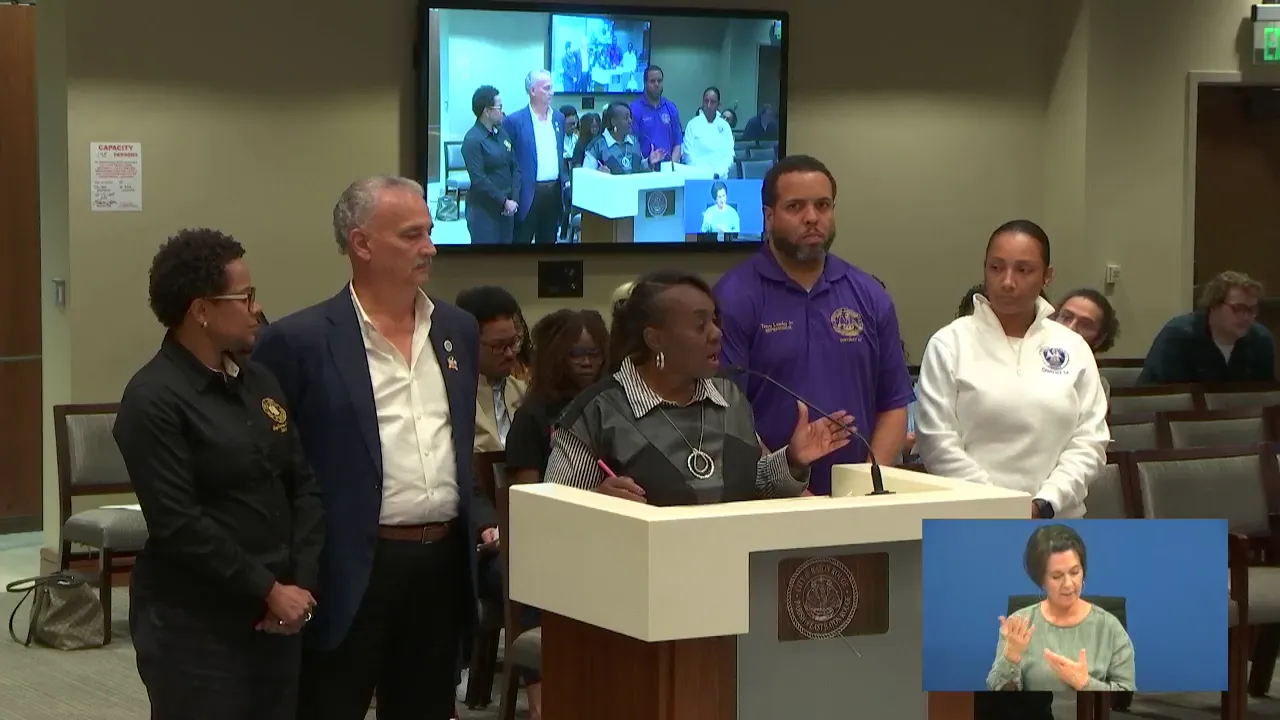
STREAMING COPY IN PREPARATION — RECORDING AVAILABLE FROM THE ORIGINAL SOURCE
Metro Council Budget Hearing for Fiscal Year 2026 – November 19, 2025\n\nThe Metro Council held its first budget hearing for the upcoming fiscal year on November 19, 2025, receiving presentations from the 19th Judicial District Court, the District Attorney's Office, Family Court, Juvenile Court, Baton Rouge City Court, and the Office of the Public Defender. Each agency detailed severe funding shortfalls, proposed cuts, and the potential impact on public safety, justice, and constitutional obligations. Legislators present noted ongoing efforts to address inequitable cost-sharing across the parish's municipalities.\n\n### Discussion Items\n- 19th Judicial District Court: Ms. Gibbons and Judge Tovell Smith presented. The court faces an 11% cut ($1 million reduction) from the prior year, which would primarily affect salaries and benefits. The court handles an average of 5,500 criminal and 17,500 civil filings annually. State cases constitute 30–40% of the docket, but the state does not pay filing fees, resulting in an estimated $750,000 to $1 million per year in unpaid fees. Council members noted that the city-parish effectively subsidizes the entire state's court system because all state-agency cases are filed in Baton Rouge. The court relies on temporary outside funding for programs like drug court and veterans court, which have graduated over 50 participants since March 2023, saving the parish jail costs of $120 per person per day.\n- District Attorney's Office: Hiller Moore and John Daly presented. The office requested $22.6 million for 2026; the current budget is approximately $16 million, with the mayor's proposal reducing city-parish funding from $8.7 million to $7.36 million. Compared to Jefferson and Orleans parishes, East Baton Rouge is underfunded by 64% and 79% per capita. Staffing has declined from 150–160 to 125 because of attrition and inability to offer competitive salaries. Unfunded mandates from the state and erosion of the local tax base due to the incorporation of St. George were cited. The office warned that if the proposed cut stands, it would need to lay off 15–25 employees, including assistant district attorneys, reducing capacity to handle cases.\n- Family Court: Chief Judge Erica Green presented with Judge Pam Baker and judicial administrator Rachel Schultz. The family court is the only constitutionally mandated family court in Louisiana. Its budget is $1.7 million, and the proposed cut of 11% would reduce funding for supplies and contractual services. The court serves the entire parish, including all municipalities, and handled 16,000 docketed events in 2024. State cases (child support) account for 33% of its workload, but the court cannot increase filing fees without state legislation. Council members asked about a statutory limit on fees, which was raised in 2022.\n- Juvenile Court: Judges Adam Haney and Gail Grover, and judicial administrator Lynn Mulloy presented. The court is one of four juvenile courts in Louisiana. The mayor's proposed budget is $1.56 million, a 14.6% reduction from current funding. The court operates on a shoestring budget, tracking even vending machine revenue ($1,400 annually). The cut would force elimination of the truancy mentoring program ($44,000 per year) and the gun intervention program (CHANCES). Both programs have shown success in reducing delinquent behavior. Councilman Moak suggested seeking funding from other municipalities and school districts.\n- Baton Rouge City Court: Judge Alexander presented. The proposed budget would eliminate 21 positions. Staff are paid $15–$17 per hour, making hiring extremely difficult. The court handles civil, criminal, and traffic matters within Baton Rouge city limits. It has the capacity to provide drug testing services for the parish but cannot hire a drug technician at the current salary. Councilman Dunn requested a list of frozen positions and suggested combining vacancies to reclassify roles.\n- Office of the Public Defender: The Public Defender (Carla Romanash) presented. The proposed cut is 38% ($482,370) from the prior year's total funding, leaving a city-parish contribution of $855,380. The office's total budget (including state and self-generated funds) would be $5.15 million, compared to the DA's approximately $15 million. The office represents 85–88% of all criminal defendants and has already laid off seven staff (investigators and social worker) to cover part of the shortfall. Without additional funding, the office cannot staff all courtrooms, potentially leading to constitutional violations and litigation. The Public Defender noted that starting salary is $52,000, employees pay $1,800 per month for family health insurance, and they do not participate in Social Security.\n- Legislative Comments: Senator Regina Barrow and other legislators present highlighted three resolutions: a SWOT analysis for the parish, a resolution to ensure every parish pays its fair share for state cases filed in East Baton Rouge, and a resolution on blight. Councilman Hearst noted that if all municipalities paid proportionally, an additional $11.2 million would be available for the general fund. Councilman Hudson cautioned that a deeper analysis of fund structure is needed before assigning blame for the deficit.\n\n### Key Outcomes\n- No votes were taken; the hearing was informational.\n- The Council requested that City Court provide a list of frozen positions for further review.\n- Council members encouraged continued collaboration with state legislators to pursue equitable cost-sharing across all municipalities, including Central, Zachary, Baker, and St. George.\n- The Public Defender warned that without increased funding, the office may be forced to limit court coverage, leading to constitutional rights violations and potential lawsuits.\n- The Council acknowledged the recurring theme that the City of Baton Rouge and unincorporated parish subsidize services for the entire parish, and discussions on restructuring funding will continue.
Meeting Transcript
Good afternoon and welcome to the first of the council budget hearings for the the 2025 budget year. Thank you so much for everyone who has come out today. There are handouts at the front desk that have the it looks like y'all have got them, the sheets from the budget book that we'll be going over today. Um if you have not gotten a copy and would like a copy, um let us know and we we'll get one to you. So today we will get started. Um our first presentation today will be by the 19th JDC. Miss Gibbons. Just give us a minute to get that slide show up. We're working on it. Got it. All right. Now you can hear me. Good afternoon. Okay. I just have a brief overview. I know that um a lot of you have come to the court recently and have uh observed some of the things that we're doing and all the things that we are working on, and so I just don't want to rehash all of that, but I'll touch on it. Council members, if you have your budget books in front of you, um, the district court is on page 100 of your budget book. All right, I think. Are we ready? Are we ready, Joe? We're ready. Okay. Very good. All right, so the 19th JDC serves the entire Baton Rouge um East Baton Ridge Parish community, and that is something that we are re-enforcing and reinforcing because it is getting lost in the shuffle of everything that's been going on right now. Um next slide, please. So the 19th JDC's budget is impacted by city parish funding in two major ways. One of those is primarily salaries and benefits, and we we get about six million dollars that cover salaries and benefits for most of our key staff. And then the other part is courthouse maintenance. We forget about that often, but that's a really important part of our overall budget and funding, and is something that um you know our building is the newest city parish building, but it is not being maintained, and we have a lot of deferred maintenance and a leaking roof and other things like that that I think a lot of you have have learned about over the years. So that is um still something that needs to be addressed and take taken into perspective. Um, so the the 19th JDC has about 90 85 full-time employees, we have 15 judges, four commissioners, and then several specialty court programs and um an administration office that consists of almost 10 people. Uh next slide. The 19th JDC handles the majority of civil and criminal matters in East Baton Reach Parish. So again, for the entire parish, there are city courts that handle some of the smaller matters, but and and then we have a juvenile court and we have a family court, but we handle primarily the criminal and civil matters. Um to give a little perspective with criminal matters, the funding for those matters is a constant dilemma statewide. It's not just a 19th JDC or East Batonridge Parish problem dealing with criminal court funding. It's really a nationwide problem. But to give you a little perspective on the number of cases that the 19th JDC sees, we have had an average of about 5,500 billed criminal cases over the last three years, and that's divided over eight criminal divisions with the incorporation of the commissioner's court over the recent year. We have been able to streamline a little bit of the and create some efficiencies within the process so the commissioners then handle call out and um bail bond reviews and things like that to free up the dockets of the criminal judges so that things can move a little bit quicker if possible. Um civil cases in 2024, the legislature actually approved an increase of fee that goes into the judicial expense fund for the first time in 55 years. So it was horribly underfunded, and so we are we're seeing some benefits from that increase, but it was long, long overdue. So and and civil matters largely sustained themselves because of this, but um we still have an average of 17,500 civil filings per year divided over seven sections. It's a busy place over there. It's very, very busy on both the criminal and the civil side of that. Uh next slide. Now to help with all of the budget processes that have been going on. The court has been proactive, and we have sought outside funding sources. We have sought those through state appropriations over we've received two state appropriations that we've used to enhance security of the courthouse as well as improve the technology of the courthouse. And then we um have also sought other types of funding, grants and otherwise to incorporate these we call it the court intervention program, and this is on the criminal side, and it it consists of the commissioner's court, pretrial services, the recovery court or drug court, veterans treatment court, re-entry court, and then domestic violence um intervention court pilot program. And all of these programs together, they are funded through these outside sources, but those outside sources are not infinite, they don't last for forever.
openpublica.com