Belgrade City Council Meeting: Street Fee and Forestry Fee Updates - June 8, 2026
STREAMING COPY IN PREPARATION — RECORDING AVAILABLE FROM THE ORIGINAL SOURCE
Belgrade City Council Meeting: Street Fee and Forestry Fee Updates - June 8, 2026
The Belgrade City Council held a workshop meeting on June 8, 2026, to discuss two major updates: the annual street fee and the annual forestry fee. The council reviewed proposals from consultants AE2S (for street fees) and Cushing Terrell (for forestry fees), heard public comment (none offered), and provided direction to staff. No formal votes were taken; decisions will be finalized at future meetings.
Public Comments & Testimony
- No members of the public spoke during the designated public comment periods for either the street fee or forestry fee discussion, nor during the general public forum.
Discussion Items
Annual Street Fee Update
- Presenter: Ryan Graft, Senior Consultant, AE2S, assisted by Assistant City Manager Greg Tryan.
- Purpose: To update the street fee methodology to equitably fund operations and maintenance (O&M) of existing streets, excluding expansion or capacity improvements (handled by impact fees).
- Current Fee: Single-family residential pays $205 per parcel per year; commercial and industrial pay the same flat $205, regardless of size.
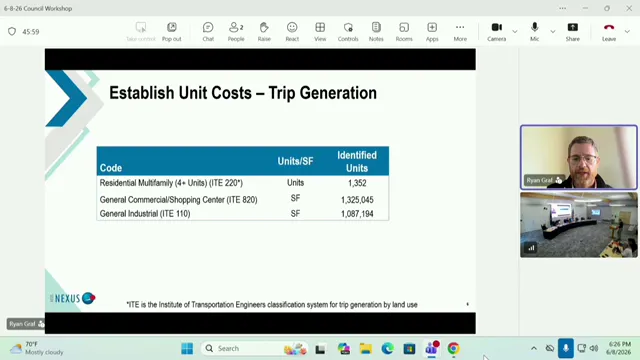
- Proposed Baseline Recommendation: Maintain single-family at $205 (O&M only) and use trip generation (ITE data) to allocate costs to other property types: multifamily ($173/unit), commercial ($676/1,000 sq ft), industrial ($303/1,000 sq ft) for combined O&M and capital. Capital costs shown as lumpy, with a $1.6 million total revenue target for FY27.
- Concerns Raised by Council:
- Councilmember Jason Gucky noted commercial fees would increase significantly (e.g., median 5,000 sq ft commercial from $205 to $1,685/year), potentially making Belgrade the highest in the state.
- Councilmember Matt Niki and others questioned the classification of FedEx/Amazon as industrial vs. commercial, given high trip generation.
- Councilmember Christine Menacucci suggested raising the residential fee slightly to ease pressure on commercial.
- Councilmember Aaron Bell noted storage units likely fall under industrial.
- Councilmember Simon criticized the lack of contribution from airport/tourism and suggested a sales tax on rental cars as a solution.
- Councilmember Michael McGee and others emphasized the need to attract businesses and avoid driving them to Bozeman.
- Alternatives Mentioned:
- Using trip generation for single-family would shift burden to non-residential.
- A cap on commercial square footage (like Bozeman's 10,000 sq ft cap) was suggested.
- A one-year punt with a flat across-the-board increase to $250–$280 per parcel.
- Staff Direction: City Manager Mikesell stated staff will revise the proposal based on council feedback, including exploring a residential increase, commercial caps, and better classification of distribution facilities. A revised proposal will be brought back.
Annual Forestry Fee Update
- Presenter: Jordan Green, Director of Parks, Trails and Recreation.
- Purpose: To update the forestry fee (established last year at $38.07 per parcel) to a more equitable, lot-size-based methodology.
- Metrics Considered: Land use, lot size, frontage, tree count. Preferred metric: lot size.
- Three Alternatives Presented:
- Alternative A (Equalized): Steady rise from $33.66 (0–1/8 acre) to $64.44 (50+ acres). Reduces fees for 93% of lots under 1/4 acre.
- Alternative B (Reduce Impact on Smallest Lots): Steep increase for large lots; 75% of lots see significant reduction; highest fees for large lots.
- Alternative C (Recommended – Balanced with Cap): Fees decrease or stay the same for 93% of lots (0–1/2 acre), with a cap of $66.67 for lots 1 acre and larger. Small increases for 1/2–5 acre parcels (often commercial/industrial).
- Council Consensus: All council members expressed support for Alternative C. Councilmember Simon asked about annual review; City Manager noted it will be brought to council each year, with potential indexation to municipal construction costs.
- Next Steps: Staff will bring a final decision to the council at the first meeting in July.
Key Outcomes
- Street Fee: Council provided directional feedback for staff to revise the proposal, including considering a residential rate increase, commercial caps, and better differentiation of distribution centers. No formal vote.
- Forestry Fee: Council expressed unanimous support for Alternative C (balanced with cap). Staff will bring a final ordinance for approval in July.
- Good of the Order: Councilmember Simon and Deputy Mayor Manimo noted they will be absent from the next council meeting (June 15, 2026) due to vacation.
Meeting Transcript
We were in there for two and a half hours. It was ugly. All right, we can get. All right, I'll call our Belgrade City Council meeting to order tonight. And please rise and follow me in the pledge. I pledge allegiance to the flag of the United States of America and to the Republic for which it stands, one nation under God, indivisible with liberty and justice for all. Roll call, please. Jason Gucky? Matt Niki? Here. Jim Simon. Michael Mees. Here. Christine? Here. Aaron Congress here. In your name, Animal? Here. Thank you. All right. First up on our discussion agenda is discuss our annual street fee update. Mr. Trian. Turn my mic back on since you already did that for me. Greg try and assistant city manager. You're going to be hearing a presentation from Ryan Graft, a senior consultant from AE2S. If that name sounds familiar, he helped us work through our utility rates previously. So he has lots of experience with the city and a background to all this. We've been doing this street fee update as part of a process with our impact fees as well. Been doing that for a little over a year now. So it's been a very in-depth process, both as a justification process as well as also what is the right method for you all to consider. So at the end of this, there's going to be a couple options for you to consider. So Ryan, are you still on? Yes, sir. All your circumstances. Thank you. I'm going to take over screen share so I don't have to bug you to keep clicking. So thank you, Greg, for that introduction, uh, members of the council. Um I am here to talk about the update to the street fees uh that we are proposing for your consideration. Uh going into this project, uh wanted to just kind of reiterate that currently the street uh fund or the city fund street activity um through both the fee that you have in place now on a per parcel basis um as well as looking to other funds through interfund transfers and the general fund to help kind of offset some of the overall costs uh that are incurred to maintain the streets throughout the city. Um I think that's maybe one thing to reiterate at the beginning of this. Uh we are talking with the street fee about uh operations and maintenance as well as rehabilitation costs to the streets and not expansion or improvement uh that is adding capacity to the streets, those are handled uh generally through the impact fee uh and not through the street fee itself. So going into this, one of uh really the key goal that was was driving it was how can what would it look like if we are uh using the street fee itself to fund those operations and maintenance that are handled through the street fund um so that they're self-supporting. And so that's what uh when we do present tonight, um uh either alternative uh what we are looking at for the city itself. Um wanted to just kind of review what we are looking at for the the fee methodology. We are proposing in our our baseline recommendation to maintain that single family residential fee at the 205 dollars per parcel that you currently um have on the operation side. Uh but as we are then looking to allocate costs and really dial in the fee on the remaining um use types throughout the city. What we're doing is uh we're going through the revenue requirements for the utility or for the fund um and really developing that cost basis, what it looks like after uh as we are allocating costs to the different parcels, um, net of those single family residential fees. Um then we're looking to a unit cost so that we have a defensible methodology to be able to assign those to the different property types within the town. We are using it's uh ITE, the Institute of Transportation Engineers.
openpublica.com