FY2027 Budget Hearing: Planning and Fire Departments – June 9, 2026
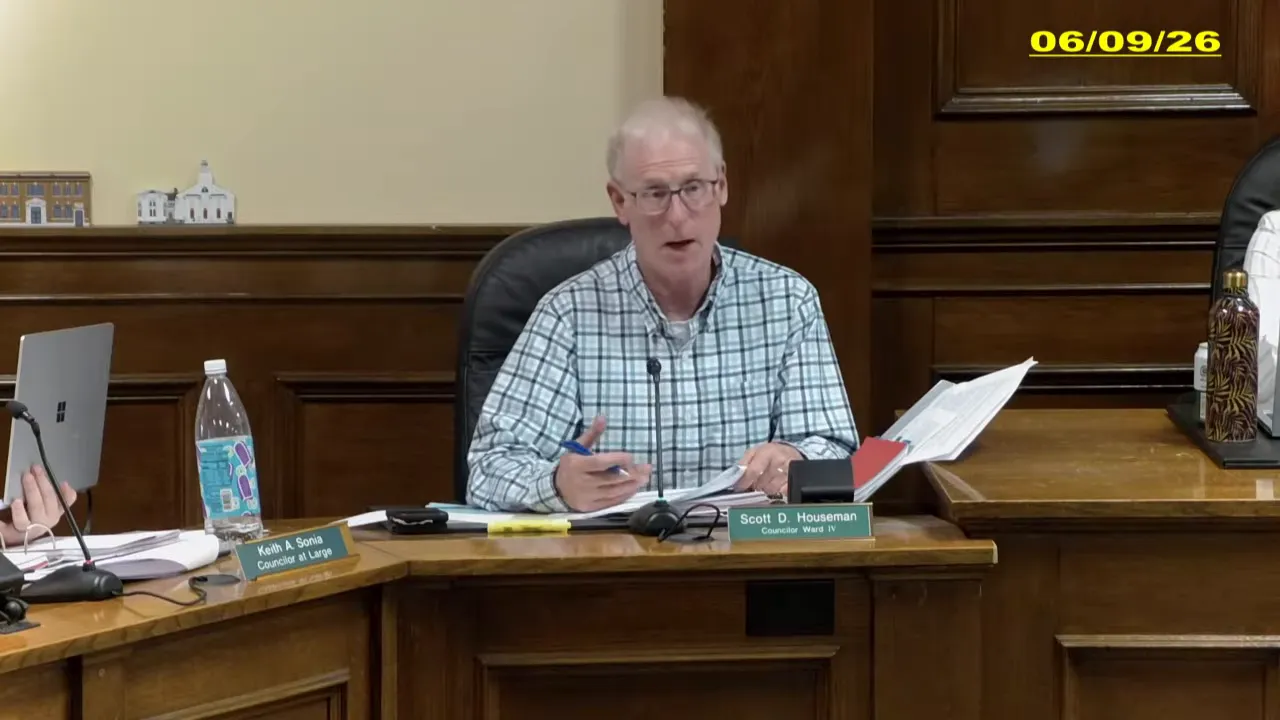
STREAMING COPY IN PREPARATION — RECORDING AVAILABLE FROM THE ORIGINAL SOURCE
FY2027 Budget Hearing: Planning and Fire Departments – June 9, 2026
This was the second budget meeting of the FY2027 cycle for the City of Beverly, convened as a joint session of the Committee of the Whole and the Committee of Finance and Property. The meeting focused on the proposed budgets for the Planning Department and the Fire Department. No formal votes were taken; the meeting was informational and included presentations, Q&A, and discussion of budgetary challenges.
Planning Department – Presentation and Q&A
- Director Darlene Wynn presented the Planning Department’s mission and operations. The department staffs nine boards/commissions, processes 200–300 permits annually (including ~200 conservation permits), and manages approximately $1 million in grants (including a $850,000 Community Development Block Grant for a housing rehab program).
- Budget reduction: The proposed FY2027 budget is $577,221, down from $784,000 in FY2026—a reduction of over $207,000 (about 26%). The department is losing one full-time equivalent (an associate planner position) through attrition, reducing technical staff from five to four (plus two administrative staff). This position had staffed the Design Review Board and Historic District Commission and provided long-range planning support.
- Impact on workload: Remaining staff have absorbed additional boards and commissions, resulting in more night meetings and administrative work. The department anticipates fewer special projects and will rely on self‑performance (e.g., updating design standards) rather than outside consultants. The consulting line was also cut.
- CADA Shuttle: The elimination of the $100,000+ shuttle service was discussed. The service, operated by CADA, provides ~10,000 rides per year (about 1,000 per month). CADA declined to extend the contract and cited federal funding legal issues. The shuttle will end June 30, 2026 (end of FY2026). Director Wynn noted that ridership data is limited, but many users are elderly or without cars. She is working with MassDOT and MAPC on a study to explore regional alternatives, and a rider survey will be issued. Councilors expressed concern about the loss of service, especially given the similar loss of the Salem Skipper.
- Comparison to Salem: Salem has 13–15 planners plus a separate transportation department (4–5 staff). Beverly’s lean staffing was highlighted as a constraint.
- Board vacancies: The Planning Board has four vacancies (with two appointments pending); Conservation Commission has two or three; CPC has several. Director Wynn noted efforts to recruit volunteers using testimonials and social media.
- Community engagement: Despite limited staff, the department prioritizes outreach (e.g., Harbor Fest, surveys, online meetings). However, fewer staff make such engagement more challenging.
Fire Department – Presentation and Q&A
- Chief Peter O’Connor presented the Fire Department budget. The FY2027 proposed budget is $8.824 million, an increase of 2.2% over FY2026. Personnel costs account for 94.3% of the budget.
- Staffing: The department has 67 authorized positions, with 64 line personnel staffing three stations (North Beverly, West Street, Headquarters). Minimum daily staffing is 13 firefighters (one engine per station, plus a ladder truck and deputy chief at headquarters). The NFPA standard is 17 on scene within eight minutes for a single‑family fire, so the city is already below that benchmark.
- Training officer change: The department will lose its full‑time training officer position (the retiring lieutenant will not be replaced). That individual will move to a line role but retain training responsibilities as a supplemental function. This is the first time since the early 1990s without a dedicated training officer. Chief O’Connor acknowledged this is not ideal but said company officers will help deliver training, and the training officer will still facilitate major projects on an overtime basis.
- Overtime lines: Two overtime accounts: General Emergency ($182,593 proposed) and Shift Coverage ($749,000 proposed, up $130,000 from FY2026). Combined, these total about $931,593, compared to an FY2026 actual of $986,000. Chief O’Connor expressed confidence that the increase will cover shift coverage needs, noting that FY2026 was an anomaly due to multiple injuries and retirements. Finance Director Brian Ailes and Budget Analyst Jerry Perry expressed concern that the combined line is $54,000 lower than FY2026 actuals and may be insufficient, especially given the third year of the collective bargaining agreement (≈4% salary increase effective July 1, 2026) and the risk of unforeseen injuries. Perry noted that the city has had to supplement overtime appropriations in four of the last five fiscal years. Chief O’Connor argued that FY2023 was an anomaly (six members on military orders), and that the new budget accounts for known retirements and a reduced injury burden.
- Minimum staffing risk: If the daily minimum of 13 cannot be maintained, a piece of apparatus (ladder truck or engine) would be taken out of service. The ladder truck was out of service from 2004 to 2020. Councilors Houseman and Flowers emphasized the importance of maintaining current staffing levels to avoid losing a station or truck.
- Other budget lines: The building maintenance line was increased after a $20,000 sewer line replacement at headquarters. The supply special line (for turnout gear) was maintained, but Chief O’Connor noted that from January 2027, new PFAS‑free gear will be required, likely increasing costs. The department has benefited from federal grants (e.g., SCBA, breathing air compressor, fireboat).
- Grant support: Lieutenant Mike Bishop (grant writer) and other staff perform supplemental functions to secure grants; these have brought in hundreds of thousands of dollars in equipment and staffing.
Key Outcomes
- No votes were taken on the budgets. The meetings will continue with other departments on Thursday, June 11, 2026, at 6:00 PM in Council Chambers, covering the Library, City Solicitor, Police, Parks & Recreation, Enterprise Funds, and Public Services.
- Councilors expressed appreciation for both departments’ work and acknowledged the difficulty of budget reductions. Several councilors noted the structural deficit and the need to address it in future years.
- The Fire Department’s overtime risk was flagged by the Finance Director and Budget Analyst as a concern, though Chief O’Connor is optimistic that the proposed funding will be adequate.
- The Planning Department will move forward with reduced staffing and will focus on mandated state projects (energy siting zoning) and internal planning work, while seeking community input on the CADA shuttle discontinuation.
Meeting Transcript
Okay, I can help you. Welcome to the second budget meeting of FY2027. And I'd like to call to order the committee of the whole and also Committee of Finance and Property. So tonight on our agenda, we have two departments. We have the fire department with Chief O'Connor here. And we have the planning department with Ms. Wynne from the planning department. Also in attendance, thank you very much. We have other members of the planning department here, and we have our finance director, Brian Ailes, and our City Council budget analyst uh Jerry Perry. So with that, let's just get right into it. So Chief O'Connor, would you mind? Oh, wait. Um, Ms. Wynn, yes, you can go first with the planning department. Okay. I slide open to planning. Uh Chief. O'Connor gratefully let me go first. I'm trying to get to the music and performing arts banquet at the high school. So no problem. She came up. And um, thank you. My name is Darlene Wynn. I'm the director of planning and community development. For anyone who doesn't know, and thank you, counselors, for hearing my budget presentation tonight. Is that loud enough? There we go. And thank you to assistant planning director Ken Clausen and economic planner, um, economic development planner uh Aaron Schaefer for attending, and to oh did I do something, and my other staff who some of them may be watching online, um, except for conservation agent because they is a conservation commission tonight meeting tonight as well. Um do you want me to so I will just give a brief overview of what we do and then you can go ahead and ask questions. Um it can be really hard to give an elevator pitch of what the planning department does, um, but our mission is to coordinate planning and development activities or how the land is used in the city of Beverly. Um, while ensuring that Beverly remains a great place to live, work, and run a business, and that that opportunity is available to anyone who wants to set up routes here. Our official task according to the charter is to assure this city's continued land use improvements are consistent with its physical, social, and economic conditions and resources. And we make sure our policies are followed and that impacts are measured and mitigated where possible. Um I like to divide up our activities into current planning and future planning. So current planning is the development review, um, constitutes constitutes most of our daily work, reviewing permit applications, managing projects, um responding to questions from constituents who come in or call or email us. Um these can be residents, business owners, or other property owners who are looking to make improvements to their property within the city of Beverly. Um and then providing administrative and technical support to the nine boards and commissions that are department staffs. Um jump back a little bit. We currently, as of this future budget of this budget, have two administrative staff and did I get it right, three four technical staff, including myself. Um one but that one position, the associate planner position um is proposed to be cut in this budget. Um so that would be the fifth position. Um but so with that current planning activity, we process 200 to 300 permits per year. Um 200 of those are with the conservation commission. We have a lot of wetland resource areas in the city of Beverly, and that is could be almost the entire job of the conservation agent doing that work. Um we staff nine boards and condition commissions, as I mentioned, um, most of whom meet monthly. Um we provide both administrative and technical support related to each of their responsibilities, um, such as processing permit applications, technical review of those permits, um, complying with open meeting law, um, and special projects. So a couple of those boards and commissions are um regulatory with discretionary roles, but some of them are not, and all of them we have more than 60 uh members of those boards and commissions who are volunteers, and they all want to do something fun and exciting in addition to the work that they have to do. And all of them we have more than 60 members of those boards and commissions who are volunteers, and they all want to do something fun and exciting in addition to the work that they have to do. So we try to help them manage a project or something or so a year, such as open state open space trail creation, uh historic resource survey that we're doing with the historic district. So then we manage approximately one million per year in grants, and that includes our new community development block grant, the $850,000 that we are currently managing for a housing rehab program, as well as a couple of other smaller grants that we use for planning activities.
openpublica.com