Charlotte City Council Budget Workshop - March 25, 2024: CIP, Bond Outlook, and Financial Partners
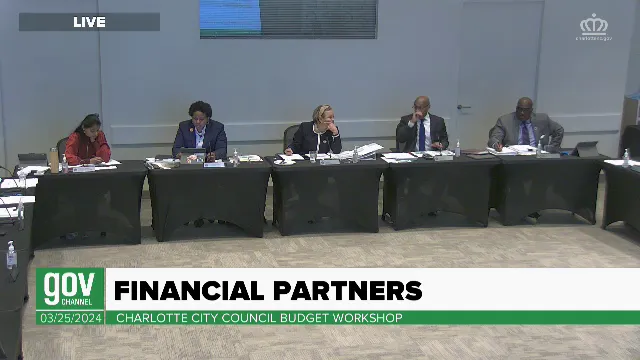
STREAMING COPY IN PREPARATION — RECORDING AVAILABLE FROM THE ORIGINAL SOURCE
Charlotte City Council Budget Workshop - March 25, 2024
This second budget workshop for Fiscal Year 2025 focused on the five-year Capital Investment Plan (CIP), the 2024 bond outlook, and the city's financial partners. The CATS budget outlook was postponed to the evening regular meeting. Council members debated funding constraints, the need for additional revenue, and strategies to bundle projects for greater impact.
Discussion Items
Five-Year CIP & 2024 Bond Outlook
- Assistant Director Hannah Bromberger and Special Assistant Ed McKinney presented the updated CIP, noting that the steady-state general obligation bond capacity increased by $18 million to $228 million. Certificates of Participation (COPS) capacity remains at $26 million per year.
- COPS projects include: fire facilities equity renovations, solid waste equity renovations, 911 call center expansion (adding 22 consoles), relocation of ARD CDC and helicopter hangar (land acquisition in FY2025), and phase three of animal care and control. A potential solid waste transfer station (requiring at least 10 acres) was introduced for advanced planning.
- The 2024 bond referendum will include three categories: affordable housing, neighborhoods, and transportation. Programmatic funding (sidewalks, resurfacing, Vision Zero) is squeezed by large named projects (Eastway-Sherlock, Bryant Farms, Robinson Church Road, Ashley-Freedom-Tuckaseegee intersection).
- Ed McKinney presented the new strategic investment areas approach: 16 focus zones citywide where bundled projects (e.g., street lighting, sidewalks, pedestrian crossings, transit amenities) aim to maximize impact with scalable, phased investments. Example: Harrisburg Road corridor in District 5 – a $20 million bundle (plus/minus) covering multiple programmatic needs.
- Council members expressed concern over limited funding for basic infrastructure. Councilmember Ajmera urged prioritizing sidewalks, resurfacing, and Vision Zero, specifically addressing high-injury networks. Councilmember Driggs noted that $20 million buys only 4–5 miles of sidewalk, while 260 miles are needed (a $1.3 billion problem, though public-private partnerships may reduce the city’s share). He called for realistic alignment between resources and plans.
- Discussion on animal care and control: Options range from a $200 million new facility (deemed too costly) to smaller satellite expansions or kennel improvements. Councilmember Driggs and others urged near-term action with a $10–20 million investment; Councilmember Mayfield opposed the $200 million figure. Staff committed to exploring cheaper options and operational improvements.
- Mayor Pro Tem Anderson and Councilmember Molina supported the strategic investment approach but stressed that without new revenue sources, the ambitious bundles remain aspirational. City Manager Jones noted that to fund Vision Zero and sidewalks at desired levels, the 2024 bond stack would need to change—and that new revenue is essential for long-term success.
Financial Partners
- Deputy Director Marie Harris presented the FY2025 financial partners process. Applications opened in November 2023; 2.4 million in requests came from new agencies, and existing partners requested an additional 708,000 (total ~5 million in discretionary general fund requests, up from 1.3 million last year). Dedicated revenue partners (Charlotte Center City Partners, Visit Charlotte, SouthPark, University City Partners) are funded via MSD taxes and occupancy tax; no increases were requested this year.
- Housing financial partners are federally funded (projections shown).
- Council discussion focused on accountability and criteria. Councilmember Mayfield questioned applications showing NA for overall budget, high administrative costs, and leadership turnover. She advocated for stronger metrics and limiting city funding to a percentage of an organization's budget. Councilmember Ajmera urged no surprises during budget adjustment and sticking to the formal process. Councilmember Johnson stressed the need for rental assistance and support for crisis assistance. Councilmember Mitchell suggested grouping applications by strategic priority to aid decision-making.
- Mayor Lyles and City Manager Jones signaled that major policy changes to financial partners would be deferred to next budget year, with a signal to current partners. The Budget Committee will develop principles and possibly revisit an earlier policy that was not followed.
Key Outcomes
- Staff will provide additional information on animal care facility options (including costs and timelines) and on solid waste transfer station design and land needs.
- The Budget Committee will develop scenarios for reallocating 2024 bond capacity to better align with council priorities (sidewalks, Vision Zero, resurfacing).
- Financial partners: No immediate policy changes; a process to revise criteria and expectations will begin next budget cycle. Council members will receive applications grouped by strategic priority.
- The CATS budget outlook was postponed to the evening regular meeting (Action Review).
- No votes were taken; this was a workshop to inform the proposed budget in May.
Meeting Transcript
At Laj. Victoria Watlington at large. Ariel Smith, Lead City Clerk. All right. With those introductions, we'll turn it over to our city manager. Thank you, Mayor, members of council. We're about three items today in terms of the budget workshop, the second budget workshop, and that is CATS budget outlook. We'll also discuss the five-year CIP and the 2024 bond outlook and as well as our financial partners. We will have in the budget committee meeting, uh, other enterprise funds, which there'll be a discussion with uh water and storm mortar and aviation that has always been a part of the plan. And we have you know opportunities even that evening if there's any additional information that we have to share. So we try to uh fit this around these uh two workshops, but also utilizing the um budgeted in intergovernmental relations committee. With that, mayor, before I uh turn it over to back to you, um we uh need to make one adjustment and move the CATS budget outlook to a third. Um with that said, Mayor, I'll turn it back over to you. All right, so we have one. So we have one adjustment to the agenda, and that is with the CATS portion. So we will go into the CIP immediately. And now I want to recognize councilmember Ajmeira for any comments as chair of the budget advisory committee. Well, let's ready to rock and roll. All right, thank we like that, Miss Edmir. It's very cool. All right, so um we'll go to Ryan. Thank you. All right, so uh the first thing we'll talk about today is our five-year CIP and our bond outlook. So when we when we propose and approve a budget, we are only approving through council the first year of our CIP, but as part of the plan, we also show the next four years so we can talk about capacity, future projects. As you know, when we go through these uh CIP projects, they take multiple years to uh plan and execute. So I'm going to turn it over to our assistant director Hannah Bromberger and special assistant for mobility Ed McKinney, who are going to uh run us through a bond outlook, but additionally some of our facility projects and uh the outlook there. Thank you, Ryan. Good afternoon, Mayor, members of council. So, as Ryan said, my name is Hannah Bromberger. I'm the assistant director for Strategy and Budget, and with me is a very familiar face, Ed McKinney, special assistant to the city manager around strategic mobility. So you'll remember that uh in February at the February budget workshop, Jennifer Smith, the city engineer, and I were with you reviewing the funding status of all active capital projects. So everything that we talked about then in February was related to ongoing previously appropriated projects. Today we're shifting gears and we're looking ahead to the existing plans for fiscal year 2025 and for the 2024 bond. As a reminder, like Ryan said, uh, you adopt a five-year capital investment plan annually as part of the budget process, but the first year of that plan is the only one that is locked in place. The remaining four out years, as we often refer to them, um, are simply a plan. So they're adjusted annually as the budget is presented to you. So the starting point for our conversation today are those four out years for the current budget. Um, and once we recap the plan, we'd like your feedback on priorities as we head towards the proposed budget in May. This graph recaps what Theresa Smith, uh, the city's chief financial officer officer, excuse me, shared with you in February around updated steady state capacity. So the previous steady state included 210 million dollars of general obligation bonds or geo bonds as we usually refer to them. And as a reminder, geo bonds have three different bond categories housing, neighborhoods, and transportation. Teresa shared that the steady state has increased by 18 million, so it's now at 228 million. We'll talk more about the 2024 bonds later in the presentation. Uh but I want to mention COPS really quickly. So the steady state also includes about 26 million dollars on average uh per year in certificates of participation, which we usually call COPS. And in reality, because of the way that facility projects are funded as they move through conceptual planning, land acquisition, design, and construction. We know that the actual funding tends to fluctuate away from that 26 million, but we build those fluctuations into our debt model. The updated steady state that Teresa talked about at the February workshop had no change in the COPS capacity. So as we move to talk a little bit in more detail about COPS projects, just a reminder that COPS traditionally fund facility construction or facility renovations. And COPS funding in recent years has really focused on public safety and on maintaining our existing assets and improving operational efficiencies.
openpublica.com