Charlotte City Council Budget Straw Votes Meeting – May 30, 2024
STREAMING COPY IN PREPARATION — RECORDING AVAILABLE FROM THE ORIGINAL SOURCE
Charlotte City Council Budget Straw Votes Meeting – May 30, 2024
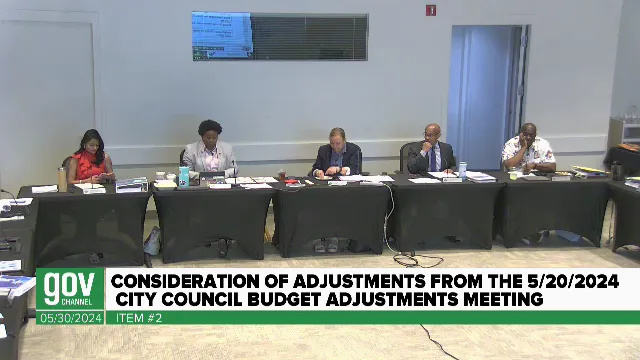
The Charlotte City Council convened a budget straw-votes workshop on May 30, 2024, at the Charlotte-Mecklenburg Government Center. The meeting focused on possible adjustments to the proposed FY 2025 budget, which totaled approximately $4.4 billion and included a 1.5-cent property tax increase. Councilmembers debated competing packages of reductions and ARPA-funded requests, held several straw votes, and directed the city manager to prepare the FY 2025 Budget Ordinance.
Budget Reduction Proposals
- Councilmember Tariq Bokhari presented a "solo plan" with two motions: Action A would reduce CIP and housing bond additions to lower the property tax increase by 0.3 cents, and Action B would cut arts funding from $11 million back to $4 million. Both motions failed.
- Councilmember Victoria Watlington presented a "collaboration plan" developed with several colleagues. It included more targeted CIP reductions, exploration of alternative arts funding, personnel cost reductions, and a salary merit pool adjustment.
Failed or Withdrawn Motions
- Bokhari's Action A and Action B both failed.
- The initial version of Watlington's CIP reduction package failed on a 4-4 tie, with Mayor Vi Lyles breaking the tie against it.
- A proposal to reduce the salaried employee merit pool from 4% to 3% failed, 4-7. Supporters argued it would still mean a raise and could help lower-paid workers; opponents said it was being decided without adequate compensation data and would undermine retention.
- Councilmember Bokhari formally withdrew his motion for $500,000 in outer carrier vests for CMPD patrol officers after stating that police command opposed the purchase. He said he would continue seeking funding from other city sources.
Approved Straw Votes and Adjustments
- A revised “Action A” CIP reduction package passed 6-5. It reduced strategic investment areas from $55 million to $30 million, reduced corridors of opportunity from $25 million to $20 million, reduced sidewalk funding from $50 million to $20 million, and eliminated $5 million for center city transportation improvements. Vision Zero funding and future city facility capacity were preserved at their proposed levels.
- Watlington’s motion to investigate reallocating the $7 million arts increase away from the general fund passed despite four opposed votes. Staff noted only about $1.5 million in ongoing tourism-fund capacity might be available, and several councilmembers cautioned against relying on hospitality funds without consulting HTA and legislative partners.
- The council approved a $1.1 million reduction in non-public-safety personnel costs, directing the city manager to find savings through attrition, vacancy management, or other operational flexibility. Only Councilmember Malcolm Graham opposed.
- Councilmember Bokhari’s motion to accelerate CMPD officer pay increases from January to November passed. The cost was refined to $427,110, offset by $231,000 in new county law enforcement services revenue, leaving $196,110 to be funded through delayed central-services vacancies or ARPA interest.
- Council approved $143,950 from ARPA interest or other one-time funds for active shooter medical kits, and $97,500 for portable ballistic shields for CMPD divisions.
- The council voted to refer the CMS Teacher Village/workforce housing partnership to the Housing and Safety Committee on June 3, with the intent of earmarking $1 million from ARPA funds and bringing a recommendation back before the June 10 budget vote.
- Workforce development and nonprofit funding requests were referred to committee, with an agreement to fund eligible organizations up to $100,000 each from ARPA interest while a formal funding policy is developed.
- Charlotte Black Film Festival was approved for $287,000 from ARPA interest for the first year, with encouragement to pursue tourism and film commission funding for future years. Boom Charlotte was approved for $100,000 from ARPA interest.
- The council approved funding for an additional litter-cleanup crew through the employment opportunity center, a transitional work program for people leaving incarceration.
- Medical insurance coverage for spouses and dependents of city employees killed in the line of duty was approved.
- The council voted to reserve $30 million in future city facility capacity for animal care and control construction, following planning for a satellite shelter.
- A request for $2 million in bike infrastructure funding was referred to the transportation committee rather than directly funded.
- The council approved $1 million from ARPA interest for juvenile crime prevention, supplementing the $3.5 million already proposed, and $1 million from ARPA for the Faith in Housing Initiative.
Final Actions
- The council voted to direct the city manager to prepare the necessary documents and resolutions for the FY 2025 Budget Ordinance. Final budget adoption was scheduled for June 10, 2024.
- The council moved into closed session under North Carolina law to discuss economic development incentives, including a proposed tenant list for business recruitment.
Meeting Transcript
I'm ready to go around. Thank you. All right, thank you. We're back. We're back to go live for the way for the We'll wait for the um we'll wait for the um studio. Studio. Okay, here we are. Okay, here good afternoon, everyone to make everybody on third day. It's maybe the quarter day. It's an important day. Um the elaborations by the Liberty City by now Charlotte City because it's this point because on this point we'd like to begin, we would like to duck in with some easy for M Lark with MR Scar on the CR. I'm CF Teresa Smith. Brian Bergman, budget Ryan Bergman, budget. Victoria Watts said, I like Tori Wattson. I don't want to make billing district to help them district to the parks Jones City Manager Jones City Manager. Okay. This meeting is the city count. This will city county on meeting 20th on the property and the prototype on the men of the ministers of city managers of the city ran at FYS coming in at Fifth that budget host at the 20th budget, 20 buttons meeting house funding now meeting by the council. After any adjustments or any of the council put in the book to the red and city manager right at the city there, the necessary are the miss and their resolutions and the readily left by 20th and five budget or any five budget or and then just nine or maybe judging it's meaning late 20 that will receive that we'll recognize at least five and we're presented and presented with staff pair of parameters but summarized great degree, great changes and changes and ideas that council some working with several of the council members, but we're going to go ahead and we're going to go ahead and talk about again process about the meeting today or the meeting too. But first I want to just say just really today to know what information we know what information we have adjustments and these are to the way that we to the way the talking about is someone talking about by someone really ill or really illustration values um values. So for this process, this process, I think that what we like to do is like time to start off council members who council members who are reacting or building out or building concept that the council that the 20th 20 or meeting of adjustment our meeting of the judge council no council eight members who voted a great two I believe to try to rest try to manage your name to manage our advice to any knowing that there is any way that we could possibly administer or a delay or layer and code not include not a property tag is increased tax. So if you guys don't want to read that, I'm a rebound and the bottom car and just the bacard that they've done, the work that they've done, then can ask me them to pick this meeting on. Thank you. I'll start thank you. I'll start and uh my colleague, my second colleague. So a lot of work has happened. The last works we last met since we again met in the context. You can have the context here. The manager, uh the manager back from all of us being back from all of us from that budget, proposed to that budget because everybody wanted to have included a one-by-mine tax property tax increase. Um we were presented when you were presented at the end of explorer after last or after last week. Um first draw vote, first draw though about to go anything out. Reduce the impact, reduce the un property tax basically tax payment. This is something that maybe some problems that you also look at. Some might say some might design your tough and timing your top, some others might say there's others might say there's a priority either go by organizing the sales and sales trade, broader transfer broader transformation transportation investment by showing with our by showing with our tax partners across our partner, just region, but also as a region, but also in Riley. We work all in or mall in the sales teams or sales technical government where we got $7 million in a million dollars on the X potential for 20 billion 20 billion investment in our transitions in our transportation once in a generation in a generation. So there's some reasons for all sides to be all sides to be interested. And I think again, I think again really big opportunities. What we've decided to work decided is important to major things that we're making things that we're gonna do to council with. The first is the first is I will call the target solo. It is something that I've designed, I sell with no involved with no in others. I don't know how anyone feels about it, anyone feels about it, but uh it is an option. It is an option on the less to get us to last nine cents or nine six reduction six cents uh in the property tax increase. Property tax the second one, the second one I will call it the Victoria collaboration collaboration. This is something that Victoria, sorry, your council member water council member spearheaded, I got input and got many, if not all many, if not all of them. And I also and I also support it myself. So uh the difference between these two input between these two proposed mine is a mine set as a broader setup, broader cut of just of increase post in this budget. I'll go into that budget. I'll go into that. And this Wattlington and this was more specific, it's more taxistic-based feedback from all of you back from all the smaller amount of smaller generates, generate segments three or generator point three, both are fixed, both are picked for the ultimate outcome. So in order for everyone to in order for everyone to have all of the options, all of the options.
openpublica.com