Charlotte City Council Business Meeting – August 26, 2024: Mobility Update, Red Line Purchase, and Historic Landmark Decisions
STREAMING COPY IN PREPARATION — RECORDING AVAILABLE FROM THE ORIGINAL SOURCE
Charlotte City Council Business Meeting – August 26, 2024: Mobility Update, Red Line Purchase, and Historic Landmark Decisions
The Charlotte City Council met on August 26, 2024, at the Charlotte-Mecklenburg Government Center. The meeting included a major action review on the Strategic Mobility Plan, a proposed 1% sales tax referendum, the purchase of the Norfolk Southern O-line (red line) for commuter rail, and public hearings on historic landmark designations. Council also approved the consent agenda with several items pulled for separate discussion, and heard public comments on animal shelter, housing, parking, and airport development issues.
Consent Calendar
- The consent agenda (items 27–70) was approved in a single motion, with the exception of items pulled by Council Members Johnson and Mayfield for separate votes. The following items received individual votes and were passed: 27 (firearm ammunition sole source contract), 28 (nuisance abatement services), 29 (asphalt purchase from state contract), 31 (flashing beacons), 33 (air filtration systems), 35 (Sardis Road North Sidewalk – rejected low bid and approved contract), 39 (engineering services for water/sewer relocations), 41 (water testing instrumentation), 45 (plumbing services), 52 (professional engineering for storm drainage), 54 (CATS bus inspection services), and 57 (airport fourth parallel runway taxiway construction). During these votes, council members raised concerns about the frequency of Charlotte Business INClusion (CBI) program exemptions, leading to a commitment from the City Manager to review policies and provide a report.
Public Comments & Testimony
- Heather McCullough (District 1 resident, volunteer at CMAC) urged council to make CMAC an independent city department and commit to a new animal shelter, citing overcrowding and understaffing.
- Cindy Campbell (Friends of Feral Felines) reported that donor-funded spay/neuter services had sterilized 1,205 cats since January 2024, and requested city support for spay/neuter programs.
- Natalie Peterman (volunteer) described the emotional toll of capacity crises at animal control, asking for a larger shelter and removal of animal control from police oversight.
- Victoria Pinnell (Reimagined Reentry) requested city resources for reentry programs to reduce recidivism.
- Alicia Harvey proposed transforming the Lamplighter Inn into a neighborhood stabilization center to address housing and economic mobility, citing Harvard research showing Charlotte children from low-income families have only a 4% chance of reaching the top income quintile.
- Shannon Bircham (Uptown worker) asked the council to reconsider parking regulation changes (two-hour zoning and extended hours effective September 3), proposing an Uptown Employee Parking Plan.
- Ukamaka Neke (recently disabled with MS) described challenges with public transit and lack of city resources, including paratransit without AC and delays in crisis assistance.
- Kimberly Potts spoke on affordable housing scarcity, noting that one-bedroom apartments cost around $1,500/month and that tent communities include children.
- Gina Gupton (Bellmead Green HOA) reported 18-wheeler trucks damaging neighborhood infrastructure and requested street cleaning and better coordination with utility companies (Google Fiber, AT&T) that break gas and water lines.
- Stephanie Loss and Diana James (Steelberry Acres residents) spoke against the airport’s development plans, the demolition of the Steele Creek Presbyterian Manse, and the de-designation of historic properties. They demanded transparency and a pause on development.
- Jimmy Vassilu (Housing Justice Coalition) criticized the airport’s rapid industrialization and the city’s lack of community engagement.
Discussion Items
-
Mobility Update and Red Line Purchase: Staff (Ed McKinney, Sarah Hazel, Brent Cagle) presented a 70-minute action review on the proposed 1% sales tax referendum (generating ~$100 million annually for Charlotte) and the purchase of the Norfolk Southern O-line corridor (22 miles, $74 million purchase price, appraised at $69.2 million) plus a Gateway Station parcel ($17 million, appraised at $15.9 million). The draft legislation includes a 60% transit/40% road split, creation of a new transit authority (Charlotte would hold 12 of 27 votes), and a priority for the red line commuter rail. Council members expressed varied positions:
- Council Member Driggs supported the plan, calling it an essential investment and noting the risk of owning the corridor if the referendum fails.
- Council Member Molina voiced support but acknowledged East Charlotte residents’ concerns that the silver line might be deprioritized.
- Council Member Watlington asked about the city’s financial exposure if the referendum fails; staff replied that the city could sell the corridor, but Norfolk Southern has a right of first refusal.
- Council Member Johnson questioned the appraisal discrepancy ($86.8 million vs. $91 million purchase price) and the $43 million already spent on silver line design. She expressed concern that the red line purchase could exacerbate disparities for East Charlotte and Matthews.
- Council Member Mitchell asked about the Mecklenburg legislative delegation’s support; staff noted ongoing discussions.
- Council Member Bokhari raised concerns about a regressive tax, timing (economy struggling), and the need for a forward-looking plan, not just light rail. He also noted that the red line decision cannot be decoupled from the sales tax legislation.
- Council Member Ajmera warned of creating “two cities,” with the red line serving the north while the east side loses the silver line. She questioned the feasibility of bus rapid transit (BRT) on Independence Boulevard, citing NCDOT constraints.
- Council Member Brown asked for extensive community engagement and raised concerns about the tight timeline. She also mentioned a U.S. lawsuit against Norfolk Southern for delaying Amtrak trains.
- Council Member Mayfield highlighted the lack of transparency, especially regarding the airport’s demolition of the Manse and the need for a separate hearing before a decision. She also called for better tracking of CBI subcontractor utilization.
- Mayor Pro Tem Anderson emphasized the economic development potential and the opportunity for a generational shift, noting that the red line purchase is a calculated risk.
-
Public Hearings on Historic Landmarks:
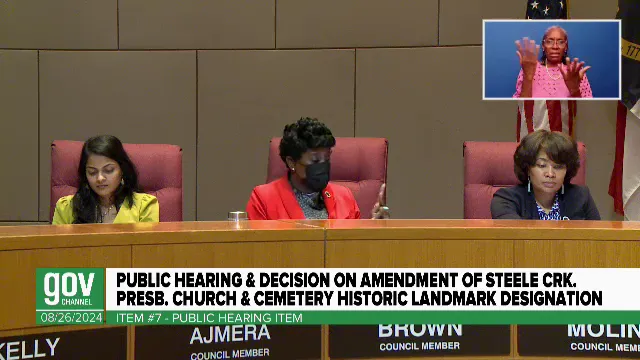
- Steele Creek Presbyterian Church and Cemetery: The council heard extensive testimony from residents, Foundry Commercial (developer), the Historic Landmarks Commission, and airport staff. After debate, the council voted unanimously to defer the de-designation decision to October 14, 2024, to allow further community engagement and transparency.
- Alexander-Howell House (250 Cherokee Road): Approved (7–1) after a plea from owner Ashley Larkin, who sought to protect the historic home from demolition.
- John Phillips Little Jr. House (1136 Queens Road): Approved unanimously.
- Alley closure off Kensington Drive: Approved.
Key Outcomes
- Deferred: Steele Creek Presbyterian Church and Cemetery historic landmark de-designation to October 14, 2024.
- Approved: Alexander-Howell House and John Phillips Little Jr. House historic landmark designations.
- Approved: Alley closure resolution.
- Approved (with separate votes): All pulled consent items (27, 28, 29, 31, 33, 35, 39, 41, 45, 52, 54, 57).
- Approved (consent remainder): Carbon Reduction Program Discretionary Grant ($3,917,562), NCDOT Municipal Agreement for traffic signal ($18,183.26), McGill Rose Garden lease, CMPD North Division short-term lease, Urban Cost Share Program agreement with Mecklenburg Soil and Water Conservation District ($59,000), CRTPO Memorandum of Understanding (reducing Charlotte’s annual share from $422,319 to $390,436), Youth Diversion Program Interlocal Agreement ($240,000), and property transactions (acquisitions/condemnations for various projects).
- Approved: Nominations to Bicycle Advisory Committee (Constance Wagner), Citizens Review Board (Theresa Marascio and Susie Taylor), Domestic Violence Advisory Board (Angelia Buford Hayes and Christine Hart), and Historic District Commission (Sarah Kern and Cameron Holtz). Nominations for other boards were deferred.
- Directives: City Manager to review CBI exemption policies and provide a report to council; staff to work with Council Member Brown and Steelberry Acres residents on a community engagement plan for the Steele Creek area.
- Next Steps: The council will consider the red line purchase and sales tax resolution at the September 3, 2024 meeting; the closing on the Norfolk Southern corridor must occur by September 9, 2024.
Meeting Transcript
It's a little bit on the slide. It's a little bit on the slide, and I think it speaks volumes because when we start to take one issue in isolation, you can pick that issue apart. But this council, through numerous uh annual strategy meetings and days and days of looking at goals and objectives and priorities, have really landed on what I call a three-legged stool. You know, it's uh uh a good place to live, a good paying job, and a way to get back and forth. And so I start off with that because we have uh you have continued to do a lot of great things even before the discussion tonight. A lot has happened since the Charlotte Moves group. Your efforts on council alongside the community leaders have come to advance all the priorities and not just this one. And we believe it's done in a way that's never been done before, whether it's through the corridors of opportunity program or efforts to address safety in the environment through Vision Zero and CAMP, these efforts work together. You have been building on minority business enterprise and transformational investments in affordable housing. These programs, especially when we start to think about MWSBEs, these programs provide capital, technical expertise, critical networking, as well as bringing the MBEs to the next level, um, legal assistance programs, how to navigate complex issues. And so when we start to think about some of the things that you've done, not just the the CAMP or what's happening around CBI, but even the Charlotte Small Business Growth Fund, which together with the private sector and the philanthropic community that supports 40 million dollars in lending to businesses that are unable to get traditional capital. Your two million dollar investment helped make that happen. What's going to happen tonight is Aunt McKinney does this uh presentation, you'll see um what's in it for the city of Charlotte, and that includes in year one of the ones in sales tax, the 40% portion that comes to transportation in Charlotte is worth a hundred million dollars. And that and that grows. So I guess what I'm saying is the community is poised to have a discussion around transportation, much like what you've done with affordable housing and what you've done with good paying jobs. I do want to talk a little bit about affordable housing before I turn it over to Ed. In this last budget, you doubled your efforts from the housing bond from 50 million to 100 million. There's some great work, and I won't do a spoiler alert, but there's some great work that's going on in the housing estate communities committee about how to deploy those funds in a way that's never been done before. So what I would say is that as we are talking about mobility tonight or transportation tonight, that doesn't wipe out four years of work around some other key areas that actually work together with what we're trying to do here. So with that said, I'd like to turn it over, Mayor to Ed McKinney. Thank you again, Ed McKinney, uh special assistant to the manager for mobility. Um just gonna go back real quick, just a reminder. What we're gonna do tonight is talk really about two things and two actions coming up for you. Transportation funding, which is really centered around the draft legislation, and then uh the red line. So I'll walk through, and Sarah Hazel and I will walk through the draft legislation, uh specifically around the funding, and then we'll turn it over to Brent Cagle to talk through uh the red line purchase quick schedule. Uh we've talked about this before. Here's where we are on our action review, and and again the goal next uh next week of September 3rd is these two uh requested actions. A couple things just to kind of build upon what the manager just described. Again, number of things we've been doing, certainly the plans that have already been described by the mayor. Thing that I think we wanted to sort of re-emphasize is really the time is now. This this notion of funding uh is critical to moving forward. It's certainly critical to our ability to move forward on our desired multimodal road investment, uh, specific to our to our strategic um mobility plan without any more funding. We simply can't do our rail projects that are in the plan, and we can't extend uh uh the the frequency and the extension of our bus system. And so that's it's really important that to move forward on these big plans, funding is absolutely critical. Let me talk about the funding and let me give you a sense of a little bit of context of the scale and maybe a different way to think about this as we move forward in some of these decisions to be made. This is some information uh prepared by the Charlotte Regional Business Alliance a couple years ago that just talk about uh the impact of doing nothing and the impact of doing something. And so I'm on the uh the right side you have is sort of what what you can gain out of this, and on the other side is what you can lose. And so scale on the on the red side, lots uh if we don't address congestion, right? There's some real impacts. These numbers are almost hard to kind of comprehend. And I don't want to imply uh that the investment that we could make, even transformational, would make that red go away, right? We're constantly and we'll always be managing congestion. I think the thing to remember though, and the the point to be made here is what we can do, right? What the investment we put in place will do. And so again, every dollar we spend will have an impact. Because I'm gonna use that increment in almost a casual way given the scale of what we're talking about. But but remind you know, remember this slide and think about that hundred million dollars of investment uh because you're gonna see it in some big numbers as we go through. What does this mean for Charlotte? Is the manager described? I want to spend a little bit of time and talk about uh certainly the regional impact of this investment, but but also being really clear with with you and the community about what this means for Charlotte.
openpublica.com