Charlotte City Council Budget Workshop for FY 2026 – February 10, 2025
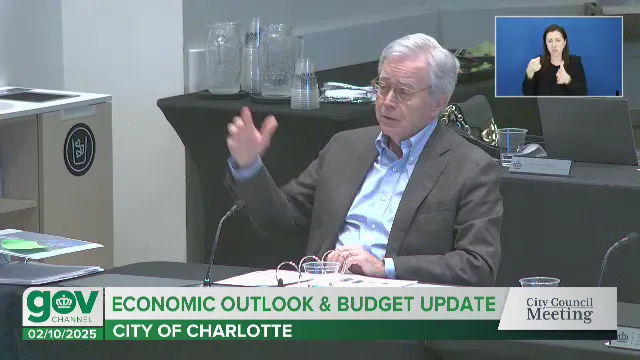
STREAMING COPY IN PREPARATION — RECORDING AVAILABLE FROM THE ORIGINAL SOURCE
Charlotte City Council Budget Workshop for FY 2026 – February 10, 2025
The Charlotte City Council held its first budget workshop for the development of the Fiscal Year 2026 budget on February 10, 2025. The workshop focused on an economic outlook, revenue and expenditure projections, public safety costs, compensation and benefits, and strategies to balance the budget. Council members provided comments and requested additional data. The meeting concluded with a motion to enter closed session.
Economic Outlook and Budget Update
- Dr. Taza presented the economic outlook: Charlotte MSA GDP grew 4.7% in 2023, faster than state and nation. Major contributors: financial services, professional services, information, and retail trade. Projected 2.5% growth in 2026 with no recession expected.
- Housing permits and completions remained strong in 2023-2024; multifamily units take 19-21 months from permit to occupancy.
- Inflation fell from 9.1% in 2022 to 2.9% in late 2024; Federal Reserve held interest rates at 4.3%.
- Sales tax growth forecast: 3.5% for remainder of FY2025 and for FY2026.
- Key risks: potential 25% tariff on steel and aluminum impacting CIP projects, immigration trends, consumer spending, and unemployment.
Discussion Items
- General Fund Outlook: Incremental growth (contracts, annualizations) requires $30.4M; projected revenue $30.9M, leaving a $0.5M surplus before any pay plan. A typical pay plan would create a $16.5M gap; a more enhanced plan a $22M gap. About one-third of that gap has been addressed through revenue and expenditure strategies.
- Public Safety Costs: 62% of general fund allocated to police and fire; 73% of personnel costs are in public safety. Recent investments include new fire positions, technology, gear, and a new Miranda Road fire station. Delay in apparatus ordering (now 4-year lead time) increases maintenance costs.
- Medic Reimbursement: Charlotte Fire runs ~85,000 calls/year as first responder for Medic, with a flat fee of under $500,000 (about $6/call), while fully loaded cost is estimated at $10.3M ($120/call). Towns get $20.90/call. This cost recovery gap is under active review.
- Compensation and Benefits: Since 2018, minimum wage increased 70% to $23/hr; salaries for police, fire, and hourly staff increased over 30% since 2019; 97% of staff make at least $50,000. Health care costs rose 29% since 2018 ($12.4M in FY25). Vacancy rate declining; 723 new positions added.
- Council Member Comments:
- Councilmember Mayfield asked about fire training facility upgrades and ensuring employees live in city.
- Councilmember Bokhari urged early proactive work on budget cuts, efficiency, and policy alignment; highlighted Medic reimbursement as a key issue; requested data on permitting and CMPD employee satisfaction; noted concerns for injured first responders.
- Councilmember Driggs requested detail on expenditure growth assumptions; expressed concerns about eroding purchasing power due to property tax revaluation; wants adequate CMPD resources (e.g., speed display screens); cautioned against avoiding tough choices.
- Councilmember Graham stressed avoiding surprises and working collaboratively.
- Councilmember Molina asked for list of cost recovery models, analysis of Marathon Health clinic service levels, five-year efficiencies list, and fire apparatus reserve status.
- Councilmember Johnson urged equitable lens and consideration of hurting residents.
- Councilmember Watlington emphasized analyzing real cost of growth and strategic growth policies.
- Staff Responses: Manager Jones noted FY24 ended with half-million surplus on expenditure side but revenue drove surplus; current FY is tight. Budget office scrubbing accounts for efficiencies. A facilities needs assessment will be presented later.
Key Outcomes
- No budget decisions or votes were taken on the FY2026 budget. The workshop was informational.
- Council members identified areas for further data and analysis, including cost recovery, health clinic performance, fire apparatus reserve, and permitting efficiency.
- The next budget workshop is scheduled for March 24, 2025, covering capital projects, solid waste services, and financial partners.
- The meeting concluded with a motion to enter closed session (pursuant to NCGS 143-318.11(a)(3) to consult with city attorney on two pending lawsuits), which was approved by majority vote.
Meeting Transcript
For those of you that made it possible for us to have a quorum, we are really grateful for that. And to start it in a reasonable amount of delay. So good afternoon. I'd like to call our first council budget workshop for FY 2026 budget development into order. As you know, this is one of the most important and impactful policy items that we work with together each year in developing a plan to allocate the city resources in alignment with our strategic priorities and the needs of our community. So I want to thank every one of you that came in on time today for joining us, and I'm going to turn the meeting over to the city manager. So mayor, thank you, uh Mayor members of council. Um so we'll just jump right into it. We have an economic outlook and a budget update. This is not dissimilar to what we've done in the previous years, which what is a bit different is we tried during the annual strategy meeting to go under the hood a bit more in terms of what's in the budget in terms of all of the different funds today. We will be focusing on the general fund uh as well as what's happening around public safety, and that's a little prelude to the uh conversation we'll have tonight, also. But with that said, Mayor, if there aren't any questions, I'd like to turn it over to Marie and uh the budget and finance team. Thank you very much. Let's see, there you are behind that way, Marie. Thank you. Thank you. And good afternoon. And as we get started, then as the manager mentioned, we're gonna do a budget overview quickly, an economic outlook, and then get into some of the real considerations as we're moving forward with the development of our fiscal year 2026 budget, and then looking ahead. And first, of course, you're all familiar with your strategic priorities, council strategic priorities, but we really wanted to make sure and put this front and foremost because all the funding decisions and decisions we make and performance metrics we come up with are weighed against advancing your strategic priorities. And along with that, the budget is one of your main policy documents, it touches all of your priorities and in particular well managed. This is how we allocate your resources, the community's resources to advancing your strategic priorities and set a strong foundation, financial foundation for all we do. And then just quickly for your building upon what we discussed at your annual strategies meeting. We talked about the triple A rating we have and how important that is to and how we've built that over time and are continuing to protect that. We put talked about how city services are provided at a comparatively low cost than other North Carolina cities, and how property tax, although it's our greatest revenue generator for the general fund, it's also flat and not growing. It except it doesn't grow when we get reevaluation, and it only grows with new construction being added. And we also talked about how we may, even though we're a good value, how we monitor performance and the trade-offs between efficiencies, cost savings, and performance, and that public safety costs continue to drive the budget, and each of these we're going to build on today further. And again, strong financial management practices. This really helps the city. We shine forward with debt and creditors. It allows us to do more with our money. It allows us also to be seen as a strong financial foundation for what for institutions granting, giving us grants and things like that as well. And as we talked about in the retreat, the come comparing the costs of government, and one thing we talked about briefly at the um at our committee meeting. You know, some residents say yes, your property taxes are flat, but other fees increase, and yes, um, all fees increase over time, not just with our city, other cities as their contract costs increase. But this graph is not just property taxes, it's fully loaded for an average resident with property taxes for the city and the county, sales tax, our solid waste fee, and storm water and water. So we still are very low compared to our peers, and our property tax is low too, but that's something we have to keep an eye on how we can keep maintaining good value at the same time meeting the service expectations of our community. And this is a whole lot of words on this slide, but this is I believe at the strategy session, council member Mitchell mentioned we don't do enough to highlight our success, and and this is very much a success. Council has adopted strategies recently that really support our workforce. And this is important to note in 2018, the minimum hour wage was 1358. It is now 23 dollars an hour. That's a 70% increase that council has put forward. We've over time with COVID and the health care costs going up. The City of Charlotte's absorbed more of the cost burden to help relieve some of that cost from it still goes up for our employees, but we've helped to balance it with the city in some instances taking on a greater share. We've in council has recently done shift differentials, so it's new in the last couple years, and commercial drivers license premiums that have really helped our operations positions, and really this is a real highlight. I know it's a lot of words on the page, but do you realize in police fire and our hourly all since 2019 have increased over 30% in salaries? And that's that is a really big deal. And then as of November 2024, 90% of our staff are making at least 50,000. So again, there's a lot of words on that page, but it's important to highlight. Oh, sorry, yeah, that's it. Not sorry, 97% are making at least 50. Sorry.
openpublica.com