Charlotte City Council FY2026 Budget Workshop - March 24, 2025
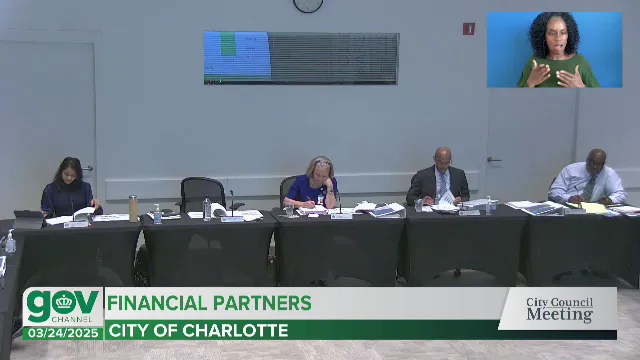
STREAMING COPY IN PREPARATION — RECORDING AVAILABLE FROM THE ORIGINAL SOURCE
Charlotte City Council FY2026 Budget Workshop - March 24, 2025
The Charlotte City Council held its second budget workshop for fiscal year 2026 development on March 24, 2025. The workshop covered three major topics: the Financial Partners Program, Solid Waste Services, and the Capital Investment Plan. Council members discussed funding constraints, program effectiveness, and future priorities. No formal votes were taken during the workshop; the meeting concluded with a closed session regarding economic development incentives.
Discussion Items
Financial Partners Program
- Staff presented the FY2026 application cycle: 50 organizations applied (a 177% increase over FY2024), requesting a total of over $8.6 million – the largest request in program history. Current available discretionary funding is approximately $1.5 million.
- A new scoring system was introduced using a cross-departmental team of 19 staff members, with each application scored by six people on a 65‑point scale. Criteria included submission completeness, performance and equity measures, and alignment with council’s strategic priorities.
- Council members expressed varied views: some emphasized the need for objective, data‑driven selection; others warned against penalizing smaller or newer organizations. Mayor Vi Lyles suggested refocusing the program on investments that lead to sustainability or integration into the city’s formal budget.
- Councilmember Mayfield raised concerns about organizations requesting more than the 30% cap of their budget and about duplication of services. Councilmember Driggs called for a more objective value‑added assessment.
- City Manager Marcus Jones noted that the budget gap remains in the single‑digit millions and that property taxes will not be increased. He stressed that city programs and partner funding would face cuts based on outcomes.
- Next Step: The Budget, Governance, and Intergovernmental Relations (BGIR) Committee will refine selection criteria and bring recommendations in April, prior to the May 5 budget proposal.
Solid Waste Services
- Residential solid waste services (garbage, yard waste, recycling, bulky items) cost about $86 million annually. Fees cover only 46% of that cost – a low recovery rate compared to peer cities. The city is analyzing splitting fees by service type (curbside roll‑out vs. dumpster).
- Staff highlighted ongoing initiatives: transition to paper yard‑waste bags (improving worker safety), a pilot for yard‑waste carts, and the need for a solid waste transfer station (land not yet acquired). The interlocal agreement with Mecklenburg County expires in 2028, requiring negotiation on tipping fees and facility responsibilities.
- Council discussion focused on the equity of fee increases, particularly for residents already facing property tax increases from revaluation. Councilmember Mayfield asked about higher fees for multifamily and small businesses (currently $250/year, unchanged for years) versus residents. Councilmember Driggs supported moving toward higher cost recovery to avoid cuts elsewhere.
- Councilmember Watlington praised worker safety improvements and asked for data on potential fee impacts. Councilmember Anderson advocated for services for aging residents.
Capital Investment Plan (CIP)
- Staff reported that 152 active capital projects are underway: 138 on target, 13 at risk, and 1 over budget. In the past year, 17 projects were completed and 20 new ones started.
- The COPs (Certificates of Participation) capacity remains at about $26 million per year, totaling $130 million over the five‑year plan. FY2026 is not a bond year.
- Advanced planning projects include: an animal care and control satellite facility (earmarked $30 million, currently in design, expected completion Q2 2028) and a CMPD helicopter hangar. The Northwest Division police station (last of six) is at risk but is expected to access previously approved funding.
- Councilmember Driggs requested a macro‑level quantification of at‑risk and over‑budget projects to assess overall stability. Councilmember Ashmira questioned the value of advanced planning given continued risk, but City Manager Jones and Councilmember Mitchell defended the process, noting it has reduced large cost overruns by basing budgets on 30% design.
- Councilmember Mayfield raised concerns about the animal control facility focus on adoption versus the need for more shelter space, and about investment in the fire training facility (simulator heat issues, water tower leaks). Councilmember Anderson echoed the need for improved fire training facilities.
- Councilmember Mitchell commended staff for completing 17 projects while adding 20 new ones, with only one over budget – a strong performance in a challenging construction market.
Key Outcomes
- Financial Partners: The BGIR Committee will develop refined prioritization criteria and report back in April before the May 5 budget proposal. Council intends to avoid last‑minute “add‑and‑delete” decisions.
- Solid Waste: Staff will return with more detailed fee impact analyses and a timeline for potential rate adjustments, including separate rates for roll‑out vs. dumpster service and an increased small‑business fee.
- Capital Planning: Council directed staff to provide a consolidated summary of at‑risk and over‑budget project totals. Discussion on the fire training facility and animal control design scope will continue.
- Closed Session: After the workshop, council moved into closed session to discuss economic development incentives as authorized by N.C.G.S. § 143‑318.11(a)(4).
Meeting Transcript
Thing called Cats Connect. And that is again one of our programs that we have to be able to reach out to people, get them into the services that they need for food, for shelter, for jobs. That I know that has helped a lot of people. We go out to a lot of our homeless camps and we give them a pamphlet pamphlets on how to get these things done. And I know a lot of them have actually utilized that system. And that is one thing that I do know that we do that we started here at Cats and it's been working very well. Hello everyone. Today we will cover some simple practices that will help you better manage your fat soils in grease. Or as we like to call it, fog. These practices are called best management practices or BMPs. Whoa there. What's wrong? The skillet needs to be clean. It'll cool down and solidify. Really? I never thought about that. Yeah. What you want to do instead is take a paper towel, wipe it clean, throw away that paper towel, or put your grease in a disposable container, and then throw that away. Huh. Okay. But what about the oil and grease from the deep fryers? Well, that should be going to your facilities rendering tank, which is also your facility's responsibility to upkeep. This includes closing the lid, keeping the bar screen clear, keeping it below the fill line, and keeping the rendering tank area clean. This can include sand or kitty litter. Once absorbed, the absorbent needs to be swept up and thrown away. Okay, Mr. Inspector. But what if there's an oil spill inside of the kitchen? Well, if it's on a floor mat, you want to wash it off in your utility sink or your mop sink. Do not wash it off outside. If it's washed off outside, it'll make its way to a storm drain. And all storm drains lead to our creeks, our rivers, our lakes, all of our surface waters. What you want to do with the actual spill location is put down some absorbent. That sand or kitty litter, let it absorb that oil, sweep it up, throw it away. Wow, I really learned a lot today. Practicing BNPs can really keep my environment clean and also my establishment. Thank you. It's a team effort. To learn more, visit our BMP page at CharlotteWater.org. Graduating training was excited to have for me. And then I knew I made it. A good relationship with my passion is number one. And if they know I'm there, they know that I'm gonna look out. Habs are often green in appearance and look like pea soup or spilled green paint and can give off a swampy odor. Habs can produce toxins that are linked to severe illness in humans and animals. If you see conditions similar to this on a lake or a pond, avoid contact. Make sure to report potential blooms to the correct agency. These are all potential signs of a pollution source. If you come across water that may contain pollution, stay out. Call 311 or use the CLT Plus app to report it.
openpublica.com