Duluth City Council Meeting - September 18, 2025: Levy Discussions and DTA Budget
STREAMING COPY IN PREPARATION — RECORDING AVAILABLE FROM THE ORIGINAL SOURCE
Duluth City Council Meeting - September 18, 2025
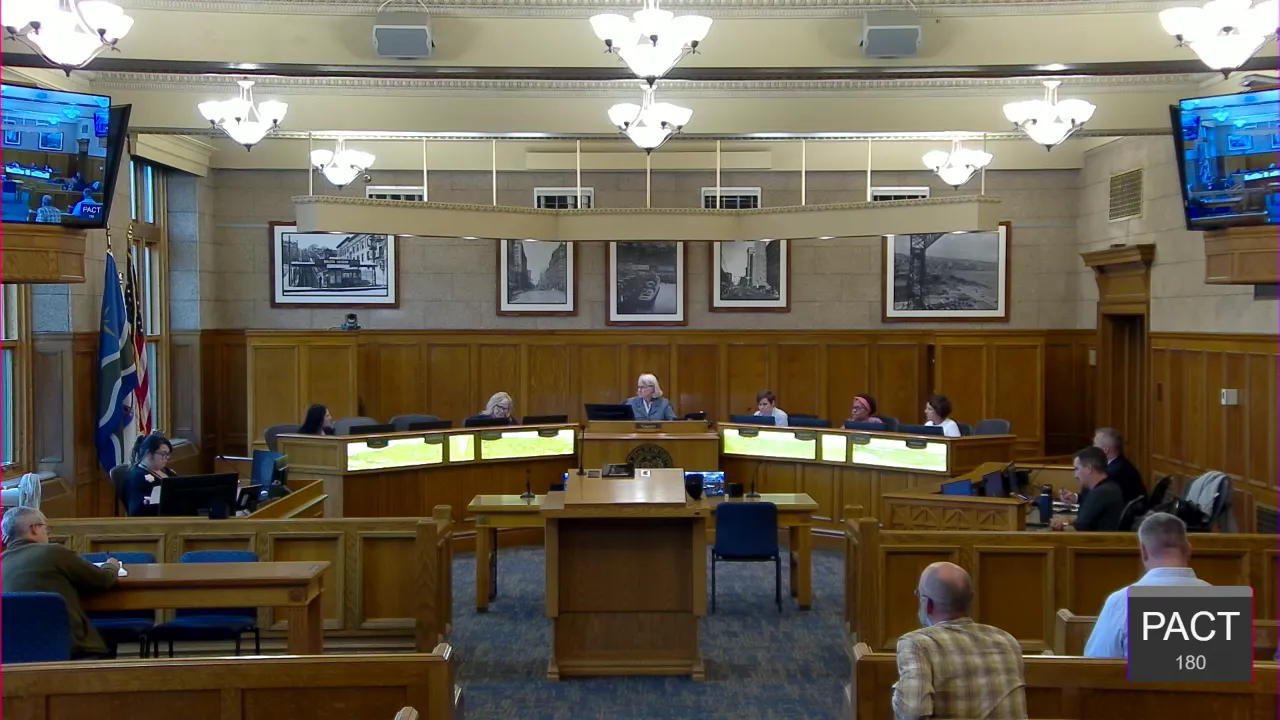
The Duluth City Council met on September 18, 2025, at 5:15 PM to discuss several agenda items, including the proposed maximum tax levy for 2026, the Duluth Transit Authority (DTA) budget, and various resolutions. The council considered a 4.13% maximum levy increase, with debate over providing additional flexibility. The DTA General Manager presented potential service cuts if the requested 42.9% levy increase were reduced to around 21-25%.
Consent Calendar
- Resolutions 697, 698, 700, 702 (Items 2-5): Proposed sums to be raised by taxation for general purposes, special parks fund, HRA, and DTA for 2026. These were discussed and later moved to the consent agenda.
- Resolutions 716 and 721 (Items 6-7): Authorizing issuance of tourism tax revenue bonds (up to $4,570,000) and acceptance of a $510,000 grant for the Lake Superior Zoo.
- Resolutions 707, 718, 719 (Items 8-10): Purchasing and licensing – network data backup software ($278,440.20), premise permits for Glen Avon hockey club and Duluth Curling Club, and various liquor licenses.
- Resolutions 726, 728, 732, 743 (Items 11-14): Personnel – amendments to civil service classifications (water system maintenance, graduate engineer, data practices compliance specialist) and appointment of Tim Meyer to the Parks and Recreation Commission.
- Resolution 725 (Item 15): Software subscriber agreement with St. Louis County for property records access ($125 per month per license).
- Resolutions 714R, 715R, 724R, 731, 733-738 (Items 16-25): Public works – contracts for Garfield Avenue repairs, Lakewood Filter Rehabilitation, easements for Lincoln Park neighborhood, and a cooperative agreement for road striping.
- Resolution 713 (Item 26): Public safety – acceptance of $52,724 grant for forensic laboratory equipment.
- Resolutions 699, 723, 727, 730 (Items 27-30): Recreation/libraries – stage repairs at Leif Ericsson Park ($298,000), grant for Hawk Ridge Nature Reserve ($155,000), tree planting grant application ($385,000), and design services for Priley Circle Restoration ($355,135).
- Ordinances 23 and 24 (Items 31-32): Authorizing issuance of lakewalk restoration bonds ($1,245,000 and $1,840,000).
- Ordinance 25 (Item 33): Amending cannabis retail business registration requirements.
Public Comments & Testimony
- No public comments were noted in the transcript.
Discussion Items
- DTA Levy and Service Cuts (Items 2-5): General Manager Chris Beldon responded to Councilor Randorf's question about managing a 21-25% levy increase instead of the requested 42.9%. Beldon outlined potential cuts: first, the warming center program (shuttle cost ~$50,000 annually, plus lost fare revenue ~$11,000); second, the Canal Park tourist trolley (Port Town Trolley, saving ~$250,000, though new trolleys would need to be disposed of with proceeds likely returned to the federal government); and third, neighborhood routes such as Route 113 (Park Point and Canal Park), Route 112 (Woodland, Kenwood, Duluth Heights, Miller Hill Mall), and Route 109 (Spirit Valley, Bayview Heights). Beldon noted that Park Point route costs ~$570,000 annually and is the lowest performing, with no alternative public transport. He emphasized that any route reductions would require community engagement and board approval. Councilor Randorf noted that a 21.5% increase would be $498,000 instead of $996,000, making it possible to avoid cutting a route if the warming center and trolley savings were applied. Councilor Owell inquired about the trolley's usage and seasonal use; Beldon confirmed it is used for events like Homegrown and Grandma's Marathon. Councilor Howell asked about the Park Point route's ridership and the possibility of an on-demand service; Beldon said it was tried during the pandemic but cost more. Councilor Kennedy asked if cutting a route would require returning funds; Beldon said no for operating costs, but yes for capital assets like vehicles.
- Maximum Levy Discussion (Items 2-5 continued): Councilor Owell expressed concern about voting on the max levy (4.13%) without a full department budget breakdown, noting that previous years had low levies (1.5% last year, 2% the year prior, and a reduction from 9% to 6% three years ago). She suggested raising the levy by 1-2% to provide wiggle room for potential needs, such as funding for boards and commissions (African Heritage, Indigenous, NQ, and Disability Commissions) that lack budgets. She also worried about dipping into the affordable housing trust fund or CIT funds. Councilor Randorf supported the 4.13% max levy, trusting the mayor's plan and noting that the council can adjust in December; he emphasized avoiding taxpayer burden. Councilor Nephew agreed, citing rising property values and the need to avoid taxing residents out of their homes, and suggested exploring public-private partnerships for parks. The council did not vote on the levy at this meeting; the decision is scheduled for Monday.
- Personnel Items (Items 11-14): Councilor Owell clarified that most items were updating existing job classifications, except for the new graduate engineer position, which is designed to attract engineers directly out of college. Administration confirmed there is no hiring freeze but a thoughtful review of vacancies. Councilor Owell asked about the sustainability officer position; Mr. Staling said Dr. Shauna Weaver is serving as interim director, and a budget retreat on October 31 will discuss the long-term vision.
- Public Works Items (Items 16-25): Councilor Owell noted the West Superior Street reconstruction project, which includes ADA-compliant sidewalks, multi-use trails, improved lighting, and green spaces. Mr. Staling confirmed that the work will also improve transit and parking, and that the council will see 24 total easement actions for this project.
- Public Safety (Item 26): Chief Sanoa explained that the forensic science grant will fund a 3D scanner for mapping crime scenes and vehicle crashes, reducing mapping time from hours to minutes.
- Recreation/Authorities (Items 27-30): Councilor Randorf asked about the Priley Circle Restoration Project (Item 30). Mr. Birkland confirmed it is funded through the CIP, with design in 2025 and implementation later; the city is paying one-third of the $355,135 design cost, with the federal GSA and county sharing the rest.
- Cannabis Ordinance (Item 33): Councilor Randorf asked about buffer distances for cannabis businesses near schools. Deputy City Attorney Enslin said he would provide the answer by Monday, including whether the city's ordinance matches the county's 1,000-foot school buffer and 500-foot buffer for daycares, residential treatment facilities, and parks with minors' attractions.
Key Outcomes
- No final votes taken on the levy. The council will consider amendments and vote on Monday, September 22, 2025. Councilor Randorf indicated that amendments should be submitted to the city attorney.
- All consent agenda items (resolutions and ordinances) were approved unanimously without separate roll call votes, as no questions or objections were raised.
- The budget retreat is scheduled for October 31, 2025.
- The city attorney will provide a written response on cannabis buffer distances by the next meeting.
- Councilor DeLuca noted an exhibit error in resolution 735, where a duplicate easement from the King trusts was mistakenly included; this will be corrected.
Meeting Transcript
Can you just assign somebody that you can go to good evening? It's 5 15 and we will begin with uh Counselor Forzman from Finance is not here. Councillor Randorf, would you read in, please? I sure can. Thank you. Senator Tomonic. We're on item two, resolution 697 is a resolution proposing the sum to be raised by taxation for general purposes for the year 2026. Resolution 698 is a resolution proposing the sum to be raised by taxation for the special parks fund levy for the year 2026. Resolution 700 is a resolution proposing the sum to be raised by taxation for the special taxing district housing and redevelopment authority for the year 2026. And resolution 702 is a resolution proposing the sum to be raised by taxation for the special taxing district, Duluth Transit Authority for the year 2026. Thank you, Councillor Randor. Are there any questions on items two through five? Yes. Councillor Randor. Thank you so much, President Tamonic. I see we have General Manager Chris Blendon here from the Duluth Transit Authority. A couple questions if uh you'd like to uh approach the lectern. Welcome. Good evening. And thank you again so much for meeting with us this afternoon, Councillor Forsman, uh nephew Swenson and myself to do a deep dive in your capital and your proposed budget. Um my question for you tonight is given our discussion this afternoon and your ask of a 42 point nine percent increase. Um tell us a little bit about how you would manage next year if that increase was more around the 21 to 25 percent increase. Yeah, so um uh a little background on that steep increase. The last two years, Minnesota Department of Transportation had a additional uh subsidy where our local match percentage went from a typical 20 percent all the way down to five percent. A few years ago we had been asking for a significant levy increase. The subsequent two years we saw that huge subsidy from the state, so we didn't need that big increase, and now that subsidy is gone, so we're we're back again. Um if that percent increase um would drop down to was that 25 percent? Is that yeah, we'll use a hypothetical 21 and a half or 22 percent. Yeah, I'd have to calculate what the dollar amount of that would be and then work backwards from our budget on what we could address to close the gap. Um where we would start would have to be with uh service cuts or programs we might have with different organizations where we subsidize uh rides or offer special service. So um under that scenario at the top of that list would likely be the warming center program and calculating what the shuttle. So there's two pieces to that. In the evening, we uh we provide rides across the whole network for free. There's no cost. Excuse me. The um passenger will board and tell the driver they're going to the warming center, and the the driver will record the ride and they'll sit down and we bring them to the warming center. The following morning we have uh a dedicated shuttle that operates for two hours in the morning. We it it does three or four loops because there's so many people waiting for a bus that it makes several rounds. And it starts at the warming center, drops off at the Damiano, uh Union Gospel Mission in the transit center, and does it again three times until everyone's uh where they need to be. Um the cost for the shuttles that we added in. That would be an annual cost, somewhere around $50,000. That would be a straight local levy reduction of $50,000. Um we do have lost fare revenue potential, and we calculate at the maximum that would be maybe around 11,000. That's if every passenger were to pay an average fare. Um it's very unlikely that we would still have that ridership. Only a small fraction would continue to ride unless some other organization picked up the cost of those fares. In addition to that, because 50,000 isn't isn't a whole lot. So likely after that would be the canal park tourist trolley, the Port Town Trolley. It's a seasonal summer service, and that would save us somewhere around a quarter of a million. One issue with that is we did buy new trolleys just a few years ago.
openpublica.com