Duluth City Council Meeting - January 26, 2026
STREAMING COPY IN PREPARATION — RECORDING AVAILABLE FROM THE ORIGINAL SOURCE
Duluth City Council Meeting - January 26, 2026
The Duluth City Council convened on Monday, January 26, 2026, at 6:00 PM in the Council Chambers. The meeting was dominated by public testimony regarding federal immigration enforcement actions, with over 25 speakers calling for city ordinances to limit collaboration with ICE. The council also adopted a large consent agenda (with one item pulled and tabled), received a presentation on HUD funding from the Community Development Committee, and heard administrative remarks.
Consent Calendar
- Minutes Approved: Meeting minutes from January 12, 2026 (item 26-003) were approved unanimously.
- Consent Resolutions Adopted (unanimous): The following items were adopted as a block, with the exception of item 26-0061R (see below):
- 26-0070R: Settlement with Cave Enterprises Operations, LLC ($20,000 payment to city).
- 26-0030R: Annual renewal of Granicus contract for software/managed services.
- 26-0048R: Temporary on-sale liquor licenses for Clyde Iron Works and Downtown Duluth.
- 26-0050R: Lawful gambling application for Portman Recreation Association.
- 26-0063R: New civil service classification of Digital Forensic Analyst.
- 26-0066R: Amendments to Utility Accounts Receivable Specialist classification.
- 26-0074R: Appointment of James Hansen to the Natural Resources Commission.
- 26-0028R: Amending 2026 fee schedule for shoreline permits.
- 26-0034R & 26-0035R: Amended and restated lease agreements for Medical District Parking Ramp with Lakeview at 333 Superior Parking, LLC.
- 26-0040R: Approval of DEDA resolution for Duluth Production Incentive Program and agreement with Upper Midwest Film Office.
- 26-0045R, 26-0053R, 26-0054R, 26-0055R: 2026 Annual Action Plan and requests for HUD CDBG, HOME, and ESG funds.
- 26-0059R: Application to EPA for Community-Wide Assessment Grant (up to $500,000).
- 26-0064R: Acceptance of $225,000 Local Housing Trust Fund grant from Minnesota Housing Finance Agency.
- 26-0068R: Amendment to Erie Pier disposal facility cooperation agreement with Army and Port Authority.
- 26-0008R: Temporary construction easement from Park Properties LLC (no cost to city).
- 26-0010R: Engineering agreement with LHB, Inc. for DTA bus stop improvement project ($94,628).
- 26-0026R: Purchase of brochures, gas survey, and Head of the Lakes membership from Giant Voices, Inc. ($53,760.58 annually).
- 26-0032R: Establishing a "No Parking" zone on 24th Avenue West.
- 26-0033R: Purchase of gas meter ERT transmitters from United Systems and Software (up to $370,000).
- 26-0039R: Amendment to LHB lead service line replacement contract (increase of $204,141; new total $2,257,831).
- 26-0041R: Agreement with Bolton & Menk for BMP Inspection and Modernization Project ($66,499).
- 26-0052R: Amendment to mailing services contract with Business Communication Solutions ($212,000).
- 26-0056R: Change order for DECC hot water pipe replacement ($35,336; new total $355,001).
- 26-0057R: Purchase of T880 Vactor Hydro Excavator truck from MacQueen Equipment ($596,635.48).
- 26-0060R: Application to MnDOT for Transportation Alternatives funding for Cross City Trail Segment 6.
- 26-0058R: Purchase of eight 2026 Ford Hybrid Police Interceptors from Tenvoorde Ford ($375,156.52).
- 26-0042R: Amendment to Spirit Mountain Black Downhill Jump Line trail contract ($110,279.71 increase; new total $303,038.71).
- 26-0046R: First amendment to development agreement with Chester Bowl Improvement Club for Thom Storm Chalet reconstruction.
- 26-0047R: Acceptance of $200,000 DNR grant for ATV route study in far western Duluth.
- 26-0049R: Amendment to Spirit Mountain bike trail contract ($66,640 increase; new total $480,472.25).
- 26-0051R: Amendment to Enger Park Golf Course renovation engineering contract ($10,161.09 increase; new total $126,991.09).
- 26-0062R: Authorization for Duluth Airport Authority to accept federal/state grants for 2026.
- 26-0067R: Contract with VSI Construction for City Hall restroom remodel Phase I ($255,278.49).
- Item Pulled and Tabled: Resolution 26-0061R (authorizing city administrator to accept gifts ≤$10,000) was pulled from the consent agenda. After debate on a proposed amendment to require public disclosure, Councilor Durrwachter moved to table the item, seconded by Vice President Kennedy. The motion passed unanimously, and the resolution was tabled for later consideration with additional information.
Public Comments & Testimony
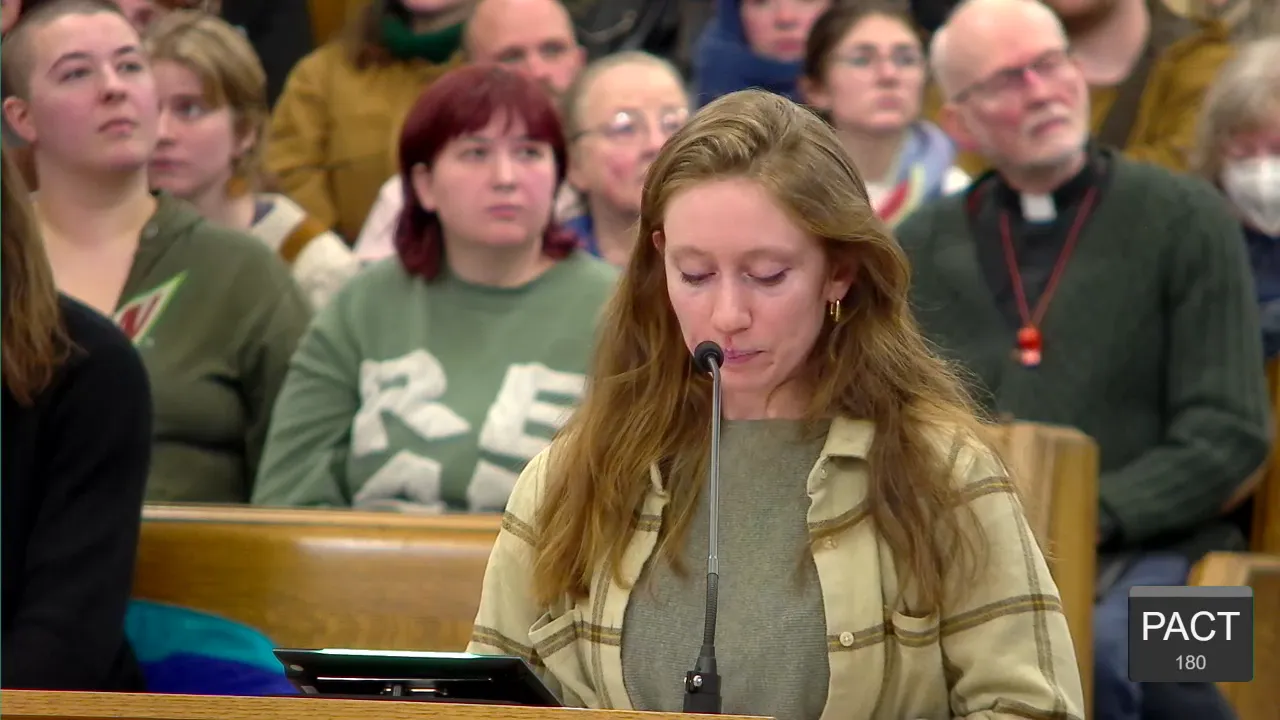
- ICE and Federal Enforcement (Majority of Speakers): Over 25 individuals spoke, expressing deep fear and anger over recent ICE operations in the Twin Cities, including the killings of Alex Predi and Renee Good. Speakers called for a series of city actions:
- Pass an ordinance of non-collaboration with ICE, CBP, and HSI, and ban sharing city facilities with Homeland Security.
- Codify the constitutional right to observe ICE activities without interference.
- Establish a city-led working group for policy recommendations and know-your-rights training.
- Pass an eviction moratorium.
- Ban ICE from staging on public property and entering non-public city spaces without a judicial warrant.
- Reverse contracts with Flock Safety and LexisNexis, citing surveillance and data-sharing concerns.
- Sign on to a petition opposing the Douglas County jail being used as an ICE detention center.
- Require DPD to protect individuals from kidnapping by ICE.
- Prohibit detainment by ICE within city limits without a warrant.
- Several speakers shared personal experiences, including being shot with a rubber bullet at a protest in Minneapolis (Taylor Krosbakken) and observing DPD cooperation with HSI (Aaron Rose). Many urged the council to act urgently.
- Washington Center (Jacob Bell): Mr. Bell, representing FFC program, requested careful consideration of the pending sale of the Washington Center property. He emphasized its importance to Black and Native families and expressed interest in a collaborative solution to preserve affordability. He asked the council to visit the center and understand its community role.
- Cross City Trail (Bruce Fehringer): Speaking on behalf of Friends of Western Duluth Parks and Trails, Mr. Fehringer expressed strong support for resolution 26-0060R (application for Transportation Alternatives funding for Cross City Trail Segment 6). He noted the decades-long effort to close the trail gap from Munger Trail to Canal Park, highlighting safety and economic benefits.
Discussion Items
- HUD Funding Presentation (Committee of the Whole): City planner Suzanne Kelly and Community Development Committee members presented the 2026 annual action plan for CDBG, HOME, and ESG funds. Key points:
- The committee reviewed over 500 pages of applications, recommending funding of approximately $3 million from an expected $3 million allocation (applications totaled nearly $6 million).
- CDBG: $623,000 for housing (creating 70 new units); $497,000 for public facilities; $352,000 for public services (at the 15% cap); $409,000 for economic development (job training, small business assistance, child care).
- HOME: $450,000 for rental assistance and affordable housing (49 total units).
- ESG: $207,000 to fund five allowable activities (street outreach, shelter, prevention, rapid rehousing, HMIS).
- A contingency plan allows staff to adjust funding up/down by 3% without new public hearing.
- Councilors questioned the impact of new HUD grant requirements (e.g., immigration status checks, ban on DEI). Staff responded that current processes already comply; they are monitoring the situation and working with commissions.
- Councilor Response to Public Testimony: Multiple councilors addressed the public outcry:
- Councilor Johnson announced she has been drafting language for a city council action regarding federal immigration enforcement, to be presented in coming weeks.
- Councilor Clanaugh emphasized the need to uphold constitutional law and work together.
- Councilor Durrwachter vowed to pursue all items in the list of demands and to work with local organizations.
- Councilor Desotelle acknowledged the fear and noted ongoing discussions with police and other cities to craft enforceable ordinances.
- CAO Stalin proposed a collaborative community-police engagement series similar to a St. Cloud model, involving the Citizens Review Board, Human Rights Commission, and faith groups.
- Administration Remarks: CAO Stalin expressed condolences for the recent killings and proposed building trust through facilitated dialogues. He stressed that some public demands are not immediately feasible but committed to addressing public safety concerns earnestly.
Key Outcomes
- Consent Agenda Adopted (unanimous): 37 resolutions passed as a block; one resolution (26-0061R) was pulled and tabled.
- Resolution 26-0061R Tabled (unanimous): The resolution authorizing acceptance of gifts ≤$10,000 was tabled to allow further discussion on transparency requirements.
- HUD Funding Resolutions Adopted: All five resolutions (26-0045R, 26-0053R, 26-0054R, 26-0055R, 26-0059R) were adopted unanimously as part of the consent calendar.
- Commitment to Future Action: Multiple councilors pledged to bring forward ordinances and resolutions addressing ICE collaboration, surveillance contracts, and community protections. Councilor Johnson will introduce a specific legislative proposal in the coming weeks. The council also signaled support for engaging with community groups and the Human Rights Commission.
- Adjournment: The meeting adjourned after councilor comments.
Meeting Transcript
Counselors, we'll start our committee the whole in thirty seconds here. So that's five thirty on my clock. Um good evening. Um Mr. Van Tassel and Company, will you be coming forward for the committee of the whole? We'll get started if you're ready. Oh remind me of your name, please. Um remind Uncle or Nephew, um excuse me. Counselor Kennedy, President Nephew, and all the other city counselors. My name is Suzanne Kelly, and I'm a planner of the planning department, and I am here with um uh director of planner Hannah Fagans, along with the community development committee members are Chair Steve Wick, Annie Schwartz, Will Wilson, and Shannon Lang. And each one will give a presentation, um, a brief presentation on these recommendations. Um first, we are very grateful to be here. Um, and also very grateful for all the work this committee has been doing. This committee has been reviewing over five hundred pages of applications and seeing what best needs the community needs for twenty twenty-six. Um they have reviewing it based on our consolidated plan needs that was described with public hearings and um a previous year's that we'll talk about and also what are currently needed. Um last year with these funds, they were able to provide um the community developed block grant funds, the home funds, and these G funds were able to provide um over two hundred units of affordable housing, provide job training to over four hundred people, assist six low income businesses, provide eighteen thousand meals, provide child care to ninety-one families, and provide shelter or housing services to over two thousand people who are either homeless or at risk of becoming homeless. The committee has worked hard this year, as I said, reviewing and scoring applications and um to make sure we best meet the best needs for twenty twenty-six. And with that, I will introduce Chair Steve Wick. Thank you, Suzanne. Good evening, counselors. So my name is Steve Wick, and as chair of the community development committee, I want to thank you for giving the committee this time tonight to present our work over the past year and our recommendations for funding. Before we begin, I want to provide some context to our process. So HUD requires public participation, especially outreach to low-income populations when determining the funding priorities. We accomplish this through community meetings, surveys, public hearings, and agency questionnaires among other opportunities. A five-year consolidated plan was adopted last year after a lengthy public input process. The previous consolidated plan represented 2019 through 2024, and the current consolidated plan covers 2025 through 2029. The consolidated plan, for those of you who are not familiar with it, is a very prescriptive document, developed to HUD's requirements and is incredibly bureaucratic. If you do get a copy of it, reading the executive summary is a good place to start. Our current con plan funding goals are affordable housing, neighborhood revitalization, increasing incomes, public services, creating living wage jobs, homelessness services, health services, food access, child care access, and community development facilities. HUD also requires that the five-year consolidated plan be reviewed annually to examine what was accomplished during the previous years of the existing consolidated plan and determine the funding priorities for the next year. This is called an action plan. Tonight we'll be presenting the action plan. The funding priorities being recommended tonight are for this 2026 action plan. HUD requires that these funding priorities also have public input, which we gathered via again, community listening session sessions and input from current agencies that serve the community. This year, we also had some special emphasis on four areas. Providing additional innovation or enhancement to downtown, and establishing collaborative partnerships and co-location of services. So multiple of these additional goals are seen throughout the proposals that we have recommended for funding. As a note, this year the committee received almost six million dollars in application requests, and we expect to receive just over three million dollars in funding from HUD. Should there be a variance in the expected award, uh we are asking for the adoption of the contingency plan at the each of the uh funding uh proposals tonight that you have. Um put in long hours as volunteers to provide input on the application process. They've worked over information provided by city staff and community partners and reviewed the applications submitted by local organizations. The recommendations that we are presenting tonight came after months of effort, long hours of discussion, and with the full understanding that with limited funding, not every need would be met. So, to start off, uh we're gonna dig into the community development block grant funding recommendations. I'm going to uh review three of those and I'm gonna hand it off to some other community community members. So to start um with our housing um recommendation. Uh this one is receiving the most funds at $623,000. Um notice that the committee had uh made a pre-commitment of funds to the Union Gospel mission. Uh unfortunately they were unable to secure the low-income housing tax credit funds necessary to complete that portion of the project at this time. So the silver lining there was that actually freed up funding to uh be moved around to other community development block grant areas, um, including our public facilities. Or actually, what I should note also uh within the housing, there are 70 new units that will be created with the funds uh being recommended tonight.
openpublica.com