Duluth City Council Work Session - July 23, 2026
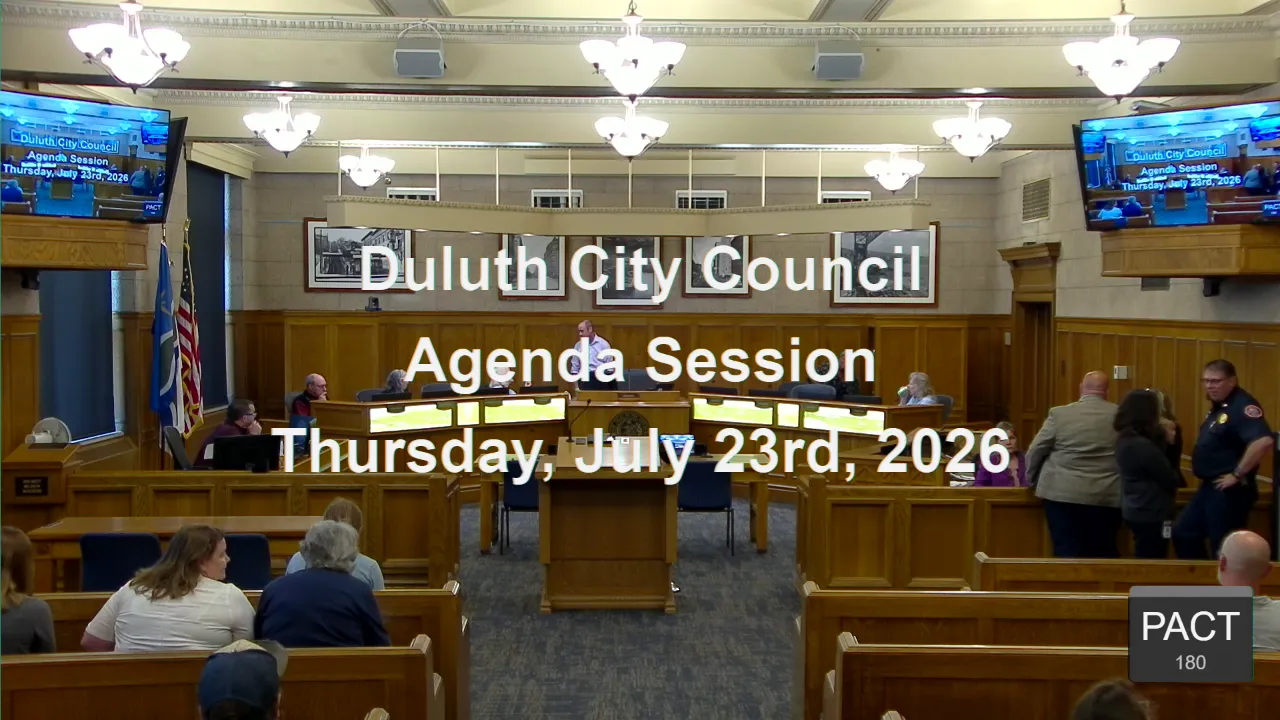
STREAMING COPY IN PREPARATION — RECORDING AVAILABLE FROM THE ORIGINAL SOURCE
Duluth City Council Work Session - July 23, 2026
The Duluth City Council held a work session on July 23, 2026, from 5:15 PM to 6:03 PM, to discuss and review several resolutions, ordinances, and reports. Key topics included a development agreement for the Armory Arts and Music Center with revised Tax Increment Financing (TIF) terms, the Lakewalk and Coastal Improvements Project, a franchise agreement with Minnesota Power, and various other items. No formal votes were taken during this session; instead, items were discussed for later approval or pulled from the consent agenda.
Discussion Items
- Resolution 647 – Armory Arts Center TIF Agreement: Manager Hobbes presented new accountability measures in TIF agreements, including a sliding scale linking public benefit reporting to TIF payments (50% for 0-8 jobs, 90% for 9-14 jobs, 100% for full compliance) and financial penalties for delayed construction (10% reduction for late start, 2.5% per month for late completion). The developer must create 14 jobs and pay property taxes in perpetuity. Councilor Randorf noted the public benefit requirements; Councilor Wactor confirmed it is a pay-as-you-go TIF. Councilor Kennedy asked about the two-year reporting period (state-mandated for business subsidy) and whether missed metrics allow recovery of withheld funds (only future payments can be restored, not past).
- Resolution 683 – Federal Reserve Focus Group Agreement: Councilor Klana expressed concern about politicization of the Federal Reserve and asked if the agreement can be canceled. Manager Hobbes explained the agreement allows flexibility; if no focus groups are scheduled, no reimbursement is needed, and the city can cancel upon request.
- Resolutions 665-667 – Lakewalk and Coastal Improvements Project: Director Birkland outlined a $10.2 million project funded primarily by federal RAISE and state grants, covering hard construction costs. Improvements include widening trails to 10-12 feet, relocating sections away from erosion, armoring shorelines, and improving accessibility (e.g., a bypass under Lake Barracks). Councilor Desitel noted a $3 million discrepancy between the low bid and next bidder; Birkland stated the project team assessed the bid as solid, with typical change orders expected. Councilor Tomanic asked about closure duration; Birkland said sections will close this season and likely next, but contractors aim to complete enough scope to reopen fully each season.
- Resolution 680 – Norton Park Grant: Councilor Durwalker asked about pursuing grants for other parks. Director Birkland confirmed that Parks and Recreation regularly seeks grant funding, citing the Hillside Sport Court as another example.
- Resolution 657 – Track Wheelchair Management Agreement: Councilor Tomanic asked about usage frequency and maintenance. Birkland explained the city owns the wheelchair, Hartley Nature Center manages use, and the city handles upkeep; he will provide usage data.
- Franchise Agreement with Minnesota Power (3-year term): Administrator Colhane announced the city shortened the typical 10-year franchise to 3 years to allow time for a new sustainability officer, Annika Peterson (starting August 10), to engage on sustainable goals and a revised fee structure. Current fee is 3%; discussions are underway for a potential increase and a two-tier structure with caps.
- Ordinances 26-27 – Permanent Outdoor Seating Permits: Councilor Tomanic asked about parking commission review and sidewalk space. Director Venture confirmed permits went through planning commission, do not extend into the street, and allow pedestrian access.
- Item 15 – Resolution 662 (Electrical Upgrades): This item was pulled from consent due to Councilor Forsman's employment with Minnesota Power (the contractor).
Consent Calendar
- Items 6-10 (Public Works): Road salt purchase (11,750 tons, $839,063), striping cooperative agreement with St. Louis County ($111,274), intersection improvements (city share $2,502,524.32), sanitary sewer intent, guard rail repair ($164,735.93). No questions raised.
- Item 11 (Public Safety): HIDTA grant acceptance ($90,250). No questions.
- Items 22-23 (Appointments): Lynn Williams to Spirit Mountain Authority, Scott Soderberg to Sanitary Sewer Board. No questions.
- Ordinance 25 (Park Property Dedication): Downer Park inclusion. No questions.
Key Outcomes
- The council discussed and advanced resolutions and ordinances for potential approval at a future meeting. No final votes were conducted.
- Item 15 (Resolution 662) was pulled from consent for further review due to a conflict of interest.
- The meeting then recessed to a special meeting.
Meeting Transcript
Good evening, everyone. We are going to get the agenda session started for tonight. It is 5 15. The first item on the agenda would be planning and economic development. Item number two, resolution 647. Resolution approving DITA resolution 26D-18 authorizing a development agreement between the Duluth Economic Development Authority and Historic Duluth Armory LLC for the redevelopment of the Armory Arts and Music Center and approving the development agreement. Item number three, resolution 673, resolution vacating a portion of a right-of-way along 18 and a half Avenue West between 4th Street and Fifth Street in the Platte of Myers rearrangement of blocks 106 and 105, 106, 127, 128, and 142 in the Duluth proper second division. Item number four, resolution 678. Resolution vacating a portion of a right-of-way along 26th Avenue West between West 10th Street and its alley in the plat of Spaulding's addition to Duluth. Line northwesterly of the northeasterly extension of the southeasterly line of said block 17, and line southeasterly of the northeasterly extension of the northwesterly line of said lot one, block 17. Item number five, resolution 683. Resolution authorizing the proper city officials to enter into agreement with the Federal Reserve Bank of Minneapolis to support the coordination of periodic focused groups. Thank you so much, uh President Nephew. I have a question uh regarding the resolution 647. Happy to see we've got some folks here from the historic armory as well. Um my question is uh we met about this at DITA yesterday, and we really got a chance to hear a lot about the public benefit, the jobs requirement, the increased uh property tax as a result of this project. So I'm wondering if we could um uh hear a little bit more about that so that the counselors um may uh may hear what the uh what the commissioners, the data commissioners heard. Are you hoping to hear from Manager Hobbes? All right, come on up. Welcome. Thank you, President Nephew, Counselors, thank you, Counselor Randorf. Um happy to speak to that in a little more detail. Also, as you said, folks from the Armory are here if you have specific questions on what the jobs are and what that might look like, um, great for them to be able to answer that. Uh but as Counselor Randorf described, with any TIFF that we proceed with, there is a public benefit requirement, um, which you'll see. I actually printed some things today. Uh the business subsidy agreement that gets attached is a great way to document what those public benefits are. And so those are also things that you'll see included within the development agreement itself. And because of this business subsidy agreement per state statute, uh, the developer is required to report regularly for a two-year period to ensure that they are meeting that public benefit requirement. And if it's okay, I'm gonna take the opportunity quick to talk about a new term that you'll see incorporated within these development agreements related to that item in particular. Um so you'll note in the council memo there are a few things that we point out as new terms that you will see in TIFF agreements moving forward that were a direct result of the work that we did just last year. It feels like much longer ago, but just last year, right related to the TIFF policy, um, really that centered around feedback that we heard from all of you, that we've heard from the community, and that we ourselves as staff have experienced. And so one of the terms related to the public benefit is creating a sliding scale for reporting that allows a little more accountability for those developers as they demonstrate how they're meeting public benefit. So, as you'll see in the agreement, um, if they're receiver or reporting anywhere from I believe it's zero to eight, they get 50% of their tax increment payment. If it's nine to fourteen, they get 90%. If they're completing their full public benefit, as they said, they get the full TIFF payment. And so this allows us a real tangible tool for accountability instead of that whole pulling the whole thing out, which gets very challenging and complicated both for us as well as for the developer. Um, if I can, I will also talk very quickly about another term that is very similar, and that relates to construction completion deadline. So we've all experienced a lot of uh amendments for agreements when projects are not on schedule and we don't and haven't had a great mechanism to enforce a little more accountability. And so what we're doing here is we're allowing some flexibility for the developer while also creating some accountability for us and for them. And so what you'll note is if the developer does not meet the date that they identified as their commencement of construction, they'll see a 10% reduction in their TIFF note. If they do not meet their project completion date, they will have a two and a half percent reduction per month until that's met. Our ultimate goal is that developers provide us with more realistic deadlines on when they think construction will commence and when they think they will complete it and allow us a little bit more of a carrot and a stick, if you will, to ensure that those things are met. And so the armory was a really wonderful partner in working through that with us. They ensured that this worked with their TIFF lender. Um, and again, this is things that came out of best practices that we see from communities across the state, uh, and at the advice of our our our TIFF advisor at Eller. So excited to see those things incorporated in there. So, Councilor Randor, to answer your question, um, there is that public benefit related to the 14 jobs. Um, of course, also the redevelopment of a historic property is incredibly important, and then finally the increase in property taxes. So, that is another new term that you'll see is the requirement of property taxes being paid in perpetuity. Uh, that we identified that as our primary purpose and goal with with uh TIFF is to see property tax increases, and so we wanted a mechanism in our agreements to be able to see that come to fruition.
openpublica.com