Joint City Council and Planning Commission Work Session on Housing and Planning - March 8, 2023
STREAMING COPY IN PREPARATION — RECORDING AVAILABLE FROM THE ORIGINAL SOURCE
Joint City Council and Planning Commission Work Session on Housing and Planning - March 8, 2023
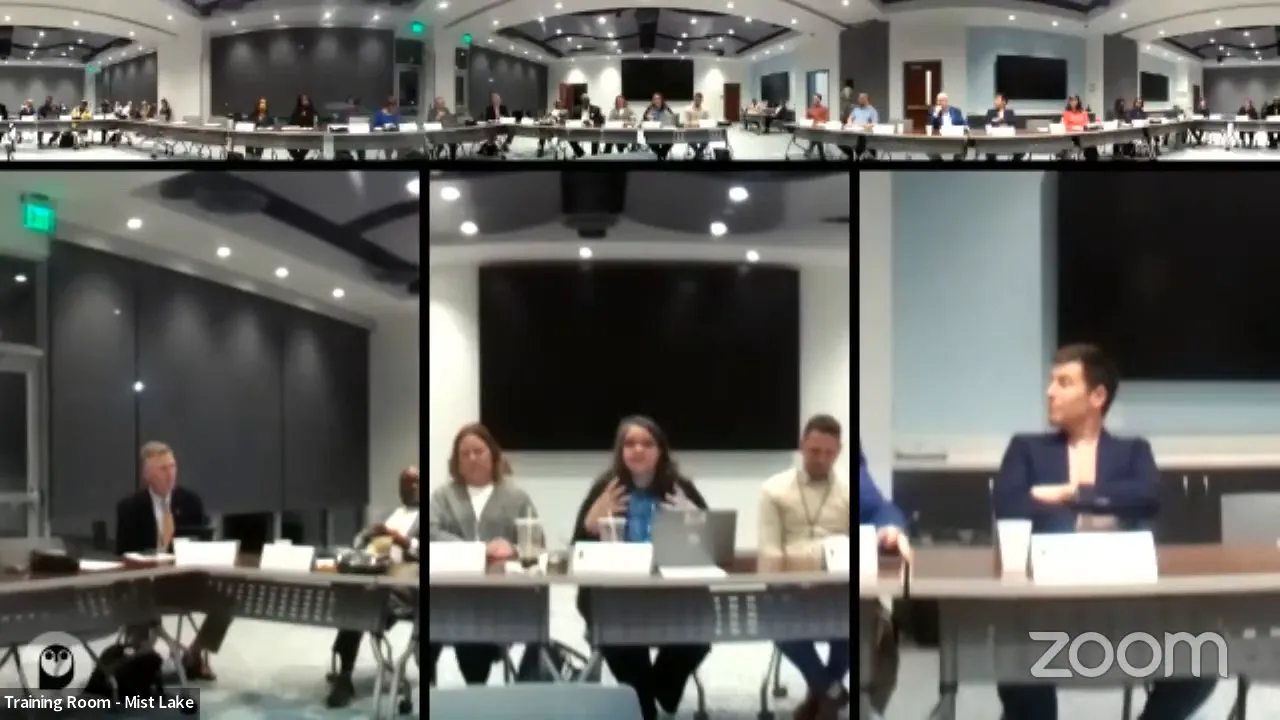
The Durham City Council and Planning Commission held a joint work session on March 8, 2023, from 5:15 PM, to discuss the planning process, affordable housing, supply and demand, and the working relationship between the two bodies. The meeting featured presentations from staff and open dialogue among members.
Discussion Items
-
Planning Process Overview: Planning Director Sara Young presented a refresh on the types of land use decisions (legislative, quasi-judicial, administrative) and the roles of the planning department, joint city-county planning committee, planning commission, and city council. Key points included the rezoning timeline, which has decreased from 15 months to under a year, though staff noted trade-offs with community engagement. Factors contributing to delays include applicant response times (up to 90 days), staffing levels, and case volume. Fees for development plans range from about $1,000 to $4,800 base fee plus acreage fees (e.g., $16–$70 per acre above 10 acres), with larger projects paying more. Staff acknowledged the need for a better tracking system and are investing in upgrading enterprise systems.
-
Affordable Housing Presentation: Reginald Johnson, Director of Community Development, presented the Home Drone affordable housing plan, funded by a $95 million bond (approved by 76% of voters) combined with $65 million in city funds for a total $160 million investment. Goals include creating 1,500 reserved rental units, 800 affordable homes, 400 homeownership opportunities, and supporting 3,000 low-income households, among others. Progress to date: 241 rental units created, 1,427 in the pipeline, and 178 homeless households served. Challenges include rising construction costs (e.g., lumber from $4 to $16, drywall from $24 to $56), capacity constraints among nonprofits, and the competitive nature of the 9% tax credit (only one per year). Staff emphasized the need for more funding and technical assistance for partners.
-
Supply and Demand & Economic Impact: Council members and planning commissioners debated the tension between market-rate development and affordable housing. Commissioners expressed concerns about large-scale projects (e.g., 100+ acres) that lack mixed-income options and affordable units. Council members noted that rejecting projects can push development to other areas, potentially exacerbating gentrification. The need for a new Unified Development Ordinance (UDO) was highlighted; the current UDO is outdated and not user-friendly. Staff plan to hire a consultant to rewrite the UDO, aligning with the new comprehensive plan. Legal constraints were discussed: City Attorney Don O'Toole cautioned against blanket policies like “no affordable units, no approval,” as it could be legally problematic; instead, council can ask questions and vote based on each case. The North Carolina legislature’s oversight was noted as a factor.
-
Working Relationship: Both bodies shared perspectives on their roles. Council members emphasized the importance of respecting the elected body’s decision-making authority, while planning commissioners highlighted their professional expertise. Several members expressed a desire for more frequent joint meetings (every 3–6 months) and better communication. Suggestions included pairing council members with planning commissioners for ongoing dialogue. No formal disagreements were aired, but some council members noted frustration with what they perceive as inconsistent advice from the commission.
Key Outcomes
- No formal votes or resolutions were taken. The meeting was a discussion and information-sharing session.
- Staff will continue efforts to reduce application processing times and improve transparency through system upgrades.
- The city will proceed with the UDO rewrite, with a consultant to be hired in the coming months.
- Council and commission members agreed to explore regular joint meetings and pairing arrangements to strengthen collaboration.
- Council members expressed support for continued funding for affordable housing, especially given rising costs.
- The city attorney’s office will provide legal guidance on any potential mandatory inclusionary zoning policies, noting that such policies may face legal challenges under current state law.
Meeting Transcript
Yeah, just like the last one. I am here. Council president, okay. I'm going to call the um planning commission. Austin and Andoya. Here Kim Cameron. Nate Baker. Here. Sarah Shagris. Gary Cutwright. Brandon Davis, Scott McGiber. David Morgan. Here. Anthony Case. Here. Brandon Track. Stephen Valentine. President. Carly Williams. Thank you so much. Very important that we need. She did not. All of them thank you for time on high and high. I haven't all of the folks have the same right. I'd like to thank you all who are here in Berkeley and a beautiful water management facility out here in terms of our end. And our public who are here to thank the office that they've seen it, but we have actually folks who are followed up here tonight, and we're glad to be a feature with us as well. And that does not go unnoticed. And we appreciate you not only and what you do as a planning commission, but agree to um meet with us as participation. And I will now like to prepare the meeting over to him. All right, well, good evening, everybody, and thank you, Mayor, for opening us up. Um a formal meeting because we are a meeting forum, but it is an opportunity for us to have uh a little less formal dialogue around the city housing and so uh we'll go get into that, but it's I think you know, due to the fact that we have so many folks that are chapping in. I think it's still it'll be uh appropriate for us kind of uh just quickly introduce who we are. Uh is that okay with you, Chairville? Uh so I'll just kick off real quick. This would be really quick. I'm council member Williams by Servant City Council, and go this way. And you all know who that is Mark Anthony Middleton, therefore, I'm the chair of the Durham. So David Morgan Planning Commission, only sees planning commission, Stephen Valentine, Planning Commission, A Baker, Planning Commission, Alexander Child Planning Department, Sarah Young Planning Department, Grace Smith Planning Department, Reginald Johnson, Community Development Department, Donald Tools City Attorney's Office, Wanda Page, Dorothy City Manager, I'm Michelle Wallace, City Manager's Office, Bertha Johnson, Deputy City Manager, Larissa Williamson, County Attorney's Office, and Ken Raver, City Attorney. Thank you all so much. So I'll say that tonight. The role that we played in the people's work. And as the public know that you know it's been quite dynamic in terms of the housing, and especially between these two bodies. So the idea is for us to have this dialogue without totally silence. But at least once again, we're able to uh come together. So we'll get an idea of how we are thinking of individual giving, you know, a point road or elective role and understand how our bodies can work together versus how we work in general. Yeah, I don't have uh much else to add on that. Um as we have a low charge to this game going, but I'm happy for our bodies to have a discussion and engage in more dialogue on the issues that are facing our city and county. Okay, so uh just the review exendative format. Um we'll get a we'll get a brief presentation from our staff, and then we'll open it up for discussion, uh perspective on that topic, and then we will uh have any questions uh or to provide it, and we'll leave to the next topic. So, first up is uh from our director of planning director drawing.
openpublica.com