Durham City and Chamber of Commerce Public Policy Discussion - January 24, 2025
STREAMING COPY IN PREPARATION — RECORDING AVAILABLE FROM THE ORIGINAL SOURCE
Durham City and Chamber of Commerce Public Policy Discussion - January 24, 2025
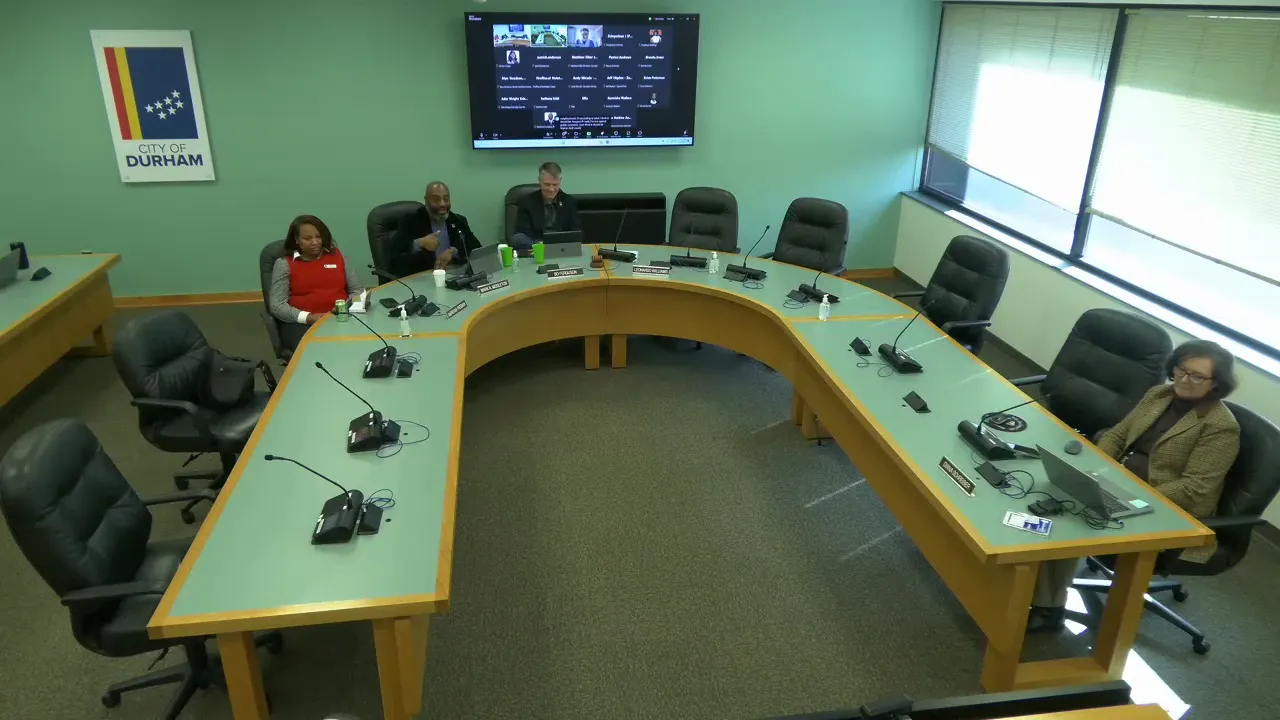
On Friday, January 24, 2025, from 10:00 AM to 11:00 AM, the City of Durham and the Durham Chamber of Commerce held a joint public policy discussion in the City Hall Committee Room (2nd Floor) with participants in person and online. The meeting featured introductions by city leaders and an open dialogue about economic development, housing, transportation, community engagement, and the city's budget process.
Introductions
- City Manager Bo Ferguson introduced himself; he has been city manager since January 1, 2025, and is in his 13th year as a city employee. He emphasized collaboration between the City of Durham and Durham County, noting that the two jurisdictions have only 12 elected officials combined, a small number compared to neighboring counties.
- The Mayor (name not stated in transcript) spoke about Durham's past economic renaissance and the need for proactive strategies to address homelessness, housing prices, and transportation. He proposed an "arts and innovation center" with convention capacity and additional hotel beds to generate revenue for social needs, and called on the private sector and philanthropy to partner with the city.
- Councilmember Freeman highlighted her eight years on the council and her focus on social equity and environmental justice. She stressed the importance of supporting local businesses, nonprofits, and schools, and acknowledged that the city's economic development arm has not been very strong.
- City Clerk Diana Schreiber described her office's role as the city's record keeper and historian, and encouraged residents to volunteer for boards and committees, noting that vacancies are posted on the city's website.
- The Chamber representative (moderator) provided context on the city's budget timeline, including budget retreats scheduled for February 14 and February 28, 2025, and the upcoming State of the City address on February 18, 2025.
Discussion Items
- The Chamber representative outlined the chamber's policy priority areas: economic development, workforce development, education, health, housing, community safety, sustainability, transportation, and planning. He noted that the chamber's recent focus has been on workforce development, education, community safety, and housing.
- Angeline Stallings (Durham Chamber of Commerce, online) asked how businesses can engage with the city and advocate for themselves. Mayor Pro Tem (name not stated in transcript) responded that business owners must be present where policy is made, and urged the business community to participate more actively in public meetings, noting that low turnout means a smaller group shapes the city's direction.
- Councilmember Freeman added that she has been active in the Small Business Credit Initiative and expressed disappointment that the city has not yet developed a post-COVID funding response to support local small businesses. She also mentioned the need for better technical support and capital access for small businesses.
- A council member (likely Mayor Pro Tem) emphasized the importance of reauthorizing the federal infrastructure law, noting that the five-year surface transportation package is set to expire and requires bipartisan support to continue funding roads, transit, and other infrastructure.
- Steve Baumgartner (Vice President at Services and Construction) asked whether the city's policy decisions prioritize short-term (2-year) or long-term (200-year) outcomes. He cited $857 per square foot in his neighborhood and questioned how the city will approach "smart development" and affordable housing while businesses struggle to hire at wage levels.
- Mayor Pro Tem responded that policy making often operates on two-year election cycles but has long-term implications, and criticized the phrase "smart development" as often meaning "not in my neighborhood." He urged the business community to bring their perspectives to public meetings.
- Councilmember Freeman discussed her consistency on social, economic, and environmental justice, stating that she supports about 63% of developments and aims to get decisions 60-75% right. She addressed climate resilience, development in wetlands and watersheds, and the need to plan for five generations forward.
Key Outcomes
- No formal votes were taken; the meeting was a discussion.
- The city's budget retreats are scheduled for February 14 and February 28, 2025, at the Miss Lake facility (open to the public).
- The State of the City address is announced for February 18, 2025, at the Carolina Theatre.
- The Chamber encouraged applications for upcoming board and commission vacancies, including the Planning Commission, Mayor's Council for Women, Affordable Housing Implementation Committee, Mayor's Hispanic Latino Committee, and Housing Appeals Board.
- Participants were directed to Engage Durham for information on the comprehensive plan and UDO rewrite.
Meeting Transcript
I'm happy to do which either is your preference. So what works for you? Okay. So does that online discussion? Great. Good morning, everyone. Really appreciate everybody's attendance in in person and online, and uh really honored uh to bring greetings from the administration of the of the city. Uh my name's Bo Ferguson. I've been the city manager since January 1st uh and employed by the city as a deputy city manager starting in 2013. So going into my uh uh thirteenth year, 13th year as a city employee. Um it is uh absolutely been uh an honor and a privilege that the city council gave me an opportunity to move into this role, and uh I've I've thoroughly enjoyed the 24 days uh uh uh of of being in that role. Um this is uh a phenomenal organization to be part of. It's a it's a really exciting uh time to be in Durham, and of course it's also a time when Durham is facing uh a lot of challenges, uh challenges that uh we as a body of employees um seek to to follow the guidance of our city council in trying to address and help our community address. Um I've spent uh my early days in this position uh trying to hear uh as much as I can from uh the elected officials from meeting with them individually as a group to understand their priorities as I transition into this role. It's also something I've uh spent a lot of time uh out in the community uh just meeting with people who uh want to uh share their thoughts on our priorities, want to share their opinions on what's working well and what could be improved. Uh and I certainly welcome anyone uh in the room listening to this to reach out to me and if uh we can go grab coffee or just hear you out on on things that are working for you and and things you'd like to see improved. Um people uh hopefully listening are pretty familiar with our form of government. Uh I don't set policy, I follow a policy that the city council sets. Uh we do our best to help inform them, bring them recommendations, uh, bring them analysis so that they can make decisions, but the the city council sets policies. So I've gotten the question once or twice as I move into this role what my priorities are, and my priorities are are their priorities. Um that said, I believe and have said uh pretty publicly and to a lot of our partners, so I don't mind repeating here. Um I do believe that we have a tremendous opportunity in Durham City and Durham County uh to collaborate in ways that other communities across North Carolina and the country don't uh we have uh twelve elected officials in uh that that run city and county government. Um that is a very small number compared to almost any other jurisdiction you might think of across the state when they put their city and county leaders in a room. If you just look at Wake County next door, uh you are into the hundreds when you want to get your city and county elected officials in the room. So um it is it is certainly a fantastic opportunity to have alignments uh in the city and county of Durham. I know that is a a uh uh strong ethic and value that the elected officials share, and certainly something that we as administrations, I think can can foster and lean into, and that that is certainly something I feel very strongly about. So spending as much time as I can with uh our colleagues across the street uh and finding out how we can collaborate on Durham's priorities is uh is a really important thing for me. Uh I think I'll leave it there as an introduction. I'll be happy to answer other questions, but I know you want to get to other folks, so thank you very much again for having me. Thank you, Mr. Beethoven for those online classes, good morning everyone. It's great to have you all here. Um it's probably my fault. Uh it's great to have everybody here, and um it's great to have this committee here. I'm a former member of this committee. Uh when I was uh serving on the board of the chamber and also have my chamber panel on today to poll. Um but yeah, I I uh don't really have a lot of comments other than I I do think that we're in a good little time to do uh some pretty groundbreaking things here in Durham. Um we I think we're uh we're on the cuff of just index phase. You know, uh there was a time where downtown drum was a bit dry, and during the Bill Bear era, Bill Bell, Bill Kelkoff, Tom uh Bonfield days. Um there were uh there was a a almost like a renaissance in a sense economically. And uh we we enjoyed the benefits of that for a while now, and I think that you know, as time has evolved, um I think it's time for us to do the same. You know, so how we um how we respond to this this moment in time is going to be kind of this uh it is up to us. And uh I believe it's far from a government side is gonna take us being a lot more proactive rather than reactive. Uh which means that we need to have strategies in how we approach some of our uh you know, uh some of the biggest issues that we face for our community from homelessness to housing prices to transportation. Uh so that's big big items. And I do think we ourselves a disciple when we say, all right, we have a health problem, that's such healthy. We have a homeless problem that's just homelessness, and we totally omit the the holistic approach to it. And so from the private sector to the public sector, I think that we we all need to, you know, have a strategy or strategies that we can that we can all buy into and work work in tandem with one another, and that's the way I see us, you know, in our uh in our moment in time for the next renaissance here at Durham. You know, we take that approach. We realize that we are you know ongoing uh on the path to generating uh attace and generating revenue that can really tackle a lot of the issues that we're that we are facing.
openpublica.com