City of Edmond City Council Budget Workshop for FY 2026-27 – April 20, 2026
STREAMING COPY IN PREPARATION — RECORDING AVAILABLE FROM THE ORIGINAL SOURCE
City of Edmond City Council Budget Workshop for FY 2026-27 – April 20, 2026
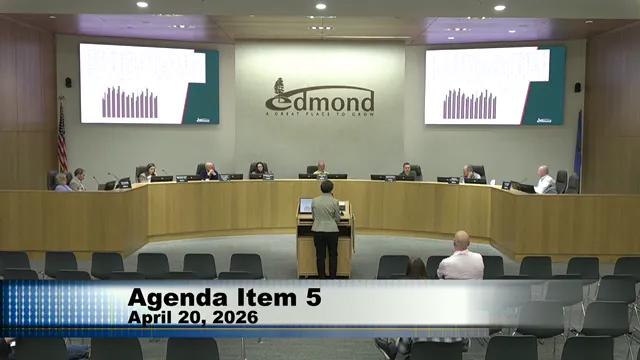
The Edmond City Council held a budget workshop on April 20, 2026, to review major components of the proposed fiscal year 2026-2027 budget, including water and wastewater rates, personnel costs, the city council budget, CityLink transit, and the fire department budget. No formal votes were taken; staff received direction to bring specific items back at future meetings.
Water and Wastewater Rates
- Staff recommended Option 1D, which would apply base-rate increases over two years with no volumetric rate increases for five years. Average residential customers (8,000 gallons water, 5,000 gallons wastewater) would see roughly 13–14% bill increases in the first year and about 12% in the second year, with smaller increases in later years.
- The city is pursuing water independence by 2030, which would eliminate a $1.2–1.3 million annual payment to Oklahoma City for reserved water capacity.
- Low-income rate assistance was discussed, including a potential $10.42 discount on base rates for customers already in an electric assistance program, plus $170,000/year in funding to the Hope Center for bill assistance.
- Council members expressed support for Option 1D as a balanced approach, while noting the need to revisit assumptions annually. Staff will bring formal rate documents to the May 11 council meeting.
Personnel Costs
- The proposed FY27 budget totals $120.055 million and increases city positions from 924 to 945 (a 3% increase). The city has 654 non-union civilian positions and 291 fire/police union positions; union contracts are in negotiation.
- Turnover is 5.95% (five-year average 7.05%); there are 32 vacant positions, providing $1.4 million in vacancy savings. Approved personnel actions totaled 27 (described in the presentation as 15 new positions and six reclassifications).
- Council members raised concerns about personnel growth outpacing revenue: an 11.6% increase in positions since 2023 and a 22% increase in personnel costs, against an expected general fund revenue increase of about 1%. The city manager responded that most new positions are funded by enterprise funds, not the general fund, and that vacancies will be managed strategically.
City Council Budget
- The proposed council budget is $430,393, a 14.1% decrease from FY26. Changes include a 3.9% personnel increase for one FTE, new cell phone and clinic costs, higher travel ($2,000 to $25,000) for participation in state and national organizations, a $65,000 increase for upcoming council elections, and a $192,000 reduction in contract services.
- Council discussed a travel/expense policy and splitting certain line items equally among the five council members; a policy will be considered at the April 27 meeting.
CityLink Transit Budget
- CityLink’s proposed FY27 budget is approximately $4.8 million. Funding sources include federal grants (~$1.1 million FTA 5307 and ~$1 million STBG-UZA) and a general fund transfer of $2 million.
- The system operates six fixed routes, one commuter route, and paratransit; paratransit is projected to hit 20,000 riders this year.
- Council members noted rising costs and estimated the city subsidy at about $16.45 per ride after external funding; some expressed concerns about long-term sustainability and the future of Route 7 expansion after initial grant funding ends.
Fire Department Budget
- The fire department is requesting a nearly $36 million budget, down about 8% from FY26. The department has ISO Class 1 rating, 157 firefighters, six stations, and responds to ~12,000 calls per year (65% EMS).
- Increases in materials/supplies are driven by replacing SCBA bottles and end-of-life radios; other services are up 6% for gear cleaning.
- Council members questioned long-term sustainability, noting the dedicated fire sales tax raises approximately $6 million per year toward a $40 million department. The city manager announced plans to transfer $5 million per year over two years from the fleet fund back to the fire fund, delaying new fire vehicle purchases.
Other Business
- The council acknowledged the departure of Parks Director Brad Rainey to Provo, Utah.
- Unfinished agenda items were added to the April 27 regular council meeting: maintenance building funding, citywide budget summary, timeline, and CIP advisory board recommendations.
Key Outcomes
- Council directed staff to prepare formal water/wastewater rate documents based on Option 1D for the May 11 meeting.
- Unfinished budget items will be discussed at the April 27 regular council meeting rather than a separate workshop.
- No binding votes or ordinances were approved during the workshop.
Meeting Transcript
I'd like to call the April 20th City Council meeting budget workshop to order. Item two on the agenda is presentation discussion consideration of water and wastewater rates, including presentation discussion of the water and wastewater rate study, discussion and consideration of setting water and wastewater rates for the purposes for the purposes of the fiscal year 2026-2027 budget and discussion and consideration of directing city staff to prepare necessary documents to formalize water and wastewater rates at a future regular meeting. Mr. Knifing. Thank you, Mayor and Council. Chris Neifing, Director of Water Resources. Sorry. I'll review it with you. And then also talk about the rate assistance and programs and what uh what we're doing for water conservation outreach, and then proposed next steps. So on the low-income rate assistance, uh, we're looking at discounts on rates for those that already qualify for an existing electric program to also be eligible on the water and wastewater side for rate assistance or a rate decrease on their base rate. Uh looking at tagging on to that program, we want to make sure we get the methodology right. Um we had looked at the ten dollar and forty-two cents, but we'll we'll make sure that we get that uh tightened up before we bring back a rate, I guess the final rate structure. And then bill assistance. Currently, we use utilize uh Hope Center. Um they help families in need. So our customer service division uh will refer them to Hope Center if they're having a one-time issue or you know, a couple months where they're on hard times. Um Edmund Electric and Water fund this at 170,000 per year. They're not utilizing all the funds right now. Uh, but we'll continue to work with them and make sure that they're adequately funded to help the people in need. And then also customer service refers not only to Hope Center but the 211 program so that you know other community nonprofits can help customers in need, so it's not just the city or the hope center, it it's churches, it's other nonprofits that can help with customers in need. Um so trying to utilize all resources to make sure that we can cover and and help those that are on hard times. So any questions on that okay. Just a little bit about our water conservation. Um I know you all have been to our uh water resources admin building at the wastewater plant or water resource recovery facility. Um we do a lot of tours out there with not only professional groups but young groups like Girl Scouts, um, even home school groups, just uh anybody that's interested in learning about their water and what happens, or even sometimes individuals that ask us where all the rate funds are going. We want to show them and highlight what is going on in the system. So gives us a chance to talk about all these things, whether it's conservation or their bills, you know, whatever we can do to help community outreach and talk about long-term planning for droughts and resilient water supplies, those kind of things. Um of the classes held are also on you know drought tolerant plants and irrigation best practices. Whatever we can do to help people understand how to save money on their bills so that you know if they move in and uh find out that you know water may be a little little more than the last community they lived in. How can they better control their bill? So any questions on that before I jump ahead. Okay. Okay, so we were asked to look at option one and then option one. We're calling this one D. Looking at the same as option one, but splitting it over a two-year two-year time frame. And this would just be on base rate charges, not on volumetric rates for the five-year period. So two years we would increase uh base charge only, and then no volumetric increases. The planned reserve fund drawdown essentially gets us to the same point. That's what that looks like. Okay, so what what that essentially gets us to is a four for an average user, 8,000 gallons of water and 5,000 gallons of wastewater. Uh 1495 increase to the base rate for a 5.8 meter, which is where most of our customers land. Uh and this says November. Um we'll talk about our request or recommendation for July. Um, and then 1497 in 27, and then no base rate increase in 28 or 29, and then no volumetric rates increases throughout that same period. So and then the um wastewater still the same under all scenarios. Questions on this? This is the whole Chris. Yes. So the only difference between option two and one D is uh in two there's a small amount of volumetric charge, and in one there's not one D. Yeah, option two has less base rate increase.
openpublica.com