Erie Planning Commission Workshop: Oil & Gas Regulations and UDC Amendments – October 7, 2020
STREAMING COPY IN PREPARATION — RECORDING AVAILABLE FROM THE ORIGINAL SOURCE
Erie Planning Commission Workshop: Oil & Gas Regulations and UDC Amendments – October 7, 2020
The Erie Planning Commission held a virtual workshop on Wednesday, October 7, 2020, from 6:31 PM to 10:05 PM. The meeting focused on two major agenda items: proposed revisions to Chapter 12 (Oil & Gas) of the Unified Development Code (UDC) and a broader set of UDC amendments covering Chapters 1, 2, 3, 5, 8, and 10. The meeting was a study session; a formal public hearing is scheduled for October 21, 2020.
Consent Calendar
- Approval of Agenda: Unanimously approved on a roll-call vote (5-0).
- Approval of Minutes: Unanimously approved the September 16, 2020 Planning Commission meeting minutes (5-0).
Discussion Items
-
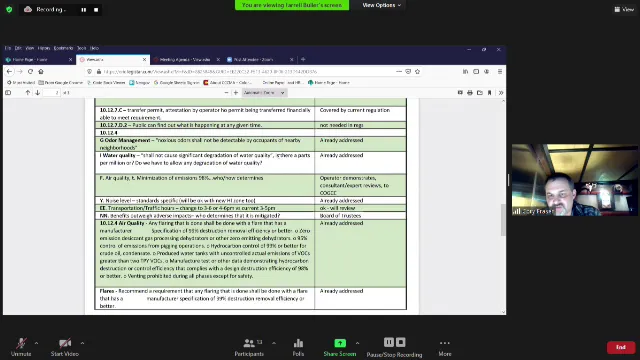
Draft UDC Amendment – Chapter 12 Oil & Gas: Deputy Town Administrator Farrell Buller and Special Counsel Barb Green (Sullivan Seavy Green) presented responses to written public comments received since the prior workshop. The discussion covered:
- Notification Radius: The draft requires applicant notification to property owners within one mile of a proposed new or modified oil and gas location. Commissioner Sawusch questioned the rationale for a one-mile notice when the state’s proposed setback is 2,000 feet and the current COGCC notice is 1,320 feet. Commissioner Witt supported the one-mile radius, citing citizen feedback about wanting to be informed of activity that could affect truck traffic, noise, and visual impacts. Commissioner Luthi argued that the one-mile notice is excessive without a rational basis given the actual impact radius. The discussion also touched on the distinction between notification and standing to comment; staff clarified that all town residents have standing to challenge a permit.
- Setback Distance: The proposed setback is 2,000 feet from residential and high-occupancy building units, consistent with the COGCC’s draft final rule based on the 2019 Human Health Risk Assessment. Commissioner Hoback noted that the study found definitive chronic health impacts at 500 feet and short-term impacts up to about 1,250 feet but did not rule out risks beyond that. Commissioner Sawusch inquired about waivers allowing a reduced setback if landowners or tenants give explicit informed consent. Staff said the current draft has no waiver, but the planning commission could recommend adding one. Farrell Buller offered to gauge the Board of Trustees’ sentiment on waivers before the October 21 hearing.
- Enforcement and Financial Assurance: Commissioners discussed the town’s authority to enforce regulations, the role of the COGCC, and the need for robust bonding requirements to protect the town if an operator abandons a well. Commissioner Luthi emphasized that the town should retain control over financial guarantees rather than rely solely on state orphan-well programs. Staff noted existing provisions for financial sureties and liability insurance; they will review whether bonding can be strengthened to ensure the town has immediate access to funds in case of default.
- Other Key Comments: Staff agreed to address several points raised in public comments and Trustee Sara Loflin’s written submission: improving definitions (e.g., closed-loop systems, geologic hazards), strengthening groundwater baseline language, adding more detail to the pre-application conference, requiring that air quality reports be submitted for sites within one mile of town borders, and clarifying that no self-bonding will be accepted. Staff also noted that legal limits prevent the town from requiring subsurface analysis beyond its surface jurisdiction (e.g., requiring the site to cover the entire area above the fracking array).
-
Draft Overall UDC Amendments: Senior Planners Chris LaRue and Autumn Gonzales, along with consultant Martin Landers (Plan Tools LLC), presented amendments to simplify and update the UDC. Key changes include:
- New Industrial Zoning Districts: Splitting the existing industrial zone into Light Industrial, Industrial (medium), and Heavy Industrial to better reflect use impacts. The use table was updated accordingly, with heavy industrial subject to additional distance buffers from residential areas.
- Accessory Dwelling Units (ADUs): Changing ADUs from a special-review use to permitted by-right in all nine residential zone districts, with a maximum size of 800 square feet (replacing the previous 500 sq ft limit and a percentage-based cap). ADUs must maintain the appearance of the principal structure but no longer require exact matching of materials. The change aims to increase housing options and reduce barriers for homeowners.
- Home Occupations: Removing the option for special-review home occupations over 500 square feet; capping accessory building floor area for home occupations at 500 square feet. Signage provisions were removed pending future sign code updates.
- Accessory Structures: Relaxing architectural match requirements to “similar materials, colors, and design” rather than exact match, and exempting small structures (e.g., gazebos, playhouses) from design standards.
- Redundancies: Removing duplicate regulations found elsewhere in the code or in the town’s standards and specifications (e.g., easements, stormwater permits, transitional regulations for pre-2011 code).
- Chapter 8 and 10: Chapter 8 (signs) and portions of Chapter 10 (enforcement) will be moved to the municipal code at the town attorney’s recommendation to improve legal defensibility. Commissioner Sawusch asked whether the removal of transitional regulations could leave applications in limbo; staff will double-check with the attorney to ensure vesting rights are preserved.
- Density Increase: The maximum gross density for the High Density Residential district is proposed to increase from 16 to 25 dwelling units per acre. Commissioner Luthi questioned the rationale; staff indicated it may support attainable housing and help make commercial development more viable near the periphery. Commissioner Witt noted that higher density is necessary to achieve the town’s commercial goals, as developers require sufficient population to support retail.
- Use Table Gaps: Commissioner Sawusch pointed out that oil and gas operations are not listed in the manufacturing/production use table. Staff acknowledged the omission and confirmed that a footnote will be added to restrict oil and gas operations to the Heavy Industrial zone, subject to a permit under Chapter 12.
-
Commissioner Reports: Commissioner Sawusch announced that he and Commissioner Witt will serve as Planning Commission liaisons for the pre-planning phase of the Comprehensive Plan Update, working with Trustee Harrison and Mayor Pro Tem Haid.
Key Outcomes
- Chapter 12 (Oil & Gas): Staff will produce a revised draft (or a list of proposed revisions) by October 21, incorporating “no-brainer” changes identified during the workshop (e.g., strengthening groundwater language, improving definitions, adding pre-application conference details). The Planning Commission will hold a formal public hearing on October 21, 2020, to take additional testimony and then make a recommendation to the Board of Trustees before the current moratorium expires in December 2020.
- Overall UDC Amendments: The proposed amendments will proceed to a public hearing on October 21, 2020. Commissioners directed staff to clarify the rationale for the density increase, confirm that removal of transitional regulations does not create legal gaps, and consider defining maximum units per building for high-density residential uses (to be addressed in Phase 2). Staff will also ensure the use table correctly references oil and gas operations.
- Next Steps: All materials for the October 21 public hearing will be posted at least 15 days in advance (by approximately October 6); staff will provide either redlined documents or a summary of proposed changes if the full redline is not ready. Commissioners were encouraged to submit any additional questions or comments by email before the hearing.
Meeting Transcript
Welcome everyone. Let's go ahead and get started. I think we're all set here. Welcome to the Wednesday, October 7th, 2020, Tanabury Planning Commission meeting. Everyone, please rise for the pledge, Pledge of Allegiance. I pledge the allegiance to the pledge of the United States of America. And to the Republic, for which it stands. One nation under God. In the indivisible with liberty, and just the secretary please call roll. Commissioner Luffy. Here. Commissioner Witt. Present. Commissioner Ames is absent and excused. Commissioner Hoback. Here. Commissioner Sawish. Here. Vice Chair Frazier. And Chair Zuniga is absent and excused. Okay, we have an agenda before us this evening. Does staff have any modifications, additions, or perhaps a motion to approve the agenda? Staff has no changes. With motion to approve. Lucy second. Could the secretary please uh perform a roll call vote? Commissioner Luffy. Yes. Commissioner Witt. Yes. Commissioner Hoback. Yes. Commissioner Sawish. Yes. Vice Chair Fraser. Yes. Okay. That's unanimous. We have the approval of the minutes from the September 16th, 2020 Planning Commission meeting. Does staff have any modifications or additions to the minutes? Staff has no changes. Do we have a motion? Go back, move to approve. With second. Would the secretary please perform a roll call vote? Commissioner Luthy. Yes. Commissioner Witt. Yes. Commissioner Hauback.
openpublica.com