Erie Planning Commission Meeting - January 17, 2025: Parking Management Strategic Framework Discussion
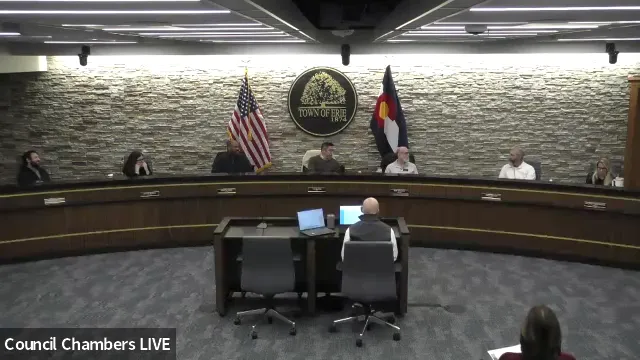
STREAMING COPY IN PREPARATION — RECORDING AVAILABLE FROM THE ORIGINAL SOURCE
Erie Planning Commission Meeting - January 17, 2025
[Note: The meeting minutes indicate the meeting was held on January 15, 2025, but the user-provided timestamp is January 17, 2025. This summary uses the specified date of January 17, 2025.]
The Planning Commission of the Town of Erie met to discuss a proposed Parking Management Strategic Framework presented by Transportation and Mobility Manager John Firouzi. The meeting included approval of the agenda and previous meeting minutes, followed by a detailed presentation and commissioner discussion on modernizing the town's parking approach. No public comments were made. The meeting adjourned at 7:39 p.m.
Consent Calendar
- The agenda was approved unanimously via roll call vote.
- The minutes of the December 18, 2024 meeting were approved with an amendment correcting a reference to Chair Burns instead of Vice Chair Laws.
Public Comments & Testimony
No public comments were taken.
Discussion Items
25-042 Parking Management Presentation John Firouzi presented a proposal to shift from the town's traditional, unmanaged parking approach to a proactive, data-driven parking management strategy. Key points included:
- Current parking is subsidized and inefficient, with no clear value assigned to parking assets.
- The proposed framework would analyze parking assets, establish zones, and use "dials" (adjustable parameters) for enforcement, restrictions, and potential paid parking in high-demand areas.
- The goal is to create a self-sustaining parking program that improves turnover, reduces strain on police enforcement, and supports economic development.
- Possible strategies include shared parking agreements, parking maximums, fee-in-lieu options, and use of license plate readers for enforcement.
- The process would involve public input, a consultant study, and updates to the Unified Development Code.
Commissioners raised several points and questions:
- Commissioner Hemphill noted that free parking is a town subsidy and asked about removing parking minimums. Firouzi responded that parking maximums and incentives could be considered.
- Commissioner Booth inquired about current enforcement and issues like long-term parking in neighborhoods. Firouzi discussed technology like license plate readers and triggers for adjustments.
- Commissioner Booth also asked about incentives for existing parking lots (e.g., Lowe's) and fee-in-lieu options.
- Commissioner Baham asked about the interface between commercial and residential parking, including shared parking agreements and permits for residents.
- Commissioner Braudes brought up bike parking, visibility, and pedestrian safety in parking lot design.
- Commissioner Dreckman expressed concern about the connotation of "free parking" and the potential for paid parking, and noted the need to avoid displacing cars to adjacent neighborhoods.
- Commissioner Dreckman also raised liability issues with shared parking agreements.
- Vice Chair Laws suggested voice votes for routine approvals to save time.
- Commissioner Hemphill mentioned the example of Carmel, Indiana, for innovative parking design.
- Chair Burns reported on upcoming security training for commissioners.
Key Outcomes
- The Commission expressed interest in the Parking Management framework and thanked staff for the presentation. The item was informational; no formal vote was taken.
- Staff will take the Commission's input to Town Council for further direction.
- The next Planning Commission meeting is scheduled for February 5, 2025.
- The Commission will prepare a bi-annual report to Town Council.
- Parks and Recreation is updating the PROST Plan and will need a primary and alternate representative from the Planning Commission.
- The meeting was adjourned at 7:39 p.m. by a unanimous vote.
Meeting Transcript
There's a lot more to come behind this if there is interest from this commission to proceed, especially with the updates to our uh municipal code associated with the UTC process. Next slide. All right. So just to provide some context here and calling this uh current conditions, we have in the town of Erie uh a traditional approach to parking, and that makes sense. Um, you know, the the town has historically not had as much traffic and congestion and uh has recently started to grow. As a result, there hasn't really been a need to have a proactive approach to parking management. Um when it's uh unmanaged, basically it's where you have uh, you know, for example, unlawful parking happening and then folks having to call on enforcement, and this often impacts resources and priorities on the enforcement front. Um it can also be inefficient, uh, where you'll have uh businesses, for example, impacted by um, you know, say their own employees parking in prime parking spaces in front of a business and having then customers or um visitors parking further away, then generating concerns about uh parking congestion in a specific area. Um then also when it comes to uh off-street parking limits and um versus on-street as well, uh there are certain types of impacts that occur with requirements that are pretty much uh straight shot, which is what we have in our code today. Uh you have uh a type of category for for land use and an associated parking number with that uh today, and that's how parking is pretty much established and rolled out in this process. Our engineering standards on the public right-of-way side is pretty similar to we build as much parking as possible in neighborhood areas. This is public parking, but it's sometimes perceived as my parking when it's in front of my house. And the reality is is that it's shared parking on street, and uh it does tend to uh have irritations, you know, for for folks when it doesn't work properly. Uh that happens in some cases in residential areas when there's, for example, a park or a school nearby when folks you know park in the neighborhood uh from those kind of activities. And then uh it's a lot different, for example, for an old town area or a business district. And they all have their own kind of flavor, but nonetheless, when it's unmanaged and open, uh it generates concerns and and that's really what happens with unmanaged parking. So uh from there, we have occasionally come across uh some other peripheral related uh items, such as bike parking in areas as well, and uh the need to be better about how we prioritize and incentivize uh parking in general, including bike parking to make sure that we're we're addressing the needs of our community members when they're going out to these various destinations and land uses in the town. Uh next slide. So you may have come across this um uh in the past and uh the the high cost of free part parking by Donald Schupe. Uh it's it's something that uh refers to the fact that um uh traditional parking measures are really at the end of the day, something that do cost towns or cities and public um money that is hidden in a sense. It's it's bundled into the cost of development, it's bundled and the cost of uh the impact and the resources like such as enforcement and such. And that it you know, free parking assigns a zero dollar value essentially to an asset that is uh constructed and maintained and does have an associated uh uh uh value with it, but isn't really captured. And that uh in in this particular case, uh it could be argued that parking can be optimized and that we could instead of building more parking and having to have a higher cost, we could manage smaller amounts of existing or smaller parking numbers a lot more efficiently to be able to uh reap the rewards of higher parking levels, but at a smaller cost, and that's much better for for towns and cities. And that's much better for towns and cities. Next slide. There we go. So what we're proposing here essentially is a change and a different approach to how parking has historically been viewed as part of our code and as part of the town's operations. Our municipal code updates provide an opportunity to do an economic analysis and understand our assets and understand their values and understand how we can perhaps make better use of these assets such that at the end of the day it serves our customers better and has a less of a strain on, say, our police department or enforcement units. In addition to that, we could be better serving our customers, our businesses and our developers or community as a whole. Some of the things that we'd want to do is to be fiscally responsible in this process and be proactive and effective with our assets and wrap in our enforcement economic planning, electrification, other various stakeholders in this process to make sure that we do develop something that's more modern as a parking strategy moving forward. So we don't need to reinvent the wheel. Parking analysis has been done in more populated areas of the metro area. There are consultants that specialize in this effort, and that there are nearby communities with existing plans and formats that we can review and follow to essentially use a similar format that's been successful in those communities, or when they have lessons learned, you know, try to avoid the pitfalls of some of the things that they've gone through. In the TMP, the transportation mobility plan, we went through a process for public input and were able to obtain that information in 2023 through 2024. We have incorporated in the TNP the environmental and economic and other strategic uh town strategic plans as part of our vision for the community and as a way to manage growth. And we have uh the opportunity essentially to provide planning commission and council with a menu of options that might be variables, you know, to help identify what would be the best fit for this community based on what we're learning from other communities. Uh we'd have to develop a scope that meets that expectation and then present it to our um elected officials here, and uh we'd want to share that information with the public as well for uh input along the way. And if desired, then we can proceed into the municipal code update and translate that information into guidelines for our code updates that then deliver the type of parking management uh that we would expect to see in our municipal code. Um another uh related item is that we'd want to define the um associated budget with a proactive approach and identify what that looks like and create a self-sustaining parking program that comes out of this uh essentially to um supply itself with the funding and resources that it needs for a proactive approach. So one of the things that uh I'd wanted to also note related to uh a proactive approach is that uh it's it's data driven and it's an operational type of uh element at the end of the day where we can collect data and use that to then make decisions using what I'm calling dials uh over here. We can share the dials and get that information and guidance from our elected officials on how much enforcement, how much restrictions, uh, where and how to essentially offer um a managed approach to parking. Uh one of the things associated with this is that uh a lot of times shared parking is a challenge, and you have to build a bit of incentive to make it work. Um this can be also very uh uh an opportunity for our some of our goals and visions associated with our varying plans to be implemented into something that's more operational at the end of the day. And uh to give you an example of what that might look like. Um I worked on a project a while back in uh old town area, just like Old Town Erie at the time. We had a parking lot that were uh ready to convert into a parking garage, a structured parking lot. And uh there was a desire to delineate the 600 spaces um for this particular garage. And what ended up happening was everybody was very interested in like their 400 or their 200 spaces in one structure. What we realized was that this wasn't a very efficient way of managing the assets, and the way we got to that was we looked at the data on on the usage of the structure and we said, well, hey, commuters during the week are interested in parking spaces between 8 a.m. and 5 p.m.
openpublica.com