Town of Erie Town Council Study Session – April 17, 2024
STREAMING COPY IN PREPARATION — RECORDING AVAILABLE FROM THE ORIGINAL SOURCE
Town of Erie Town Council Study Session – April 17, 2024
Note: The agenda lists the meeting date as April 16, 2024, but the user-provided timestamp indicates April 17, 2024. This summary uses the user-provided date.
The Town Council held a virtual study session on April 17, 2024, beginning at 6:30 PM and adjourning at 9:36 PM. The meeting covered five major topics: a new Neighborhood Speed Management Program (NSMP), an informational update on the proposed Draco oil and gas development, the process for annexing the remaining portions of Erie into the Regional Transportation District (RTD), confirmation of council direction on 2024 ballot measures, and an overview of the development review process for initial zonings and rezonings.
Discussion Items
Neighborhood Speed Management Program Development
- Presenters included Town Engineer David Pasic, Senior Transportation Planner Miguel Aguilar, Police Chief Lee Mathis, Communications Specialist Jarod Ballentine, and consultants Bill Cowern (Fox Tuttle Transportation Group) and Margo Josephs (Leadline Project Management).
- The program is a comprehensive strategy to address neighborhood speeding through education, enforcement, engineering, and evaluation. It will react to resident petitions and also be incorporated into new development standards.
- A peer review of 10 Front Range and 4 national communities, plus a community focus group (10 selected residents), informed the draft policy. The focus group unanimously supported moving forward, with one dissenting opinion.
- Council discussion focused on concerns about shifting public safety responsibility from government to residents, the need for pedestrian and bicycle prioritization, the effectiveness of traffic calming measures, and the role of enforcement. Several council members expressed support for adding back pedestrian/bicycle prioritization criteria that had been removed after focus group feedback.
- Council directed staff to reincorporate pedestrian and bicycle safety prioritization measures into the program.
Draco Proposed Oil and Gas Development Informational Presentation
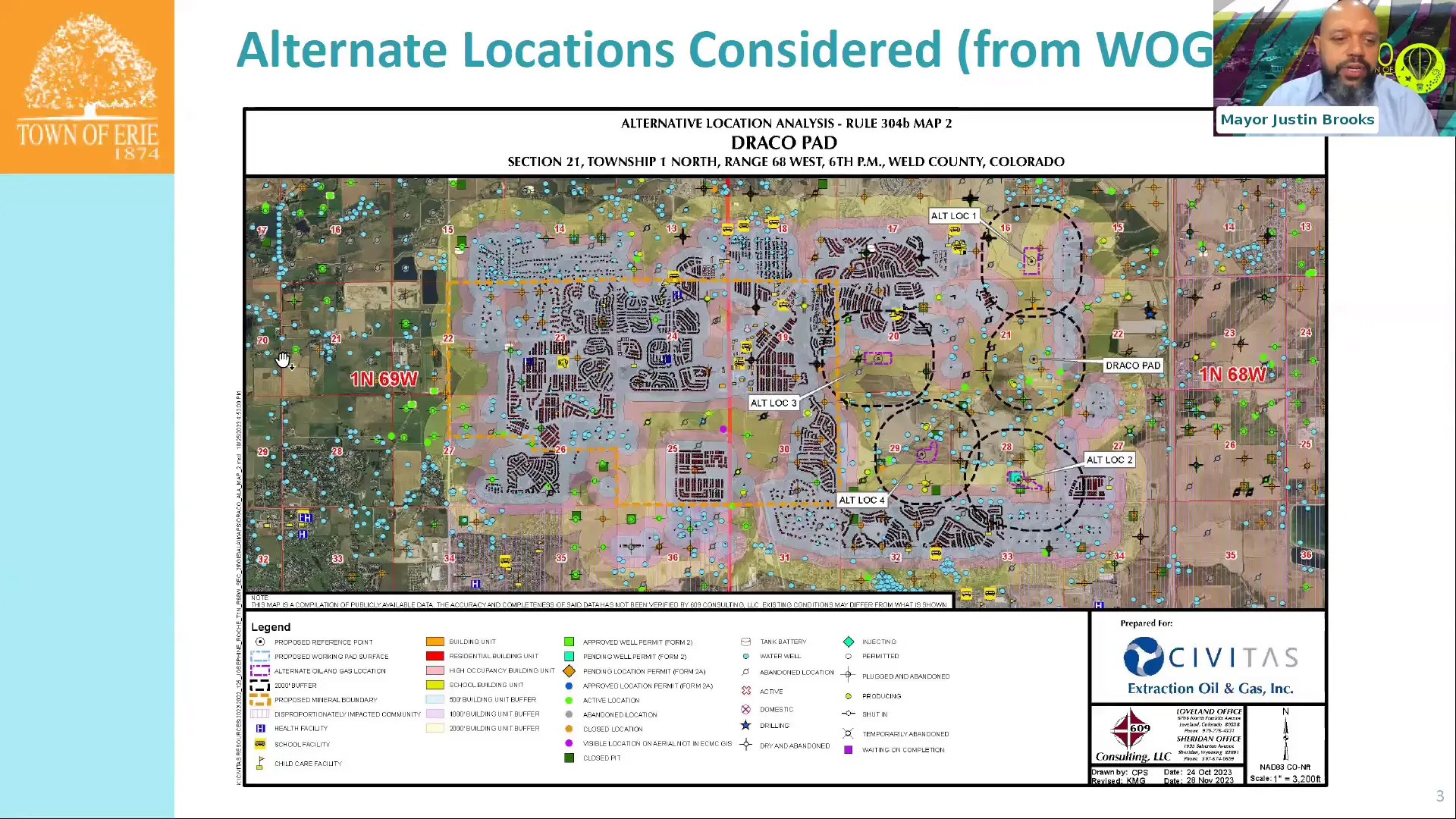
- David Frank, Director of Environmental Services, presented on a proposal by Civitas Resources to drill 26 horizontal wells from a pad in unincorporated Weld County, approximately 3,000 feet from the nearest Erie resident. The production area would extend roughly 5 miles west under portions of Erie, with wellbores at about 7,800 feet depth.
- The proposal includes plugging and abandoning 23 existing wells and removing 37 tanks from neighborhoods. The pad meets all state regulatory setback requirements. No Erie residents are within 2,000 feet; five Weld County residents are within that buffer, and four have signed non-objection letters.
- Council members raised concerns about air quality impacts (the site is in the Front Range non-attainment area), the operator’s track record (citing unreported spills and lack of notification), and the potential for forced pooling of municipal mineral rights. They also noted the lack of a state cumulative impacts rulemaking.
- Staff will continue to negotiate road maintenance agreements, request soil vapor testing near old wells, review visual mockups, and advocate for strong air quality monitoring. No formal council action was taken, but consensus was to escalate concerns to the state.
RTD Annexation & Election
- Senior Transportation Planner Miguel Aguilar presented the history, benefits, and challenges of fully annexing Erie into RTD. Currently, four areas of the town (downtown, airport, Erie Highlands, and the I-25 area) are outside RTD, creating a checkerboard pattern.
- Benefits of full annexation include extending the JUMP bus route to Erie High School, making Access-a-Ride available to all residents, free fares for youth, and eligibility for RTD grants. Challenges include a 1% sales tax increase for newly annexed areas, lack of service guarantees, and the need for capital improvements (e.g., bus stops).
- The preferred annexation path is a Weld County Commissioner resolution to hold an election among affected Weld County residents. RTD will fund the election; the town will pay for a land survey. The timeline calls for a council resolution in early May, a Weld County study session on May 22, and a potential election in November 2024.
- Council discussed the risk of RTD losing its Tabor exemption (estimated $40–70 million annually) and the need for service commitments before asking residents to approve the tax. There was consensus to move forward with the process, with the understanding that the final decision rests with the voters in the affected areas.
Confirm Council Direction on 2024 Ballot Measures
- Town Manager Malcolm Fleming recommended proceeding with a ballot measure for a marijuana excise tax (to allow recreational marijuana sales in Erie), but postponing measures on short-term rental taxes and a lodging tax due to pending litigation, legislation, and the small number of short-term rentals (about a dozen).
- Council agreed with the recommendation, with discussion noting that the short-term rental issue may be affected by a state ADU bill and that more community engagement is needed.
Development Review Process for Initial Zonings and Rezonings
- Planning & Development Director Sarah Nurmela and Planning Manager Kelly Driscoll provided an overview of the development review process, from pre-application through final plat. They highlighted the required reports at each stage (e.g., assessment of impact, traffic study, drainage report) and the role of external review agencies.
- Council members asked about public outreach, the length of the process (typically 6–7 months for simple projects, longer for complex ones), and the inclusion of supporting documents in agenda packets. Staff noted ongoing efforts to streamline the process and improve the information provided to council.
- No formal action was taken; the presentation was informational.
Key Outcomes
- Neighborhood Speed Management Program: Council directed staff to reincorporate pedestrian and bicycle prioritization criteria into the draft policy. Staff will return for program adoption.
- Draco Oil and Gas Development: No formal vote; staff will continue to engage with the operator and state regulators and will return with updates.
- RTD Annexation: Council confirmed direction to proceed with the Weld County resolution and election process. A formal council resolution is expected in early May.
- 2024 Ballot Measures: Council agreed to place only the marijuana excise tax on the November ballot. Short-term rental and lodging tax measures will be revisited later.
- Development Review Process: No action required; staff will continue to enhance agenda packets and presentations based on council feedback.
Meeting Transcript
Okay, well, um, we can get started since everyone's here. Uh the first item up is a neighborhood traffic safety program. Is that what it's called? Neighborhood speed management program. Thank you. Neighborhood speed managed. Over to you, David, uh, our town engineer. You can kick us off. I'll actually hand it off to Miguel first off to kick us off. So appreciate it. Thanks. Miguel, that's started. Um, just want to make sure I get this all right. Is it going to presentation mode for you guys? Is it on the wrong side? Wrong side. Really, Miguel, all you have to say is that all the counselors have to slow down while they drive. So that's your speed management program. There you go. This is pretty timely. Um one of the officers um myself met with a resident just this past Sunday, I think it was, to talk just about this very thing over on uh Mountain View Boulevard. So yeah, we believe I've heard about that complaint on Mountain View. Um yeah, something to address with this program. But uh speaking of going to the neighborhood speed management program. I just want to make sure you can see the full screen of the slide. Right. Um right. Um this presentation is on the neighborhood speech management program that's been developed by town staff and a couple of consultants. And speaking of, here is uh our list of the project team. Uh we have four staff from the town, David Passett, Miguel Aguilar, Jared Ballantin, and Sheep Mathis. Um, and we also have consultants who have helped develop the plan. Um those are Bill Cowern with Fox Telegral Transportation Group and Margot Joseph Joseph's with uh leadline project management. They will go a little more um detail on the project uh the program itself. Um about the presentation, we have our agenda. We just have four items to discuss or to go over. First one is the speed neighborhood speed management programs overview, and then second would be a method methodology and approach to creating ERIES NSMP. And number three, proposed structure and components of ERIES NSMP. And then on the fourth item, we'll enter into questions and discussion with the council. All right, I'll uh I'll pick up from there from Miguel. Um Miguel, can you go ahead and go to the next slide? So before we dive into our process and our draft policy that we're going to be presenting to you tonight, we wanted to briefly highlight a general overview of neighborhood speed management. Uh, through coordination with other town staff, EREPD, and residents, one of the common concerns that we hear in our community is around uh neighborhood speeding and traffic calming. Given that concern that uh we keep hearing from our residents, town staff has decided to pursue a development and implementation of a neighborhood speed management program for the town. Um this program will help to influence town staff's direction and implementation of chapter calming measures and enhance the comfort and quality of life for its town residents. Next slide. So we wanted to briefly highlight what is a neighborhood speed management program. Uh we have a very simple explanation here of it's a comprehensive strategy and a set of measures designed to mitigate neighborhoods traffic speed related issues. And below are several key components that are commonly included in a neighborhood speed management program. Some of these are uh measures that the town staff already takes with education and outreach, some data collection, um, police enforcement when necessary, um, and evaluation. What this program will specifically help us do, though, that we aren't able we don't currently have uh guidance on at the moment is to help us define parameters around which we evaluate, prioritize and implement physical speed mitigation and traffic calming measures.
openpublica.com