Erie Town Council Study Session - May 21, 2024
STREAMING COPY IN PREPARATION — RECORDING AVAILABLE FROM THE ORIGINAL SOURCE
Erie Town Council Study Session - May 21, 2024
This study session covered several informational items and discussions, including the US 287 safety study, the Erie BIPOC history project, affordable housing strategy, updates on County Line Road improvements, statewide ballot measures, and a discussion regarding the CML conference's scheduling on Juneteenth. No formal votes were taken.
US 287 Vision Zero Safety Study
- Presenters: Landon Hilliard and Alex Hyde Wright from Boulder County, with Miguel Aguilar (Town Senior Transportation Planner).
- The study covers 24 miles of US 287 from Broomfield to Larimer County, identified as a high-injury corridor.
- From 2011-2020, there were 34 fatalities on the corridor, with ongoing fatalities in 2024.
- Recommended countermeasure: concrete median barrier for 12 miles in rural sections to prevent crossover crashes. Other recommendations include signal timing improvements and automated speed enforcement.
- Funding: CDOT submitted a federal grant application (MPDG) for barrier construction; previous state HSIP applications were unsuccessful.
- Councillor Sowish raised concerns about the Isabel and 287 intersection, where injury accidents occur frequently despite recent improvements. Boulder County will follow up with CDOT on signal timing adjustments.
- Councillor Baer asked about roundabouts; the study considered them but did not recommend due to high cost and right-of-way constraints, and because most recommendations fit within existing ROW.
- Councillor Bell asked about nighttime crashes; presenters did not have specific data offhand but noted lighting was not a top recommendation outside intersections.
- This was an information-only item; no action taken.
Erie BIPOC History Project
- Presenter: Dr. Ashley Lawrence Sanders (contracted historian) and James Everett (DEI Manager).
- Project aimed to uncover stories of Black, Indigenous, and People of Color (BIPOC) in Erie's history, in anticipation of the town's 150th anniversary.
- Key findings: Erie was diverse from its founding; by 1920s, ~15-20% of population was of Mexican descent; early residents included many immigrant groups; no evidence Erie was a sundown town, but there was segregation and depersonalization in local newspapers.
- Indigenous history: pre-settlement, Cheyenne and Arapaho occupied the land; treaties and conflicts led to their displacement by the time Erie incorporated in 1874.
- Challenges: limited oral histories from people of color; census records are only available up to 1950.
- Recommendations: Continue oral history collection, involve youth, connect with descendants, integrate history into local museums and the miners memorial.
- Councillors expressed strong appreciation; Councillor Baer suggested connecting with older Americans and youth council for oral histories.
- No formal action; information only.
Affordable Housing Needs Assessment and Strategy
- Presenters: MJ Adams (Affordable Housing Manager) and Eric Leverage.
- Goal: 12% affordable housing by 2035. Currently only 1.3% of Erie's housing is affordable.
- Gap analysis: Significant shortages of rental units affordable at 50% AMI and below; homeownership options are insufficient at all income levels below 120% AMI.
- Only 28% of Erie renters have incomes at 120%+ AMI, but 81% of homes are only affordable to that group.
- Proposed policies: Inclusionary housing program (voluntary and mandatory), impact fees, land acquisition, seeking Prop 123 and county funds.
- Councillor Sawish questioned the 12% goal feasibility; MJ Adams acknowledged it is aspirational and will require many strategies.
- Councillor Sawish also raised concerns about impact fees on commercial development potentially discouraging development.
- Councillor Baer asked about leveraging inclusionary zoning to address rental gap; Adams confirmed income restrictions would apply.
- Mayor Pro Tem Laflin requested updated research on commercial impact fees for affordable housing.
- Staff will return with a request to adopt the housing needs assessment and policies at a future meeting.
County Line Road Improvements Update
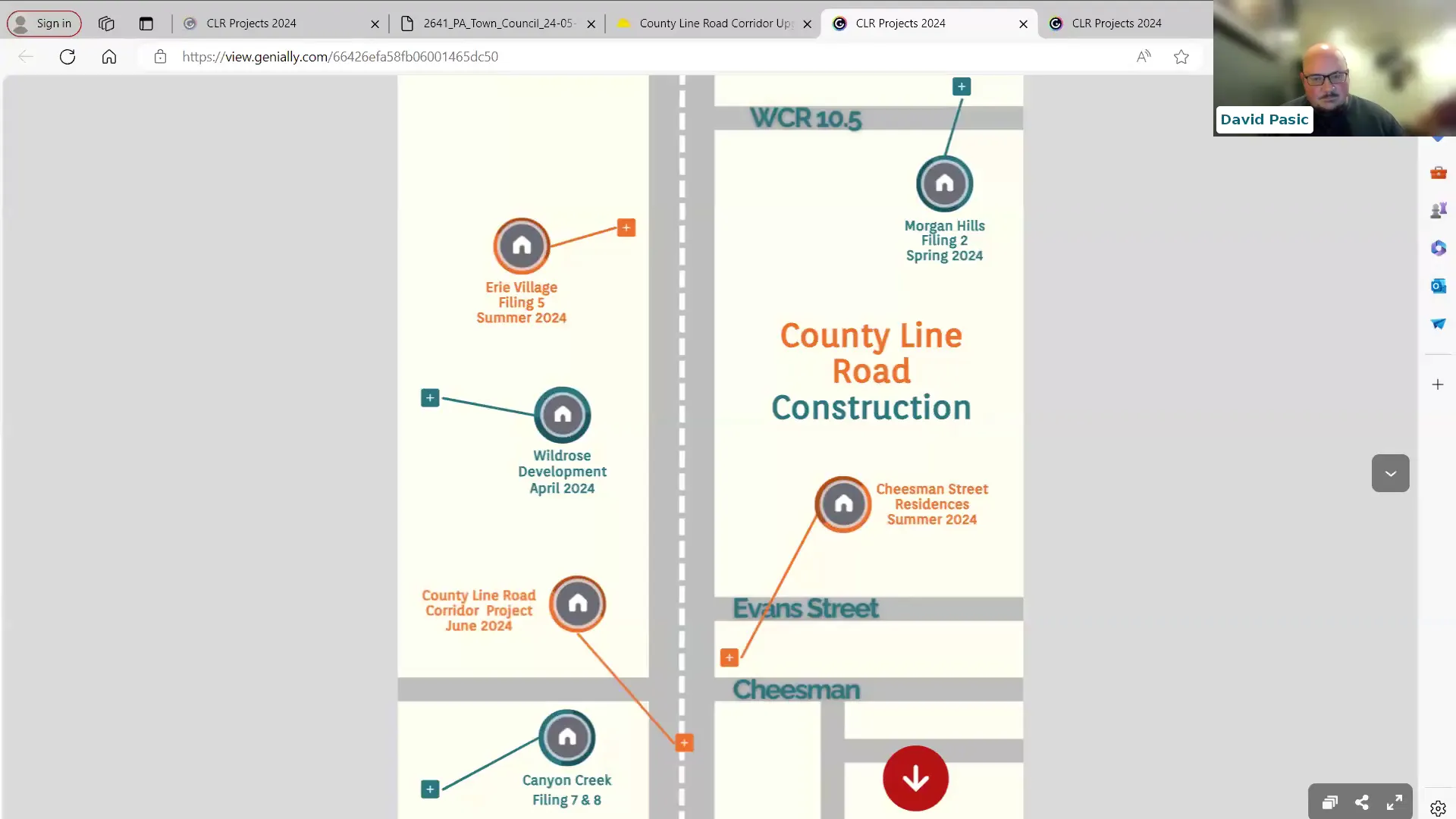
- Town Manager Fleming and Deputy Town Manager Wiley presented an infographic showing multiple projects along County Line Road, including road work and development.
- A cross-departmental team is coordinating to minimize impacts and maintain access to businesses.
- From June-December, there will be segmented closures between Telleen and Cheesman for multimodal improvements.
- Councillor Sawish asked about staging near schools; confirmed contract includes provisions for school access.
- Councillor Bell raised concerns about business access; staff are communicating with businesses.
- Councillor Sawish suggested using automated one-lane systems (like at 120th and South Boulder) to minimize full closures.
- Mayor Pro Tem Laflin requested ensuring at least one thoroughfare open in each neighborhood.
- This was an update; no action.
Review of Statewide Ballot Measures
- Town Manager Fleming reported nine certified measures and many potential ones; final list expected in September.
- Councillors had no detailed questions; acknowledged the information.
Discussion of Juneteenth Boycott of CML Conference
- Councillor Baer raised concern that the CML annual conference is scheduled on Juneteenth (June 19) with no recognition in materials.
- CML explained the contract was signed in 2018 before Juneteenth became a holiday; they plan some recognition but not detailed.
- Discussion on whether to draft a letter or boycott. Councillor Bell advocated grace and education; Councillor Baer noted the importance of Juneteenth.
- Councillor Sawish suggested a united front with other municipalities and not attending on Juneteenth but attending other days.
- Mayor Pro Tem Laflin summarized to reach out to partner municipalities for a coordinated statement.
- Staff directed to explore a collaborative letter or action.
Endorsing Candidate for CML Executive Board
- Town Manager Fleming initially suggested endorsing a candidate, but after discussion with Councillor Sawish, recommended focusing on policy committee instead.
- Councillor Baer noted the executive board steers the organization; but Councillor Sawish argued it is one of 21 members and policy committee is more effective.
- Consensus: Do not pursue endorsement at this time; better to engage with policy committee and other regional groups.
- No action taken.
Key Outcomes
- No formal votes were taken. Staff to follow up on specific action items, including:
- Boulder County to review Isabel and 287 intersection with CDOT.
- Affordable Housing Division to return with adoption request for needs assessment and policies.
- Town staff to coordinate with other municipalities on Juneteenth letter/action regarding CML conference.
- Town will not endorse a candidate for CML Executive Board at this time; focus on policy committee.
Meeting Transcript
May 20. It is May 21st, and tonight is a study session, and my internet is being wonky in pulling up the agenda. And we have a couple of discuss study items coming up tonight. The first one is item 24-154, the US 287 study project. And our presenter on that is Miguel Aguilar, along with Landon Hilliard and Alex White. So, Mr. Aguilar, if you want to go ahead. Great. Thank you, Mayor Bro Tem. My name is Miguel Aguilar, Senior Transportation Planner for the Town. And we have two presenters from Boulder County. I'll let them introduce themselves and they'll be talking about the US 287 safety project that was conducted recently. So with further ado, I'll let Alex and Landa take over. Thanks, Miguel. My name is Landon Hilliard. I'm a senior transportation planner with Boulder County. And I'm here with Alex Hyde Wright, who is the regional multimodal transportation planning division manager. And we have a short presentation to give to you, and then we hope a little bit of town uh time for uh question and answer after that. And so with that, Miguel, should I bring up the uh and share my screen? Yes, go ahead and share your screen, and then you should be able to select the uh the correct screen uh that your presentation is on. We'll do okay. Would you see the US 287 Vision Zero Safety Study slide? Yes, we can see that one. Okay, good. Well, with that, I'll begin again. Thank you, uh, town councillors for your time to give us tonight for the study session, and thank you. Uh we will give you the highlights of the US 287 Vision Zero Safety and Mobility Study for short, the safety study. We are here for the purpose uh so that you have some information and to raise awareness around the effective work that your staff is doing. This is just a short presentation, but if you were to distill it in the three major points, it would be one that this 287 is a key corridor for regional and local travel. A second point would be that the corridor is evolving and growing fast. And the third has to do with the fact that they're known. Uh this leads us into this safety study presentation. Just as a bit of background, uh, before I pass it off to Alex Hydewright to talk about the safety analysis recommendations, I'd like to just give you uh some context, and that is there are a number of safety uh or study partners from the local to state to the regional level that have been involved with this safety study. And those partners are part of a core group that um has come together around the US 287 coalition and identifying opportunities to move the vision forward of a multimodal stage corridor. So with a little planning background, the study area is about 24 miles from the south in Broomfield to the county line with Larimer County up around Horseshoe Circle. And the six stakeholders you can see, including the town of Erie with the Colorado Department of Transportation. It's an interesting corridor in that there's a variety of land uses of urban, rural, and suburban. In 2022, Dr. Cog, our metropolitan planning organization identified the corridor as a high injury corridor. And back in 2014, the Northwest Area Mobility Study called out the corridor for for transit development. And from that, uh there was a feasibility study for transit. So why do we think it's uh important to study the corridor? Thinking broadly, there are social, economic, and environmental reasons. From everyday reasons, there's air pollution, there's traffic congestion, and there's growth. And the growth, as I mentioned, is coming fast. The 20 year on the 20th year horizon, according to the Devra Regional Council of Governments, there'll be a great increase in jobs and in population. And of course, that means travel activity along the corridor. The safety study had about a 15 month period. And wrapped up in December 2023, the final report and everything that Alex and I will be talking about can be found online at a Boulder County planning website. Throughout the study, there was their regular touch points for community engagement.
openpublica.com