Town Council Special Meeting: Utility Fee Study and Flex Ride Service Plan - August 20, 2024
STREAMING COPY IN PREPARATION — RECORDING AVAILABLE FROM THE ORIGINAL SOURCE
Town Council Special Meeting: Utility Fee Study and Flex Ride Service Plan
This special meeting of the Erie Town Council on August 20, 2024, from 6:30 PM to approximately 9:00 PM, focused on two major items: a utility fee study session for proposed water and wastewater tap and dedication fees, and an update on the Flex Ride service plan. No consent items or public comments were on the agenda. The meeting concluded with an executive session regarding the Town Manager and adjournment without returning to open session.
Utility Fee Study Session
- Presenter(s): Sara Hancock (Finance Director), Todd Fessenden (Utilities Director), Todd Cristiano (Raftelis).
- The study, begun in December 2023, proposes a shift to a two-year review cycle for fees, starting with tap and dedication fees (residential rates will be discussed at a later study session).
- Water Dedication Fee: Proposed increase from $16,000 to $31,400 (approx. $15,400 increase) for a 3/4-inch residential meter. This includes costs for existing water rights (CBT, Windy Gap, ditch rights) and future NISP participation, including carrying costs for debt issuance.
- Water Tap Fee: Proposed increase from $12,050 to $17,290 (increase of $5,240) for a 3/4-inch meter. Drivers include new expansion projects (Zone 2 transmission line, storage tanks, new water treatment plant).
- Wastewater Tap Fee: No change proposed, remaining at $8,000 for a 3/4-inch meter. The expansion cost increment is offset by the capacity added.
- Gateway Trunk Line Fee: A new fee of $1,561 per single-family equivalent (SFE) for the Gateway development, estimated at $32 million serving 11,700 SFEs. This is in addition to the standard wastewater tap fee.
- Total Proposed Fees (without Gateway): From $37,153 to $57,550 (approx. 55% increase), driven primarily by the dedication fee.
- Peer Comparison: Erie’s proposed fees place it in the middle of surrounding communities. Lafayette’s fees have risen significantly due to indexing to CBT and adding NISP costs.
- Discussion Topics:
- Clarification on meter sizing for fire sprinklers (3/4-inch tap fee applies, not 1-inch).
- Impact on affordable housing: staff acknowledged this increases the gap but noted options like rebating other impact fees.
- Concern about smaller builders and ADUs: staff is internally reviewing water tap requirements for ADUs.
- Assumptions: The fee calculation uses capacity-based methodology, not annual tap projections; however, cash flow analysis uses estimated 600 taps/year over 10 years.
- Historical over-collection: Councilor noted actual taps exceeded 2019 assumptions (400/year). Raftelis explained that accelerated growth led to higher fund balances, but capital project costs have also increased.
- Timing of new water treatment plant: staff stated planning is underway, and the utility can issue bonds without a public vote.
- No formal vote was taken; the study session was informational, with a follow-up session on residential rates scheduled later.
Flex Ride Service Plan
- Presenter(s): Miguel Aguilar (Senior Transportation Planner), with consultant Farron Pierce (Fair & Pierce) via video.
- The service plan is based on community outreach, streetlight data (cell phone data) analysis, and demographics. Key findings: Erie has high youth (14% age 10-17, 9% age 18-24) and older adult populations; 90% of households have 0 or 1 vehicle; 63% drive alone.
- Top trip pairs: Erie Highland/Colliers Hill to Erie Commons, Vista Ridge to Highway 7 corridor. Top destinations: Erie Community Center, parks, library, grocery stores, medical appointments.
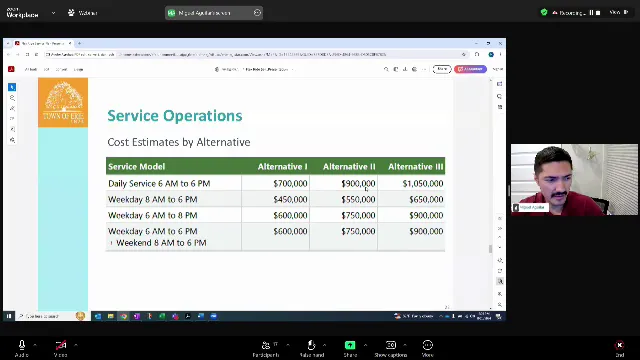
- Three alternatives considered: Alternative 1 (Erie + US 287 businesses in Lafayette), Alternative 2 (adds Lafayette Park-n-Ride), Alternative 3 (adds Good Samaritan Hospital).
- Recommended Alternative: Alternative 1, with service area covering most of Erie, Highway 7 businesses, and US 287 commercial corridor in Lafayette.
- Service Details: Free-to-ride, funded by a $600,000 CDOT grant. Hours: Monday–Friday, 6:00 AM to 8:00 PM (selected based on community input). Rides requested via smartphone app, phone, or online; English and Spanish available. Two vehicles required; estimated 75–90 passenger trips per day (2.5–3.5 passengers per service hour; typical trip ~10 minutes).
- Branding & Marketing: Local branding with vehicle wraps to be developed; promotion at town events in early 2025; inclusion in new resident packets.
- Connections to Other Transit: Service will connect to RTD’s JUMP route, Boulder County’s FlexRide (2025/2026), Broomfield’s FlexRide (late 2024), CDOT’s Bustang at I-25/Highway 7 mobility hub, and future BRT services.
- Next Steps: Complete branding, finalize CDOT contract (funds available Oct 1, 2024), issue RFP for transit provider (by end of 2024), aim for service start in 2025.
- Discussion: Councilor Bear requested training for drivers on invisible disabilities (e.g., seizures). Councilor Songwish inquired about connections to regional transit; staff confirmed transfers are possible, and a comprehensive trip planner will be incorporated into the RFP.
- No formal vote was taken; the plan was presented for information and guidance.
Executive Session
- The council voted unanimously (5-0) to enter executive session at 9:00 PM for discussion of personnel matters concerning the Town Manager, pursuant to C.R.S. § 24-6-402(4)(f). No further open session was held.
Key Outcomes
- No official votes or directives were issued on either agenda item.
- Staff will proceed with: (1) refining the utility fee proposals and presenting residential rate analysis at a future study session; (2) moving forward with Flex Ride branding, contracting with CDOT, and issuing the RFP for transit operations.
- The council provided feedback on affordability impacts, ADU tap policies, and Flex Ride accessibility training.
Meeting Transcript
Can take a roll call, please. Okay. Absolutely. Hang on just a second. Sure. Sorry, I had to send Malcolm's um link to him again. So all right. Roll call. Um councillor Bell. Mayor Pro Tem Laughlin. Mayor Brooks. Here. Councilor Hoback. Here. Councillor Bear. Councilor Bear, you mute it. Counselor Songwish. I can see Bear. So yeah, you can see her. Counselor. That's okay. Counselor Sawish. Live via Zoom. Mary O'Corm. All right. Thank you very much. Is there a motion to approve the agenda? So moved. Second. Okay. And I'll do a show of hands for approving. Okay. It appears to be unanimous with the four of us that are here. And next up, we have general business. The first item is a utility fee study session. And we've got finance director, Sarah Hancock, Utilities Director, Todd Fessenden, and Raftalus, Todd Cristiano. Am I saying that correctly? You are. You are, although I'm showing up as Nikki for some reason. So we have two Nikki's on here this evening. Well, take it away, sir. All right. Well, good evening, Council and Mayor. Thank you so much for having us. And we're excited this evening to present some information for you guys to consider. We started work on this water rate study in December of 2023. So that was a full year earlier than we usually do within a five-year cycle. So this work was uh started, like I said, a bit earlier, and um that has lended itself well to um you know long range planning as that has become abundantly clear that it's important for us, especially with um inflation and impacts on capital projects uh as those increase. Uh we also are um intending to do this more often. So we're going to be shifting to a two-year review cycle that will really help uh with the impacts of any changes around fees.
openpublica.com