Erie Town Council Study Session – September 17, 2024: Utility Rates, Minimum Wage, and Firearm Discharge on Agricultural Land
STREAMING COPY IN PREPARATION — RECORDING AVAILABLE FROM THE ORIGINAL SOURCE
Erie Town Council Study Session – September 17, 2024
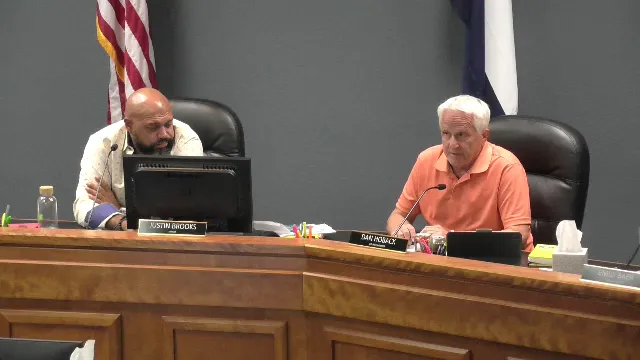
The Erie Town Council held a study session on Tuesday, September 17, 2024, from 6:30 PM to 9:52 PM. The meeting included three major discussion items: a utility rate study session, an update on regional minimum wage efforts, and a proposed municipal code change regarding firearm discharge on agricultural properties. No formal votes were taken, but council provided direction on next steps.
Discussion Items
Utility Rate Study Session (6:30–8:30 PM)
- Presenters: Sara Hancock (Finance Director), Todd Fessenden (Utilities Director), and Todd Cristiano (Raftelis).
- Overview: Second phase of a rate study covering water, wastewater, and stormwater utilities. Key proposals included a water rate increase of 8.5% annually for five years; no increase for wastewater; and a 7% annual increase for storm drainage for five years.
- Typical Bill Impact: For a customer using 8,000 gallons of water per month, the combined water, wastewater, and stormwater bill would rise from approximately $128 to $134 (a 4.5% increase, or $5.80 per month).
- Cost of Service & Rate Design: No changes to the existing rate structure; tiered water rates for residential customers will continue. The irrigation rate (for HOAs and parks, not residential yards) will increase, prompting discussion about potential tiered structures to encourage conservation.
- Financial Plan Assumptions: Growth projection of 650 new accounts per year; inflation factors of 6.8% for operations and 3% for capital; bond interest rate assumed at 4.5%; debt service coverage target of 1.25 times.
- Council Questions: Counselors asked about the impact on affordable housing and fixed-income residents; staff noted existing assistance programs (payment plans, leak adjustments, community partner referrals) and mentioned exploring income-based subsidies. Other questions addressed commercial rates, the impervious area (SFRE) calculation for stormwater, and the potential for using non-potable water for irrigation and fire suppression.
Regional Minimum Wage Update (8:30–9:30 PM)
- Presenters: Stephanie Pitts-Noggle (Economic Development Manager) and James Everett (DEI Manager); consultant Andrew Dyke (Ecot Northwest) presented the economic analysis.
- Background: Erie joined a consortium with Boulder, Louisville, Lafayette, and Longmont to study a regional minimum wage. Staff conducted community engagement (surveys and in-person conversations) with limited response: 44 Erie-specific survey responses (75% against raising the minimum wage) and 42 regional survey respondents from Erie (76% of business owners opposed; 69% of employees supported).
- Consultant Findings: Andrew Dyke presented an economic impact analysis comparing scenarios (Denver-style and unincorporated Boulder County-style) to the state minimum wage baseline. Key regional effects: employment would be 0.4%–1% lower by 2030 under various scenarios; prices would increase by up to 0.1%; net income for low-income households would rise, but high-income households see small declines. The analysis also noted that Erie has a high proportion of small businesses (employing <25 people) that would be disproportionately affected.
- Staff Recommendation: Step back from pursuing a local minimum wage and instead monitor regional developments, while focusing on other economic empowerment initiatives (affordable housing, entrepreneurship, small business support).
- Council Consensus: All council members agreed with the recommendation. Councilors cited Erie's unique geography, high small-business concentration, and the need for more data on local business conditions. Council also expressed interest in a future workshop to brainstorm small business incentives and support.
Discussion on Municipal Code Change Regarding Discharge of Firearm on Agricultural Property (9:30–9:50 PM)
- Presenter: Sarah Nurmela (Planning & Development Director).
- Proposal: Amend Section 6-3-3 of the municipal code to allow discharge of firearms on properties zoned Agricultural Holding (Ag Holding) that are larger than five acres, for recreational purposes, provided it is done safely and the projectile does not leave the property. This would apply to six of eight properties in the proposed Erie West annexation area (northwest corner of town) and any future Ag Holding parcels.
- Background: The Ag Holding district was created to allow agricultural properties to annex into Erie while maintaining agricultural uses. Current code prohibits firearm discharge within town limits, which is a sticking point for property owners who wish to continue hunting on their land after annexation.
- Council Questions: Chief of Police Mathis confirmed that stray rounds have been reported in the past (e.g., Vista Ridge) but no injuries occurred. Enforcement challenges were discussed—officers would need to verify parcel size and zoning. Council also clarified that the five-acre threshold applies to individual parcels, not the entire Ag Holding district. The proposed ordinance would not allow commercial shooting ranges.
- Council Direction: Council expressed no objections to the proposed change and directed staff to prepare an ordinance for a future meeting.
Key Outcomes
- Utility Rates: Staff will incorporate council feedback and bring forward rate ordinances for adoption at a future regular meeting. A revisit of rates is planned within two years to adjust for actual growth and costs.
- Regional Minimum Wage: Council supported staff's recommendation to step back from a local minimum wage ordinance and focus on monitoring regional actions and developing small business and entrepreneurial support programs. No formal vote was taken.
- Firearm Discharge: Council gave direction to proceed with drafting an ordinance amending the municipal code to allow firearm discharge on Ag Holding properties over five acres. The ordinance will be presented at a future council meeting for action.
- Next Meeting: Regular council meeting scheduled for September 24, 2024 (per the mayor's closing remark).
Meeting Transcript
September 17, 2024, town council meeting for the town of Erie. I'm the presiding officer, Mayor Justin Brooks. We'll start off. This is a study session, by the way. This is not a regular regular meeting. We do have Councillor Bell online and I think that's all. And the rest of us are here. We'll start off our discussion with a utility rate study session topic with a presentation from Ms. Sarah Hancock. Welcome, our finance director. And over to you. Yeah. Thank you. And I'm going to fiddle while you're working just to get my display up. You are fine. So I'm going to go ahead and pull up our PowerPoint presentation here. We have our representation from Raffitelli's here today to review this rate study for you. So I'm going to pop this open here. And a presentation edit, Matt, are you ready? Yeah. Come on. And I believe you guys remember Todd. Yes. Welcome back. Well, Mayor, Counselors, and Counselors Online, good evening. Thank you for the opportunity tonight. This is part two of our rate study. We talked about TAP fees back in August, and today is the financial plan and rates and cost of service for the water, wastewater, and stormwater utilities. And my presentation tonight really summarizes over nine months' worth of work with staff developing this plan. And I've worked with the town of here before, and one of the great things is that it's a growing community, which obviously makes these studies very robust and interesting because there's just something always moving. There's always changes as we go along. And so we worked really diligently to get our assumptions down and hold things to the fire to make sure that we had all the right numbers and things in place to get an accurate picture for the town to make decisions going forward with the with those utilities. So I'll jump right in. A couple of things we're going to be discussing today. Obviously, what were the goals and objectives? We'll review that real quickly. We're going to go over the main components of the rate study, the financial plan, cost service, and rate design. But more importantly, we're going to get to the typical bill comparisons because that's obviously some of the biggest impacts, and most people are very concerned about what's going to happen to my bill, what's going to happen in my wallet. And then we obviously have the peer utility survey, and we have two versions of the peer utility survey we'll look at. So we'll talk about that here in just a moment. So obviously the rates and fees the town assesses to the in the water utility, wastewater, and stormwater, their enterprise funds and they need to recover their costs through rates and fees. And they need to fund operations, fund the capital projects. You need to maintain reserves, you need to fund growth and ensure you have cost recovery. And we're going to do that by obviously evaluating developing a financial plan, looking at a cost of service analysis to make sure that those residential customers are paying their fair share and the commercial customers are paying their fair share. And then the rate design of well, how are we going to get the money from our customers in terms of a volumetric or um service charge? And obviously, tap fees is a big component of this. That factors into the financial plan, but we're not talking about the calculations of tap fees today. We are we talked about that in August, but the the projections we had in the TAP fees from August are projected in this financial plan. So the rate study process is really four components. We've already looked at number four, but the first one, the financial plan.
openpublica.com