Town Council Study Session: 2025 Proposed Budget - October 15, 2024
STREAMING COPY IN PREPARATION — RECORDING AVAILABLE FROM THE ORIGINAL SOURCE
Town Council Study Session: 2025 Proposed Budget Presentation - October 15, 2024
The Erie Town Council held a study session on October 15, 2024, from 6:30 PM to 8:52 PM, to review the proposed 2025 budget. Finance Director Sarah Hancock presented the budget, emphasizing a collaborative process with department directors. The budget shows a healthier general fund with a projected 7.5% turn back, increased revenue projections, and a focus on funding community priorities.
Consent Calendar
- No items were on the consent calendar; this was a study session for discussion only.
Public Comments & Testimony
- No public comments were made during the study session.
Discussion Items
Financial Overview and Fund Balance
- The general fund beginning balance is approximately $16.5 million, with revenues of just under $65 million and expenditures of just under $60 million. The spendable fund balance is projected at $15.3 million, with a 7.5% turn back (underspending) expected.
- The Conservation Trust Fund includes a proposed $350,000 revenue (to be entered later).
- The Police Impacts Facilities Fund shows a negative $34 million ending balance due to planned certificates of participation (COPS) for the police building expansion; this is not a true deficit.
- Revenue projections were refined: sales and use tax growth set at 10%, property tax at 3%, recreation fees at 18%, building permits at 10%, and utility fees aligned with the rate study.
Expenditures and Positions
- Total operating expenditures are lower than the 2024 adopted budget, reflecting departmental collaboration to find savings.
- The budget includes 14 new full-time positions: 12 in the general fund and 2 in utility funds. Key positions include in-house attorneys, deputy finance director, development review engineer, utilities engineer, desktop support technician, communications specialist, fleet procurement specialist, affordable housing planner (grant-funded, two-year term), victims advocate, and utilities project manager.
Departmental Presentations
Each department director presented highlights and goals:
- Information Technology (Denise Jacon): Focus on cybersecurity (firewall replacement), relocation of server room, and hiring a desktop support technician for the police department.
- Communications and Community Engagement (Gabby Ray): Budget decreased; requesting one additional communications specialist to serve planning and development departments.
- Human Resources (Alicia Melendez): Saved nearly $1 million by switching employee medical insurance to Kaiser; working on risk management evaluation to potentially leave CIRSA; filled 38 full-time and 79 part-time positions.
- Town Administration (Amy Teetzel): Budget increase mainly due to in-house legal transition; no net savings expected, likely $180,000 increase.
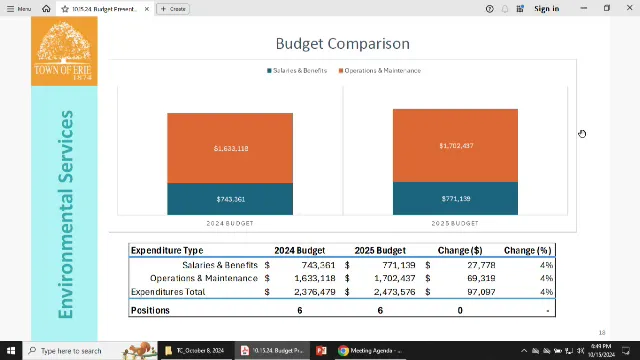
- Environmental Services (David Frank): New department; highlights include identifying re-plugged oil and gas wells, successful turf replacement program, and over $175,000 in grants.
- Finance (Cassie Bath): Department doubled in size to 17 staff; implementing ClearGov software, updating policies, and seeking deputy director.
- Economic Development (Julian Jackman, via Zoom): Decrease in operating costs; progress on Erie Gateway URA, Town Center, downtown infrastructure, and makerspace; working on first economic incentive policy.
- Public Safety (Chief Lee Mathis): Budget increase (51%) due to vehicle costs moved from fleet; no new police officer positions requested; hiring a full-time victims advocate; expanding drone and canine programs.
- Planning and Development (Deborah Batchelder): Added code inspection staff; processing 6% more land use applications; requesting one affordable housing planner (grant-funded); reduced affordable housing capital fund by $300,000 and operating fund by $2 million due to no immediate projects.
- Parks and Recreation (Luke Bollinger): Completed Schofield Farmhouse rehabilitation; funded new playgrounds; expanding recreation programming; updating parks master plan.
- Public Works (David Passick): Separated from utilities; major projects include County Line Road, town hall expansion, pedestrian bridge, and neighborhood speed management program; requesting four new positions.
- Utilities (Todd Fessenden): New department; completed North Water Reclamation Facility expansion ($30M); designing new North Water Treatment Plant ($175M over 5 years); requesting fleet procurement specialist and utilities project manager.
General Fund Forecast and CIP
- The forecast shows total expenditures below projected revenues throughout the five-year period, allowing for a healthy fund balance and transfers to the Capital Improvement Program (CIP).
- Street maintenance funding is restored to $4.5 million per year (2025-2028) and $5.5 million in 2029.
- The CIP fund balance is projected to grow, providing a buffer for unexpected costs.
Key Outcomes
- The council did not take formal votes but provided direction and asked clarifying questions.
- The proposed budget will proceed to a first public hearing on October 22, 2024, with a second public hearing and adoption on November 12, 2024. A supplemental tax levy and URA meeting are scheduled for December 10, 2024.
- Council members expressed appreciation for the collaborative process and the improved financial picture compared to the July preliminary forecast.
- Several councilors requested additional details on specific items (e.g., airport funding, 111th and Arapahoe intersection, nine-mile corridor revenues) to be provided in future meetings.
Meeting Transcript
But Cassie Bath. Yes. I'm great with faces, bad with names. So if I saw you every day that way, I wouldn't have. Good evening, Council. As Mayor said, I am Sarah Hancock. I'm the director of finance. We're gonna be walking you through a study session version of the budget this evening. Um first thing I wanna talk about is just our agenda. It looks really packed, but that is because all of the departments are here to speak on their individual um budgets, how the year has gone for them, and how that has informed their upcoming 2025 recommended budget. Um we're gonna talk through our community priorities and how we linked those to um how we drafted the budget this year. We'll talk through some of the financial summaries, including fund balance, general fund, revenue projections, and uh as well as our expenditures and any positions that we're um asking that we add this year, and then we'll get into having the departments talk through their budgets, and then we'll bring it back and talk quickly about the forecast, which once again, all of this information you'll see a lot more of uh next week with the official first reading. Um, but for now, this is more just to have a back and forth and help you all to understand how we put this together. Thank you. So I said that incorrectly. This is the first viewing first reading. Yes. No, it's reading will be at the official meeting. Exactly. Yes. So um, before I talk about the community priorities, I do want to briefly touch on the importance of process this year. We did things a little bit more collaboratively than we have in the past. Um that's something that I've spoken to uh at length uh every time I've been in front of you, the importance of having that kind of process. Um this year that included working very closely with the department directors, um making decisions as a collective, uh, working with the executive budget team, which included some department directors and staff that helped review and understand the budget. So we had a lot of eyes on this and um a very strategic lens to it. So I'm very proud of it. I'm proud of the team and excited to show it to you. One of the things that was big for us was to connect with the community priorities. These are our 14 priorities. We found a way to really focus in on five goal areas. Um, and we will speak speak at length uh next week about some specific projects that connect to those. Um, but just to reiterate that these priorities are on the top of our list and how we are looking at what we keep in the budget, what we add, and how we prioritize the different um funding requests that we get from departments. So this is a fund balance summary. We've seen this one before. This just really talks through what our beginning balance was based on the AC for this year, um, what we expect in revenues expenditures, and then whether or not we're expecting to see an increase or decrease and whether or not there's a restriction on that fund. Uh just a few things to note here. Uh, as was noted in the memo, the conservation trust fund does have a proposed uh revenue of $350,000 that still needs to be entered into the system. You will see that next week. Um, and then you'll also notice um that there's a 34,000 or sorry, 34 million dollar uh ending fund balance in the negative for the police impacts uh facilities impact fund. That is because of the COPs that we're planning to issue. So that is not truly a negative. That's just uh we don't budget for debt issuances. So if for some reason we decided not to move forward, that would simply come out of that budget. We wouldn't have a negative. Correct. The general fund um is in a much healthier place than the last time that you saw it. Um so you'll see the beginning fund balance uh is around 16.5-ish million. We have general fund revenues coming in just shy of 65 million. Uh at this point, our general fund operating and debt expenditures are just shy of 60 million. We'll have some transfers out, and then our non-spendable fund balance will stay at 3.6 million with a spendable spendable fund balance at 15.3.
openpublica.com