Town Council Study Session on Budget and Capital Projects - January 22, 2025
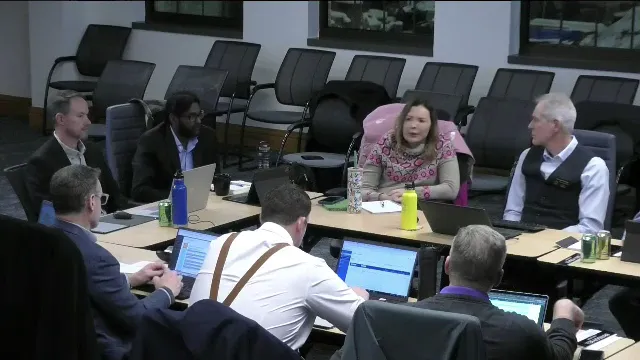
STREAMING COPY IN PREPARATION — RECORDING AVAILABLE FROM THE ORIGINAL SOURCE
Town Council Study Session on Budget, Fiscal Condition, and Major Capital Projects - January 22, 2025
This study session, spanning from 6:00 PM to approximately 9:00 PM, focused on the Town of Erie's financial outlook, budget process, major capital projects, and funding strategies. Town Manager Malcolm Fleming, Deputy Town Manager Melissa Wiley, Deputy Town Manager Patrick Hammer, and Director of Finance Sara Hancock (absent due to illness) were the primary presenters. Council members discussed revenue assumptions, expenditure trends, reserve policies, police station financing, and community priorities. The meeting was held on January 22, 2025, despite the agenda and transcript indicating January 21, 2025; the discrepancy is noted per instruction.
Discussion Items
- Budget Process Overview: Fleming outlined the year-round budget calendar, noting that the budget is formally presented to council by October 15 per charter and state law, with adoption required by year-end. He highlighted the dependence on mill levy certification from Boulder and Weld counties, which arrives in preliminary form in September/October and final in December.
- Fund Balance Summary: The all-fund summary showed expenditures exceeding revenues, but Fleming explained that transfers out (especially to the capital projects fund) account for the difference. He clarified enterprise funds (water, wastewater, stormwater, airport) are restricted to specific purposes. The airport fund's enterprise status is in question because more than 10% of its revenue comes from a general fund transfer; the current subsidy began about 18 months ago when the management contract with Vector Air was restructured to improve transparency. Councilmember Pastor Romelli requested a deep dive on airport finances.
- General Fund Forecast: Fleming reviewed slide 12, showing 2025 general fund revenues of $63.9M, operating expenditures of $58.9M, and an ending fund balance of $25.9M. The town maintains a 25% operating reserve (comprising TABOR 3%, emergency reserve 12%, stabilization reserve 10%). Mayor Moore noted that a previous $7M+ rainy day fund was repealed, and council has since adopted a resolution specifying reserve percentages and transfers to CIP. The ending fund balance is slightly above the 25% minimum.
- Revenue and Expenditure Assumptions: Assumed 10% sales tax growth, 3% property tax growth, 10% use tax growth, and 10% growth in building permits based on historical trends. Fleming noted that about 40%+ of revenue comes from sales tax, including internet sales. Development fees have shrunk relative to the past. On expenditures, personnel and benefits were assumed to increase 10% for 2025 (including 3% market adjustment and 3% merit), but benefits savings from switching to Kaiser kept total expenditure growth at 5%. Councilmember Schnieder questioned the 6% annual salary increase trajectory versus 2.5% inflation, urging awareness of public perception.
- Salary and HR Policies: Discussion delved into the merit system. The town decouples performance from pay increases (3% market + 3% merit for meeting expectations, plus a $500 bonus for exceeding), considered best practice by HR. Councilmember Pennock expressed unfamiliarity with this approach. Fleming promised to provide data on percentage of employees meeting vs. exceeding expectations.
- Capital Improvement Plan: The five-year CIP (slides 18-21) showed major projects including the Page property renovation ($3.6M for design in 2025), street maintenance ($4.5M annually), and water treatment plant (large jumps in 2026). Councilmember Pastor Romelli questioned the Page property cost versus new construction; staff noted the feasibility study will determine the best approach. The PROST strategic plan update was announced for February 11, 2025, to include community input on future recreation and performing arts facilities.
- Police Station Financing: The previous council directed using Certificates of Participation (COPs) for the new police station. Council debated COPs vs. general obligation (GO) bonds. With a $40M issuance over 25 years, COPs at 4.4% would cost about $700K more than GO bonds at 4.3% (a wash considering one year of construction cost escalation). Councilmember Pastor Romelli argued COPs tie up $65M in future revenue and divert from other projects like parks. He preferred a voter-approved bond despite risk of failure. Mayor Moore emphasized the need for community buy-in and transparency. Councilmember Pennock raised ownership concerns: with COPs, investors effectively own the building until repaid. Fleming noted the adopted budget already assumes COP payments, but other priorities (rec center expansion, outdoor pool, performing arts) are not yet funded. It was agreed that staff will bring back detailed analysis on COPs vs. bonds, including all-in costs, impact on other projects, and potential use of the police facilities impact fee fund.
Key Outcomes
- Staff will provide a comparison of COPs vs. GO bonds with hard numbers, including police facilities impact fee fund status and options for extending existing bonds (like St. Vrain’s model).
- The need for community polling on police station and other large projects was acknowledged; the existing bi-annual survey may be supplemented with specific questions.
- Upcoming study sessions were prioritized: comprehensive plan, affordable housing, water 101, and transportation.
- Fleming committed to sending council the CIP timeline for parks like Morgan Hill and Compass.
- The PROST strategic plan update and performing arts feasibility study will be presented at the February 11 regular meeting; council discussed possibly moving to a study session for deeper discussion.
Meeting Transcript
Tuesday, the twenty first of January, and I'll call to order the town council study session on the budget, fiscal condition, and major capital projects overview. And with that, I'll turn it over to our town manager, Malcolm Fleming. Thank you, Mayor Moore. I'm playing, I guess, back up. We were hoping to have Sarah Hancock here to do the bulk of this presentation. But uh people seem to be dropping like flies with the flu lately. And so she is out with the flu, and the common denominator seems to be having kids at home. And since my wife and I are empty nesters right now, um, I seem to be invincible when it comes to the flu. We'll look at the all fund summary, uh, the general funds specifically, because if you're not familiar with with how the town finances things, we have general fund that covers general categories like the police department, parks and recreation, mostly the recreation function, general government functions, and then we have a number of special funds fund specific purposes. So this separate fund accounting is a really important aspect of how we do our accounting. Um we'll look at the assumptions that we make about future revenues and expenditures that are the basis for how we put our forecasts together. We'll look at our long-term financial plan and uh again revenues, expenditures, uh reserves that we project over time. And then we'll look at some of the specific CIP projects that we have in mind for the future, some of which we're still trying to figure out how we will fund those because although I would say we're in strong fiscal condition, we still have to live within our means, and we can't fund everything. So we have to prioritize, and we'll talk about the prioritization process and get your feedback on that. And uh then we'll talk about our work with some consultants that have advised us in the past, and uh their recommendations on CIP and financing. So feel free to jump in anytime with questions. Uh we'll also have QA at the end. We've got three hours for tonight's discussion. Uh I hope there's a time to stand up and stretch during that at some point. So, but hope there's enough time to cover all of your questions. All right. And I'll say one thing just about study sessions in general, but I'm hopeful this is more of a free flowing conversation. Don't feel like I have to recognize you if we can just ask questions, and I will jump in if it looks like somebody's trying to get in and they they can't, but I'm hopeful this is more of a conversation than the formality of our board meetings. And actually, I don't do we have enough chairs. Uh I'd like staff to be around the table next time. We'll have a larger set of tables so that we don't have backbenchers. Um next time we'll we'll make sure that we get more tables so everybody can see. Oh yeah, yeah. Yeah, I'm gonna give the nice chair. Come on, Todd, you want the nice chair? I mean, you typically have senior shorter than usually don't give Todd senior. It's a dangerous thing. And I know you all have met the directors. Has everyone met Chad as well? I don't think so. I mean, we met passing, but normally uh facility generally. And Chad was instrumental in getting this building built on time and within budget, and facilitating the move from the other space to this one. I attribute uh this great meeting space to Todd and lots of other Chad and lots of other excuse me. I was thinking Todd, but in the great ceiling and acoustics in here. Well done. It turned out right. I was here for that conversation about the ceiling. A lot of conversation. And he's got a pulse on all of our other facility needs too, so that's why he needs to be at the table. All right, sounds good. So uh in terms of the town's budget process, you might think it's something that we really only do uh in October and November of the year, uh, but it's really an ongoing process throughout the year. Seems like uh just as soon as we get one adopted, we have to start again on the next one. And in February, we actually have at the department level our budget kickoff where we start um exploring um the budget calendar, make sure everybody's gonna be here for crucial meetings, and start looking at uh both what did we end up uh 2024 as and what does 2025 look like. Uh we'll start bouncing around big projects, um staffing issues that we might be looking at, and uh really look at training needs, uh fleet and capital requests. Uh we'll look at uh again draft forecasts.
openpublica.com