Erie Town Council Study Session: Comprehensive Plan and Affordable Housing Discussion - March 5, 2025
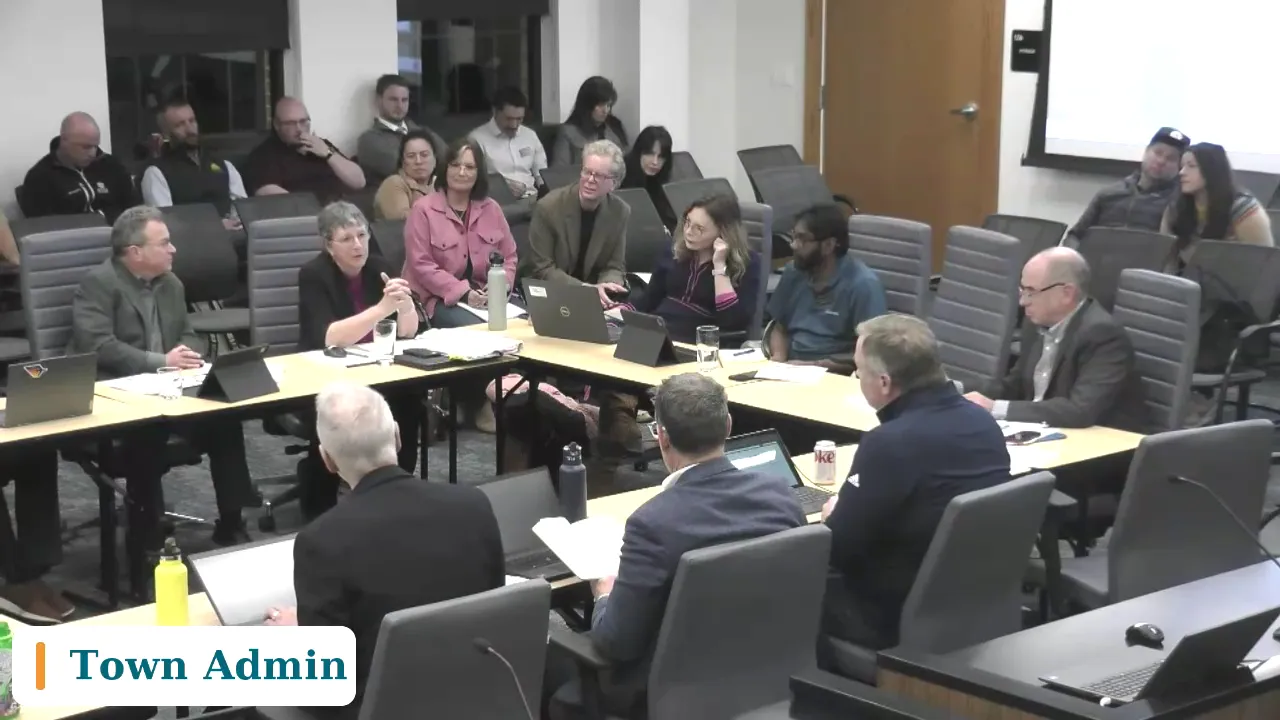
STREAMING COPY IN PREPARATION — RECORDING AVAILABLE FROM THE ORIGINAL SOURCE
Erie Town Council Study Session: Comprehensive Plan and Affordable Housing Discussion - March 5, 2025
The Town Council held a study session to discuss the Comprehensive Plan, related transportation and housing topics, and Ordinance 017-2023 on expedited development review for affordable housing. Staff presented details on land use density changes, fiscal analysis, housing affordability, and transportation planning. Council provided direction on several items, including a plan to repeal and rewrite Ordinance 017-2023.
Discussion Items
-
Comprehensive Plan and Land Use: Staff reviewed the two-year process to update the Comprehensive Plan, which included 7% community engagement. The new land use map increased medium density to 6-18 du/ac and high density to 12-30 du/ac, reflecting actual building trends. No new high-density areas were mapped; existing high-density zones are already entitled or built. A fiscal analysis showed that diverse land uses could reduce average cost per household by 46% compared to existing patterns. Some council members expressed concerns about density changes and requested a deeper economic analysis to understand trade-offs between density, taxes, and community character.
-
Affordable Housing Strategy: Presenters noted that 41% of Erie homeowners and 73% of renters are housing cost-burdened. The Cheeseman Residences project (deed-restricted, 120% AMI) has received 63 pre-applications but no contracts yet. Council requested data on applicants’ employment locations and occupations to assess whether the program serves Erie workers. Mayor Moore suggested exploring a voter-approved stipend program for affordable housing, similar to the open space tax. Council also discussed the need for rental affordable housing and the role of deed restrictions.
-
Transportation Mobility Plan: John Firouzi presented the Transportation Mobility Plan, which forecasts 2050 traffic volumes and identifies gaps. Council emphasized the need to see specific problem areas and planned solutions, particularly north-south connectivity and multimodal options. A detailed traffic model is expected to provide results in 4-6 months.
-
Ordinance 017-2023 (Expedited Development Review for Affordable Housing): The ordinance allows administrative approval of projects with 12% or more affordable units, including a 25% density bonus. Council members criticized the lack of public input and council oversight. They directed staff to begin the process to repeal the ordinance while retaining the definition of affordable housing, and to draft a replacement that requires planning commission and town council approvals, mandatory neighborhood meetings, and limits project size. Staff will also engage with the state to address the 90-day approval requirement tied to Proposition 123 funding.
Key Outcomes
- Ordinance 017-2023: Council directed staff to start the repeal process and bring back a replacement ordinance with stronger council oversight and public participation. Staff will also work with state partners on legislative changes.
- Comprehensive Plan: No immediate changes to the land use map; the 80,000 build-out population figure is acceptable for planning. Staff will provide cost estimates to bring in the fiscal analysis consultant for a study session.
- Affordable Housing: Council requested detailed data on Cheeseman applicants (residency, employment, occupation) and a breakdown of costs and funding sources before proceeding with further projects.
- Transportation: Transportation staff will present a list of identified traffic problems and planned solutions within 4-6 months.
- Community Survey: Staff will develop a proposal for a town-wide survey that explains trade-offs (e.g., density vs. taxes) and seeks resident input on growth and services.
- Village at Coal Creek: The formal agenda item was deferred; staff will provide information via memo to allow continued discussion.
Meeting Transcript
We have two items on the agenda tonight the comprehensive plan and related topics, and the second one is a discussion on ordinance 017 2023. I'm gonna read a brief introduction and then I'm gonna turn it over to our town manager, Malcolm Fleming, and we'll get uh get going in the study session. So, first I wanna uh welcome everybody here tonight, community staff and our council members for our open discussion on the comp plan, affordable housing, transportation traffic, densities, and of course, ordinance 17 2023. For me, this is less about growth because I believe growth will happen. It's really more about uh the quality, the type of housing, and of course, um the quantity of housing um that we'll move forward with. Um, we're here to learn and to ask questions uh that will ultimately inform our direction as a council. Um council has prioritized this topic from our retreat as it is fundamental to what Erie will become five, 10 and 50 years out. We are setting the pathway for growth, whether to hold or adjust the course. Either way, we will inform our move to higher density levels or not. We will also discuss ordinance 17 2023, which provides alternative standards for affordable housing projects, including the ability for staff to administratively approve high density developments with 12% affordable housing units and increased densities that are in the complan um by up to 25% with no council input or knowledge. In the end, this is a highly complex and nuanced discussion that has long-term implications on the most important community direction from numerous surveys. And that that is fiscal responsibility, thoughtful development, natural environment protections, and expanded recreational opportunities. I'll facilitate this meeting in an open conversation format, meaning that this is open dialogue, um, a much less formal than the council meetings. I'll only intervene if we start to talk over it on each other. And with that, I'll turn it over to our town manager, Malcolm Fleming. Thank you, Mayor Moore. Uh, I'm really gonna do a very brief introduction because it's mostly we're here tonight to let the staff talk about how they uh engage the public on the comprehensive plan, background information on the comprehensive plan, uh, some of the details about where density might be, how much it consists of, why we changed some of the definitions of uh density in the comprehensive plan, how comprehensive plans have uh morphed over time, and it's uh QA opportunity with council um to make sure that you're all up to speed on on all those details. So with that, I'll turn it over to Sarah Nermella, planning director. All right, uh thank you, Mayor, Mayor Pro Tem and Council members. Uh my name's Sarah Normella, I'm planning and development director. I have with me at the table our planning manager Kelly Driscoll, our affordable housing manager MJ Adams, and our transportation and mobility manager, uh John Frizzi. And then I also have a bunch of staff that have worked uh diligently on the comprehensive plan and related documents uh here tonight from multiple departments that are available to answer questions as we have this discussion. So let's see. So our intent tonight, let me just figure out how to move this, is to one inform the council with any information that may be pertinent and helpful to uh the policy discussion that we are going to have this evening and the direction that we're hoping to have from council tonight is on a policy level to help us understand where we might need to make updates to potential documents like the comp plan or others. So we will be asking for that to be confirmed at the end of the evening. So tonight I will be just introducing the comprehensive plan overall, and then each uh staff member at the table will take an area or two of interest that we've heard from the council over the past few months. Just to give you a bit of background on the comprehensive plan. I would say that the last time that we substantially updated our comprehensive plan was back in 2005. And we did a minor update in 2015, uh, what that was mostly map-based, but it had been a really long while and a lot of growth since we had updated our plan. And so it was very much due at the time that we embarked on it in 2022. So in October, we started the process. It's it was approximately two years in the making. And the pro every comprehensive plan process is iterative. It means that every step that we take, it builds on itself. And so we started with just understanding where we were. We had a lot of analysis and existing conditions, a lot of that, all of that actually is on our website, and uh that's something that people can dive into. And through that, we identified issues that helped us understand what we might need to tackle policy-wise in the document itself. Then we spent a good amount of time, about six months visioning with the community. And that process was the intent of that was to develop a vision statement that encompassed where we wanted to go as a community, and to make sure that that was an underpinning for the work that we were going to do with the comp plan. After that, we went through a land use scenario process where we were able to test that vision out on a many different levels, you know, density here, commercial there, and understand what the trade-offs would be, and that's why we do land use scenarios. We play a little bit with if we do this, what happens with that? We analyze traffic and we also did a fiscal model for the town so we could understand what that map mean in terms of our long-term resilience. And then we developed our policy framework that's every other page but the map in the comp plan. So a lot of work went into that. And then we finalized the draft plan in September of 2024 and took that to planning commission. We had a unanimous recommendation of front planning commission and move that into town council. We had a 4-2 adoption of the uh of the comprehensive plan, and we did have one former counselor speak in favor. Um, on the right side of this uh slide, I just want to note that this was a process that uh included a lot of community engagement. We'll dive into that a little bit more in a few minutes, but this hit about 7% of our population in terms of getting feedback from them. And I would say that in general, most comprehensive plan processes hit around one to three percent.
openpublica.com