Town Council Special Study Session on Facilities Needs and Capital Improvement Plan Overview - March 13, 2025
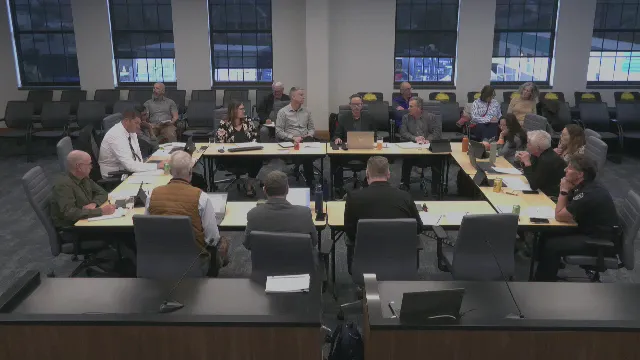
STREAMING COPY IN PREPARATION — RECORDING AVAILABLE FROM THE ORIGINAL SOURCE
Town Council Special Study Session on Facilities Needs and Capital Improvement Plan Overview - March 13, 2025
This special study session, held on March 13, 2025, from 6:00 p.m. to approximately 9:00 p.m., focused on the town's capital project needs and funding mechanisms. Mayor Andrew Moore opened the meeting, emphasizing an open conversation on the "what" (capital project needs) and the "how" (funding including taxes, cash flow, impact fees, and public-private partnerships). The session was led by Finance Director Sarah Hancock, who presented a comprehensive overview of the Capital Improvement Plan (CIP), facility needs assessments, financial position, and financing tools. No formal votes were taken, but council provided direction on next steps.
Discussion Items
-
Facilities Needs Background: Staff contracted with World Architects in 2020 and 2023 for facility strategic plans. Highest priorities identified: Town Hall (underway), Erie Police Station and Municipal Court Building (design nearly complete), Law Service Center (modular office planned, long-term expansion needed), and Erie Community Center. The airport terminal also has capital needs. The 2023 update focused primarily on the police department and law service center.
-
Staffing and Population Projections: Current population is 39,171 with 345.9 approved FTEs. The 2021 staffing plan projected 352 FTEs at 41,000 population, indicating the town is on track. Council discussed the need to align staffing projections with a timeline and noted the plan only extends to 66,000 population while the comp plan considers up to 80,000+.
-
Financial Position: Operating expenditures have grown in line with population. A capital improvement fund (CIF) was established with a $22.844 million transfer in 2025. The police facilities impact fund shows a negative ending balance of $33.7 million due to anticipated debt issuance (COPs) not yet budgeted as revenue. The town has very low debt, using only 5.3% of debt capacity. The general fund forecast shows a minimum fund balance maintained throughout the projection.
-
Water Treatment Plant: The largest CIP project, with preliminary design nearly complete. Construction budget may increase, estimated total cost includes raw water system and reverse osmosis. Approximately $70 million can be cash-funded from enterprise funds, with the remainder via revenue bonds.
-
Police Facility Expansion: Current police station was designed for 50 officers; staffing is 47 officers and 13 non-sworn staff, plus two co-responders. The building is over capacity. The proposed expansion (32,000 sq ft addition, 18,000 sq ft renovation) is budgeted at $35 million in the 2025 budget, funded via Certificates of Participation (COPs). Cost of delay was presented: one-year delay could add 10% construction inflation, election costs ($50,000+), retrofit costs ($1.1 million for courtroom remodel if delayed), and interest rate inflation (2% assumed). Council requested additional scenarios at 5% inflation and a 10% deflationary recession scenario.
-
Parks and Recreation: Key projects include Morgan Hill Park and Compass Park (design in 2027-28, construction 2028-29), Schofield Farm redevelopment ($10 million appropriated), and the Page Property/Village at Coal Creek ($6.75 million). Parks funding is scattered across multiple funds. Discussion of an aquatic center (estimated $17.5 million, 62% cost recovery) and potential partnerships with St. Vrain Valley School District and others. The PROS Playbook update is underway to gauge community priorities.
-
Funding Mechanisms: Presentation covered general obligation bonds (voter approval, property tax increase), revenue bonds (voter approval, sales tax), revenue bonds for utilities (no voter approval), and Certificates of Participation (COPs, no voter approval, higher interest rate, appropriate for mission-critical projects). Council debated using COPs for the police station vs. going to voters for a bond/sales tax. Impact fees were discussed as a way to recoup costs from new development; current police facility impact fee is $686 per dwelling unit; raising it to $3,850 could generate $2.5 million annually (assuming 650 units/year), but statutory limits and a rational nexus study are needed.
-
Community Survey: Council reached general agreement to conduct a more comprehensive community survey in 2025 to prioritize capital projects, gauge willingness to pay for different amenities, and provide context for trade-offs. Staff will issue an RFP for a survey consultant. The survey will not be completed in time to inform the 2026 budget process.
Key Outcomes
- Police Station: Council directed staff to continue design and pre-construction work (construction manager at risk procurement is underway). A final decision on funding (COPs vs. voter-approved debt) is expected by Q3 2025, when construction contracts would need to be signed. No stop was ordered.
- Community Survey: Council agreed to proceed with a comprehensive survey via RFP. Staff will bring back options for survey methodology and cost.
- Aquatic Center / Performing Arts Center: Feasibility studies deferred until survey results are available. The PROS Playbook update will provide additional data.
- Impact Fee Study: Staff will explore accelerating the impact fee study (currently planned for 2026 budget) to help inform police facility funding.
- Other Directions: Council requested multi-scenario cost analysis for the police station (5% inflation and 10% deflationary recession). Staff will also research ordinances on e-bike speeds on trails, loitering on medians, and potential street renaming (111th to Flatiron Boulevard). A joint meeting with Boulder and Weld County Commissioners was suggested. Free Wi-Fi in Old Town via Allo is being explored.
Meeting Transcript
To order the town council's special study session on March thirteenth. It's uh six p.m. I'm Andrew Moore, the mayor of the town of Uri. Um, and this will be an open conversation. Um, one of the things I love about study sessions is that we don't have to be as formal. I'll only uh interject if we start talking over each other or if time uh starts to become uh an issue. And so uh this is an important topic for us tonight. It's really on the what, what are the capital project needs and the how? How do you pay for capital improvement needs? And that could be everything from taxes to current cash flow to uh impact fees or maybe public private partnerships. And so I'm looking forward to uh just an open conversation on this journey to help us as council members understand where we're at, and then um, likely a survey that can help us solicit input from our community on what um what their priorities are. And so with that, um I turn it over to Sarah, or I turn it over to Malcolm for a few words. Sarah's done the bulk of the work on this. Uh has been a team effort, but we're really relying on Sarah, and she knows the ins and outs of our capital program. So this with that comment, I'll turn it over to Sarah. Sure. Uh, thank you. Sarah Hamcock, I'm the director of finance here. First, before I get started, I want to just let you know what you have in front of you this packet. I wanted to us to have something in front of us to look at while we're having a discussion. I know sometimes you know, turning and looking at the screen is a little rough. And then also I don't like spreadsheets on screens. It's hard to read. So now you have something to look at that should help us with the conversation. Additionally, there's a the page number that the uh project is in this little packet. These are pages from the CIP. And the reason I put this together is that if we want to look quickly at the funding sources, at the years that these are scheduled, at any details that were uh included in the CIP, we have that right there at our fingertips, and we don't have to just you know try to figure out how to get it up on the screen. So that idea was to add some ease to the conversation. Um the only other thing I will say uh this uh presentation probably feels like a lot. Um and I do know that it's gonna be a lot of information. I am gonna ask that we try to get through the presentation before we have too many questions, simply because I think I'll probably answer some questions by the time I get through it. Obviously, if it's something like burning, like jump in, um, but really want to try to get through it because I crafted it really to support the discussion. Um, so with that, I will jump in. So this evening we're going to um go through a journey, if you will. Um, we're gonna start with how we got here and how we have come to the projects that you see before you, and that includes several years of facilities, needs assessments and planning, uh, as well as our long-range staffing plan. Then we're gonna look a little bit at the financial position as it relates to capital projects, and that means how we've structured them, how some of the funding is structured, uh, and then some of our main capital needs, including um some main uh main facility needs and some parks, uh, which seem to be the ones that we really need to grapple with uh in terms of funding mechanisms, which brings me to how we'll wrap up, which will be talking a little bit about what tools we have in our toolbox outside of our existing revenue streams, which in general means debt. So we'll talk through that as well. So, way back in 2021, um, actually 2020, we contracted with World Architects to develop a strategic plan around our facilities. And the idea was to understand our current facilities and how they were uh how they were doing, how many people we had in them, um, what their condition was, uh, and what our staffing projections were going to look like as the population in Erie grew. Um, this also included a space needs analysis as well as standardizing uh our office space and also identifying any needs we had, including additional space and recommendations from that um from that group. So the large needs that were um immediately apparent in the study were town hall. Um we were found that that was the highest priority. Uh I was not here then, but I heard that we were elbow to elbow in here, and so the that became a very high priority for for the town. Uh, as well as the Erie Police Station and Municipal Court Building, uh, the Laws Service Center and the Erie Community Center were all identified as top needs for the town. Um, so this, you know, once again, way back in 2025 years ago, we started to realize that these were the priorities and they needed to be addressed in terms of facilities. Then in 2023, uh, we contracted with World Architects again to update the strategic plan to make sure we were still on track, um, but also to take a really close look at the PD building because that seemed to be a need that was emerging quicker than others. Um, so the plan was aligned to the 2021 plan, like I said, to make sure we're still on track. Um, and then the objectives, priorities, and the criteria were updated specific to the PD building. Um, then those space needs for the facility were outlined in the plan, and those final recommendations ultimately informed uh the what we have now, which is moving towards uh completing design. Uh most of the needs were related around how many officers and uh non-sworn folks we could have in the building, but as well as the square footage just needed for doing reports, lockers, um, basic uh areas for people to have meetings.
openpublica.com