Erie Town Council Study Session - March 18, 2025: Economic Incentives, I-25 Gateway, Legislative Agenda, Beneficial Electrification
STREAMING COPY IN PREPARATION — RECORDING AVAILABLE FROM THE ORIGINAL SOURCE
Erie Town Council Study Session - March 18, 2025
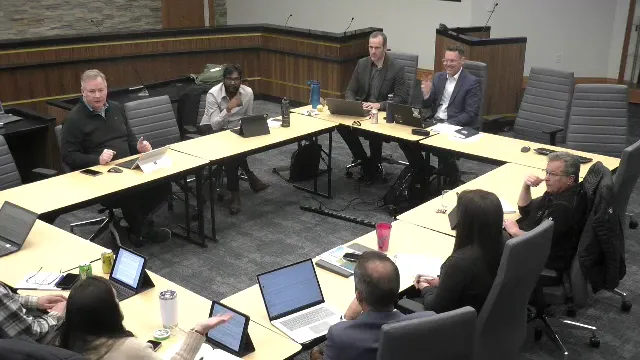
The Erie Town Council held a study session on March 18, 2025, from 6:00 PM to 9:40 PM. The meeting covered four major agenda items: an overview of economic incentives, an update on the I-25 Erie Gateway development, discussion of the 2025 legislative agenda, and a presentation on the draft Beneficial Electrification Plan. The scheduled discussion of oil and gas was postponed due to time constraints. No formal votes were taken; the council provided directional guidance on several items.
Discussion Items
Economic Incentives Overview
- Staff (Jack Hill, Economic Development Specialist) presented that there is currently no town-wide incentive policy, as Erie transitioned from a statutory to a home-rule town. Existing tools include the Enhanced Sales Tax Incentive Program (STIP), metro districts, and a separate policy for the Urban Renewal Authority (URA).
- Hill outlined various incentive types: sales/use tax rebates, development fee discounts/rebates, property tax rebates, special financing districts (e.g., metro, business improvement districts), cash grants, infrastructure support, land provision, and expedited development review.
- Discussion emphasized targeting retail/restaurant development to capture sales leakage. Hill cited $64 million in annual restaurant leakage and a commercial vacancy rate of 0.5% (99.5% occupied), indicating strong demand but insufficient inventory.
- Council members expressed support for a policy that includes safeguards (performance-based incentives) and flexibility for unique projects (e.g., an amphitheater). Staff was directed to bring back a formal incentive policy document, including a comparison table of incentives used in neighboring communities (Windsor, Loveland, Johnstown, Brighton).
I-25 Erie Gateway Overview and Update
- Planning Director Sarah Normella, Economic Development Director Julian, and Public Works Director David Passick presented. The Gateway area covers approximately 1,200 acres at Erie Parkway and I-25, with 600 acres owned by CDG (John Lee) and 255 acres town-owned.
- Infrastructure challenges: a $30.6 million sanitary sewer trunk line and lift station needed; a phase of the Summerfield trunk line is under construction. A CDOT-funded interchange study for Weld County Road 10 is underway, but CDOT has indicated no support for new interchanges due to spacing and greenhouse gas emissions policies. Private funding may be possible.
- A URA (Urban Renewal Authority) Phase 1 was adopted in August 2024 for 1,100 acres and 600 parcels, expecting up to $180 million in tax increment financing over 25 years for infrastructure. Revenue sharing agreements were reached with nine taxing districts.
- Heinz (developer Chad Murphy) was selected via competitive RFQ in 2021 for the town-owned 255 acres. A letter of intent was signed in 2024, including a minimum 20% affordable housing requirement. A land contract is expected summer 2025. The planned development (PD) will go to planning commission in April and council in May.
- Council discussed potential for a future recreation/community use (e.g., ice rink, aquatics) and an amphitheater concept. Field trip to similar walkable developments (e.g., Part Terra in Thornton) was suggested.
2025 Legislative Agenda Discussion
- Communications Director Gabby presented the draft legislative agenda. Council provided direction on several items:
- Kept: Support for local government autonomy/home rule; funding for transportation; affordable housing funding aligned with local costs; construction defects reform for condos; rights of manufactured home communities.
- Revised: Item on transportation to remove "reduce greenhouse gas emissions" and "prioritizes" – replaced with support for legislation that funds innovative and collaborative approaches to safety and multimodal investments.
- Removed: "Expand housing funding…including by referring to voters a measure to amend the state constitution" – council preferred a neutral stance on real estate transfer taxes.
- Pulled for further review: Item on programs/services for housing crisis/homelessness (rent control/eviction concerns). Staff will send a revised version for email feedback; a deeper dive scheduled for fall 2025.
Town of Erie Beneficial Electrification Plan Draft with Partners In Energy
- Sustainability Manager Erica Forley and Andrea McCarthy (Partners in Energy) presented the draft plan, developed at no cost to the town through Xcel Energy’s partnership.
- The plan addresses 58% of Erie’s greenhouse gas emissions (38% from buildings, 20% from transportation) through efficient electrification of heating, cooling, and vehicles. Goals: community building electrification, electric vehicle adoption (aligned with Boulder County Regional EV Plan), and 100% net zero energy for municipal facilities by 2030.
- Strategies include residential energy audits, heat pump installations, new construction pilot projects, and town fleet electrification. Xcel Energy and United Power representatives described contractor education and grid preparation.
- Council discussed: heat pump efficiency in cold climates (confirmed effective); availability of home energy audits (Xcel and United Power offer free audits); concerns about rooftop solar after hailstorms and insurance issues; community solar garden options (available via Xcel but not United Power yet).
- An award of $900,000 from the Energy Impact Assistance Fund for solar floatovoltaics at the wastewater treatment plant was announced. Also, a grant for 13 Level 2 EV chargers at town sites was received.
Key Outcomes
- Economic Incentives: Staff will return with a formal policy document incorporating council feedback and a comparison of neighboring cities’ incentives.
- I-25 Gateway: The PD for town-owned property will go to Planning Commission in April and Council in May 2025. The land contract with Heinz is expected mid-2025.
- Legislative Agenda: Revised agenda will be circulated via email for council approval; some items were removed or modified. Council will revisit in fall for the 2026 session.
- Beneficial Electrification Plan: Final plan to be brought for adoption in April 2025. Staff will continue implementation with Partners in Energy for 18 months.
- Oil & Gas Discussion: Postponed to a future meeting.
Meeting Transcript
Here we go. I'm uh Mayor Andrew Moore, and I'm calling to order the study session on March 18th, 2025. We have four agenda to items tonight. Uh, the economic incentives overview presentation. This was moved from our last meeting to this meeting simply because the meeting was going too too long. Um, we also will um learn about the I-25 year gateway overview update. Um we will go through the legislative agenda and to see if there's any uh directional changes in that. Um then we'll move on to the town area beneficial electrification plan draft with partners in energy, and last um there will be a discussion of oil and gas. Um we will stop the meeting tonight right around 9:30 p.m. And so Malcolm and I have spoke about um the fact that um if anything isn't urgent um prioritize it last. And so this uh the order of items tonight um actually staff uh set the order, and so um um I think we're set, and with that, I think I'll turn it over to Jack and we'll talk a little bit about economic incentives and yeah to go from there. Absolutely. My name is Jack Hill, this is well. I'm a specialist for the town of Erie economic development department. Um here with you all today to talk about economic incentives and what that might mean for the town. Um quick overview of the agenda. I'll give a kind of a quick background, incentive overviews, kind of some incentive types that there are eligible, typical eligible industries, the incentive process as a whole, our kind of staff recommendation, and open it up for questions and discussions at the end. Um so currently there is no town-wide incentive policy. That's kind of something that I was kind of shocked to find when I first started working here a year and a half ago. Um I learned that's because we were a statutory town at the time, and now we are home rule, and now we kind of have the ability to craft a true economic incentive policy. Um we have a couple of tools in the tool belt right now. Right now we have the enhanced sales tax incentive program, the STIP program, which is codified. Um, I'm not sure it's ever been used. Um, but it's there, it exists. Um we have metro districts, um, and we have a separate policy for Tor. Um and so the goal tonight is kind of um we we kind of started this process of crafting a policy and then kind of stopped ourselves and we're like, we should probably bring this to council and talk about um incentive types, you know, what others in the region are doing and what kind of makes the most sense for Gary. So um that's why we're here tonight. Um economic incentives are um typically targeted uh public assistance to businesses and developers to uh catalyze the local economy, whether it's through uh job creation, capital investment, um filling a market gap, um revitalizing old buildings underutilized land, um towns utilize incentives to um incentivize businesses and and developers to build something, create something that might not exist otherwise. Um and so our mission is is up there. It's is it's to um both create new jobs in capital investment in town, but but also attract um new and unique users that the town is kind of um say desperate for, but currently we're we're losing out um a lot of money to our neighbors, especially on the retail and restaurant side, and so having a dedicated policy um kind of creates not only guardrails, but having a targeted approach to incentives that I think would be beneficial. We think would be beneficial to the town. Do you want questions as we go or um to questions as we go? Yeah, um so the incentives um as we go. I'm thinking about the restaurants. If we had a standardized policy, does that help you in the negotiations by saying kind of like our UDC? Um, I think help Sarah to a large degree when she's doing development agreements. Would a policy in this frame also help you, or does it create too much constraint? Or you know, where's that balance? Yeah, and I think that's kind of what we why we're having this discussion is because you can make this as broad as you want. You can also make it very targeted, and so I think there is a healthy balance between the two. Saying that this these are the type of businesses we want to attract in the immediate future because especially when it comes to retail of restaurants and the independent and more local type businesses, it's very difficult to build out new retail and to build new retail, especially. I know we talked to a lot of developers that see retail as a as a loss leader in most cases, where um without public assistance, they're likely not going to build these larger developments. So it is definitely helpful for us to have something to point to to be like these are the things we can do to help you know get you over the hump and make your dream a reality. Um it definitely helps give us the tools we need to be successful. Right, and I guess uh not to be, I mean, just put it out there for you to maybe answer as you continue to go forward in a similar way that the UDC sets our code, but then we have PDs that sit on individual developments that may change the UDC. Um, you know, is it does there need to be a mechanism for that, right? In general, here's our incentives in separately. Do we need to do something where council could approve more flexibility? I don't know. Anyway, I'll just put it out there for you to think about as we're going forward.
openpublica.com