Erie Town Council Special Meeting – May 20, 2025: Building Code Sprinkler Requirement and Air Quality Monitoring
STREAMING COPY IN PREPARATION — RECORDING AVAILABLE FROM THE ORIGINAL SOURCE
Erie Town Council Special Meeting – May 20, 2025
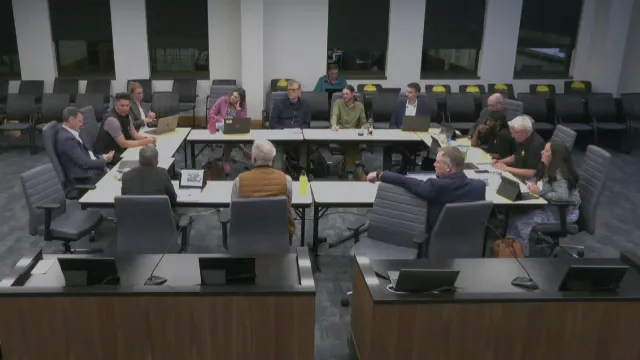
The Town Council held a special meeting on May 20, 2025, at 6:30 PM in Council Chambers to discuss and vote on two major topics: the residential fire sprinkler requirement in the building code and the future of the town's air quality monitoring program. A future parks funding presentation and a discussion on oil and gas were deferred to a later date.
Discussion Items
Update to Building Code – Sprinkler Requirement for Residential Homes (6:45–7:30 PM)
- Joel Champagne (Deputy Building Official), Morgan Cullen (HBA of Metro Denver), Doug Saba & Michelle Kelly (Mountain View Fire Protection District) presented. The town adopted the 2021 IRC with full sprinkler requirements in 2022. The HBA argued the $16,000 cost per home, combined with other rising fees (water tap fee increase to $57,000, new IECC mandates ~$5,500, metro district requirements ~$5,000), has made Erie the second most expensive in Metro Denver for impact fees. Building permits dropped 45% year-over-year (386 permits Jan–May 2024 vs. 173 in 2025). They requested repeal to improve affordability and regional competitiveness.
- Mountain View Fire Protection District countered with NFPA statistics: sprinklers reduce risk of dying in a fire by 89%, reduce property loss by 70%, and only one sprinkler operates in 85% of fires. The average cost in Erie is about $1.75/sq. ft. ($7,000 for a 4,000 sq. ft. home). They noted a potential 8-12% insurance premium reduction.
- Council debated cost discrepancies ($7,000-$60,000 estimates), insurance savings, and the balance between safety and affordability. Some members proposed keeping sprinklers only for townhomes/duplexes, but concerns about disincentivizing missing-middle housing led to support for a full repeal option.
Air Quality Monitoring Discussion (8:00–10:29 PM)
- David Frank (Environmental Services) introduced the program, which has cost $2.96 million since 2021. Detlev Helmig (Boulder AIR) presented data from the Erie Community Center station, showing Erie has higher ozone, PM2.5, methane, and VOC levels compared to Longmont and Broomfield. He highlighted a finding that actual oil and gas emissions are 2.5 times higher than industry-reported inventories.
- Brent Buck & Morgan Frazier (Ajax Analytics) described their mobile summa canister network that has triggered rapid responses, such as during the Flat Iron Meadows combustion device event. They highlighted the upcoming Draco pad as a key monitoring priority.
- Council considered five funding options. Option 5 (only summa canisters, no live station) was estimated at $415,000/year; Option 3 (live station + canisters) at $615,000. The 2025 budget was $500,000, but $400,000 already spent, leaving $93,000 for the rest of the year.
Key Outcomes
Sprinkler Requirement
- Motion passed (6-1): Direct staff to bring back an ordinance repealing the residential fire sprinkler requirement for single-family, duplex, and townhome dwellings. Additionally, staff will gather:
- Clarity on actual insurance benefits/costs
- Average install cost for a 2,000 sq. ft. home
- Builder savings from reduced fire separation requirements
- Potential setback incentives for sprinkler-equipped homes
- The repeal ordinance will return to Council for a public hearing and vote.
Air Quality Monitoring
- Motion passed (7-0): Pre-allocate $300,000 for the 2026 budget for air quality monitoring (retaining the Boulder AIR live station and funding a summa canister network). For 2025, a supplemental appropriation of approximately $50,000 will be requested to provide flexibility. Staff are directed to negotiate with vendors to achieve the best value within that budget.
Meeting Transcript
May 20th, 2025. It's a special meeting to allow us to actually make motions if necessary to give staff direction. But we're going to use the study session format. And so this is going to be just open discussion, and I will only uh facilitate if we start to talk over each other. All right, with that, um you please rise and join me in the political leader. I pledge allegiance to the flag of the United States for which one nation under God with liberty uses. All right. Please take roll. Councilman will test me around. Council member of Honor. Here. Here, just on the neck at the end. Here. Council Member Baer. Present. Council Member Mortalera. Here. And Councilman Mm. Here. All right. Thank you. All right. Do we have an approval of the agenda of which we have four topics tonight? I'll just go through them quickly. The sprinkler requirement for residential homes, future perks funding options, air quality monitoring, and uh discussion on oil and gas. We have a motion to approve. Motion approved. Second. All right, we have a motion second. All in favor say aye. Aye. Aye. All opposed, say no. All right. We have an agenda, and with that, we'll jump right into the building code and sprinkler requirement discussion. Thank you. Deborah Basselberg, Deputy Director of Planning and Development. Tonight we have here to discuss this topic, Ed Kablinski, who's our building official. Joel Champaign, our deputy building official. Dan Galasso and Morgan Cullen from the Home Builders Association of Denver. So we're here to talk about the requirement that the town of Erie has for fire sprinklers in single family and attached residential dwelling units. Next slide, please. Okay. So history uh with as it goes to um residential fire suppression in uh residential structures. Um prior to uh 2019, the town of Erie was enforcing the uh 2006 I codes. Uh specifically, the 2006 IRC did not require residential fire sprinklers at that time. Uh in 2009, the IRC introduced residential fire sprinklers and it was adopted. Um the entire and require a requirement of the code at that time. Uh in 2019, the town of Erie adopted an ordinance uh and adopted the 2015 IRC and with uh an amendment exempting the residential fire sprinklers from the code at that time. 2022, the town of Erie adopted the 2021 IRC with full sprinkler requirements were retained in the code at um at that time and has been in force since then.
openpublica.com