Fort Worth CCPD Board Approves FY2027 Budget of $146.7 Million on August 21, 2026
STREAMING COPY IN PREPARATION — RECORDING AVAILABLE FROM THE ORIGINAL SOURCE
Fort Worth Crime Control and Prevention District Board Meeting – August 21, 2026
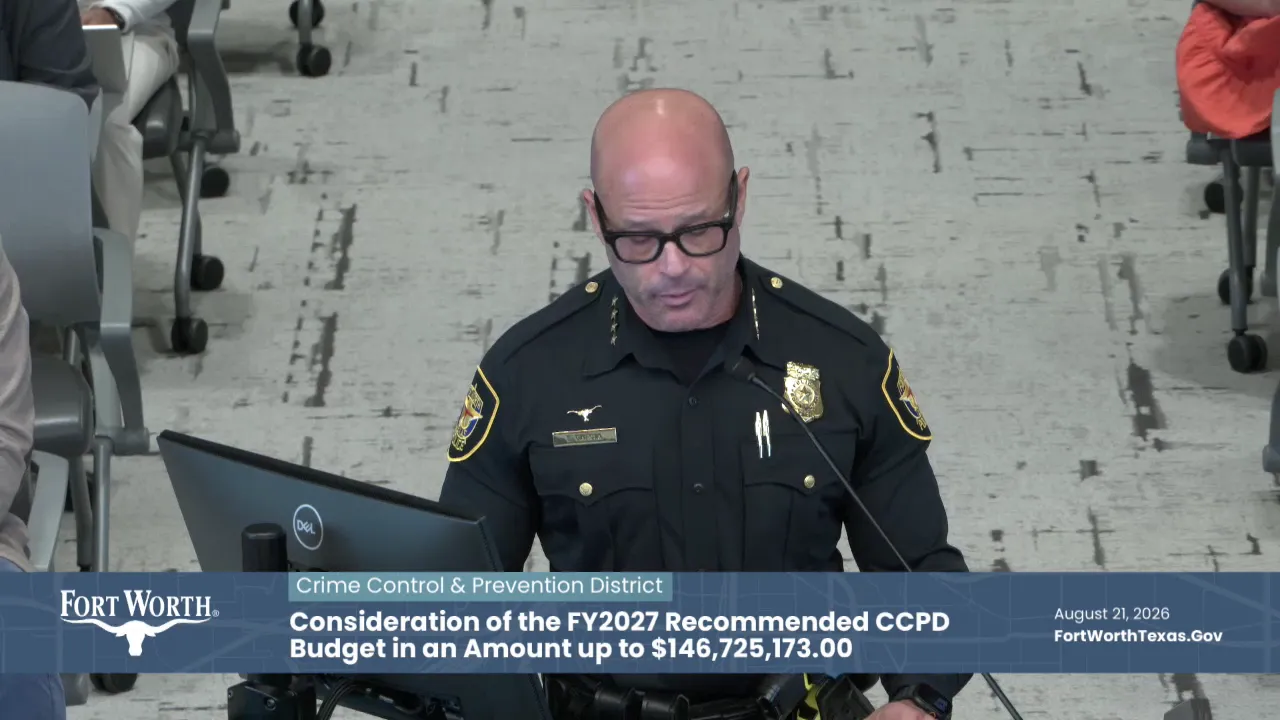
The Fort Worth Crime Control and Prevention District (CCPD) Board of Directors met on Friday, August 21, 2026, immediately following the City Council Budget Work Session. The primary action was consideration and approval of the FY2027 Recommended CCPD Budget totaling $146,725,173.00. The meeting included a staff presentation, a public hearing (with no speakers present but written comments submitted), and a detailed discussion on the use of Flock ALPR technology and constitutional policing.
Public Comments & Testimony
- Two individuals registered to speak (Antoine Joseph Hadari and Ryan Al Moussawi) were not present. Written comments were submitted, distributed to the board, and placed on file.
Discussion Items
- FY2027 Budget Presentation: Keith Morris, Assistant Director of Police, presented a simplified overview of the budget changes between FY2026 and FY2027. Total expenses increased by $8.1 million, revenue increased by $6 million, and a planned use of fund balance of $2.1 million was included. Staffing changes were outlined, including the movement of a sergeant from the CIT team to the Stockyards bike patrol team. Reductions across programs (e.g., crime prevention specialists) were made through cuts to operating supplies rather than eliminating entire programs.
- Program Evaluation and Partner Review: Chief Garcia and Councilmember Charlie Lauersdorf discussed evaluating CCPD partners through a criminological lens to ensure programs are evidence-based and effective in reducing crime. The Chief emphasized being good stewards of CCPD dollars and using data to measure program impact.
- Flock ALPR and Constitutional Policing: In response to a question from Councilmember Michael Crain about submitted comments on license plate readers, Chief Garcia provided an extensive overview of the department's approach to Flock technology. He highlighted its value in solving crimes and reducing violent crime, while acknowledging the need for robust guardrails. He outlined a work plan including: developing a structured process for use, misuse detection audits, annual recertification for officers, updating the ALPR general order, and advocating for state-level penalties for misuse similar to CJIS violations. Councilmember Chris Nettles requested that a future presentation include both successes and any missteps or abuses locally and nationally. Mayor Mattie Parker suggested that all council members visit the Real-Time Crime Center to inform future discussions.
Key Outcomes
- Approval of FY2027 CCPD Budget: The board voted unanimously to approve the FY2027 Recommended CCPD Budget in the amount of $146,725,173.00. Mayor Flores complimented staff for their hard work and responsiveness to questions.
- Future Agenda Items: A request for a future agenda item regarding the Flock ALPR presentation was noted by staff.
Meeting Transcript
Okay, it's 11 after 10. The call to order the CCPD board of directors meeting for Friday, August uh 2st. And uh first item business is a consideration of FY27 recommended C CPT budget. Uh Keith Morris. Keith Moore, Assistant Director of Police. Uh I have a few follow-up slides that I sent through based on some of the conversation that we had. Uh I think we do have queued up uh behind that the other slides if we need to get into them. Uh so I'll just I'll share a little bit uh this morning and then here for any questions that you may have. Uh so this is a simplified uh version. Uh there's so much in CCPD, 50 over 50 programs, and they each have a very unique identity. And so it's always a challenge how to divide it out. And so we tried to go simple on this just to kind of show you the overall changes between 26 and 27 uh with the uh the total increased expenses of 8.1 million, the increase in revenue of six million, and then we have a planned use of fund balance of 2.1. And so that's kind of how all the numbers shake out what we presented on Tuesday uh between all of the programs. Uh also in here uh is uh kind of a simplified uh detail of the staffing changes. Uh those are just the the affected programs and and the 26 numbers and the 27 numbers and kind of how they changed. We had some changing between uh programs to staff up uh programs like bike patrol uh and uh and move some positions over from uh general fund for the the community alliance commands, some of the gr expiring grant positions, that kind of thing, and uh additional positions that are listed in there as well. Uh the other slides that I provided uh sent through yesterday. Hopefully you got them, uh, provides a summary of the changes uh for each program. And so with that, I'll open up to any questions uh because there's lots of different programs, there may be a lot of different questions. Yeah, I just go ahead and yeah, one question about um the decrease in the uh the one person decrease in the CIT team. Yes, that's a sergeant that we moved over uh to the stockyards bike patrol team. Okay. Um just a point of uh clarification, Keith. Um cover for us uh what reductions you have uh as it impacts uh uh crime prevention specialists. Uh so the crime prevention specialist program, uh so we went through the reductions, the one and the three percent reductions across the board. We did it in C C P D as well, so all of uh the department was going through the same reductions, and so we identified uh some reductions in each program. I believe in the crime prevention specialist program, we had some reductions in uh operating supplies uh in some of the the signs. We let there still left some in there, but the deputy chiefs reviewed each of the units underneath their command uh to look at reductions in the individual programs. So rather than cutting large programs, it was a little bit of cut to individual programs. All right, any questions by board members? Charlie. Thank you, Keith. Um uh Chief Garcia and I we've we've had good conversations regarding the um uh constitutional policing, and I think the really good things that will come from that, especially driven from data, uh, and not just emotion. And part of that conversation was regarding um partners with the shared mission as well, and really evaluating those partners and make sure that we have the right ones in place. So I don't know if Chief Garcia just put you on the spot um just so others can hear it since it was great information, just telling us about what your your plan is there and your outlook. Oh, yes, council member, thanks for the question. I think I alluded to it on Tuesday. Uh when we look at our partners and our partnerships of really taking a look through a criminological lens at the programs that are providing. Um obviously, as we've said before, and as we've talked about with budgets, I mean, in particular in these times as well, being good stewards of our C C P D dollars. Uh, we have to ensure that we have programs that aren't just nice to have, uh, but actually have shown that they're they do have an impact on what we're trying to accomplish with C C PDE, which is reduction of crime, prevention of crime, and better public safety. And so by looking through a criminological lens, we're gonna be able to see what programs actually have shown uh if there's literature, if there's things around the country working with criminologists to show that they have worked. Uh in addition to that, what programs uh what what metrics do we need do we need to grade these programs? Um are they offering in a year-year basis what you promised that you would offer? Um so if you're gonna we're gonna fund you, then we hope that what you promise we're gonna have that is showing its worth. Uh and so I think it's something that uh looking through it through a criminological lens as we're being data driven and looking at the programs that we have, really truly just looking at it and saying, okay, what programs are nice and what programs have shown evidence that they work. Uh, and obviously that's gonna help in our selection process uh and this and as we go through our uh um you know through that program. Thank you, Chief. Thank you. Any other questions? All right.
openpublica.com