Budget Work Session – August 21, 2026: Fee Overview and Restoration Options Discussed
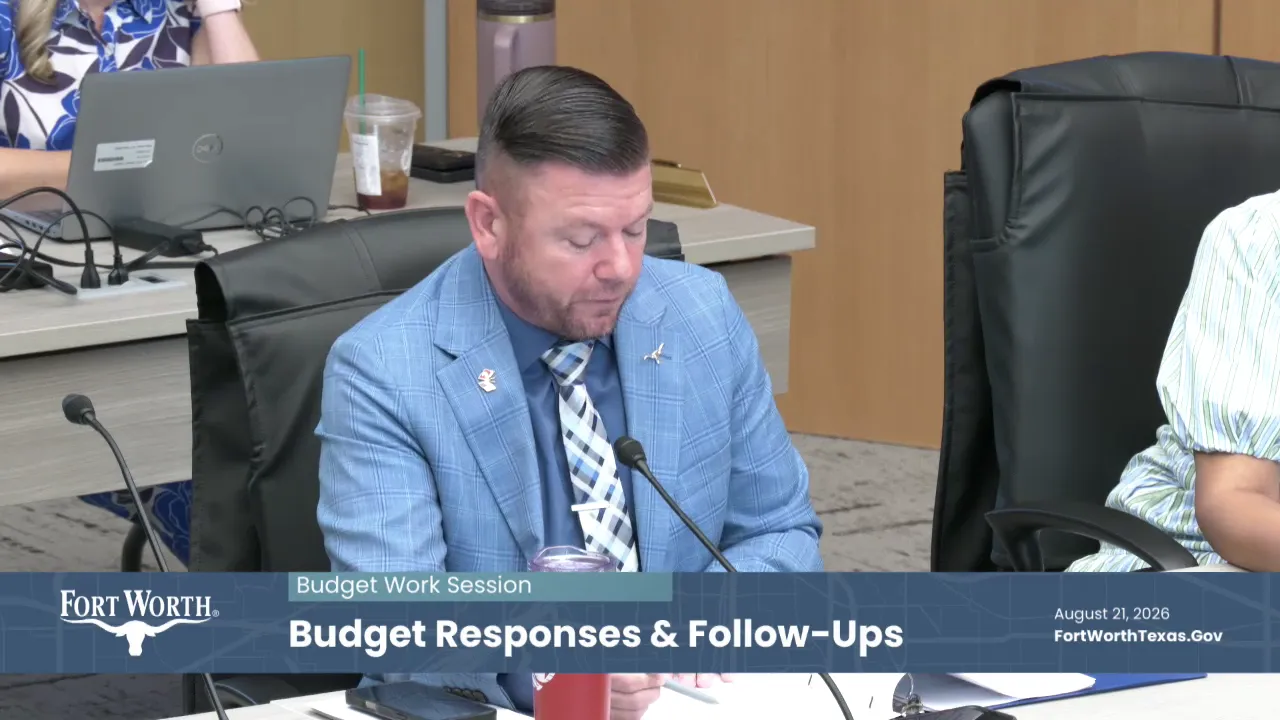
STREAMING COPY IN PREPARATION — RECORDING AVAILABLE FROM THE ORIGINAL SOURCE
Budget Work Session – August 21, 2026
The Fort Worth City Council held a budget work session on August 21, 2026, to review proposed fee increases for FY27 and discuss options for restoring previously recommended cuts to services and positions. The council heard presentations from the Fort Worth Lab and several department directors, and provided direction to staff to prepare a revised budget that includes service restorations and a mid-year pay-for-performance plan for general employees, while still keeping the average property tax bill below the current year.
Discussion Items
- Property Tax Rate: The recommended budget includes a 3.2% increase to the tax rate (to $0.702 per $100 valuation), but because taxable values have fallen, an average homeowner would pay about $16.69 less per year (a 1% decrease).
- Water, Wastewater, and Stormwater Fees: Water fixed charge increases ~5% (~$0.70/month), wastewater fixed charge ~6% (~$0.63/month), and stormwater fee increases ~5% (~$0.36/month). Volumetric rates for water are unchanged; wastewater volumetric increases <1%.
- Solid Waste Rates: Recommended 20% increase for a typical 96-gallon cart ($5.15/month; $62/year) to ensure long-term capital planning.
- Environmental Fee: 11% increase ($0.25/month; $3/year).
- Combined Impact: Total increase for a typical household is ~$5.70/month ($68/year), which equates to less than a 2% annual increase when property tax savings are included.
- Development Fees: A 5% across-the-board increase, supported by the Development Advisory Committee and Real Estate Council. Impact on a newly built home is estimated at less than $100.
- Parks and Recreation Fees: Junior golf pass fee increase (special rates for First Tee and ISDs unaffected); community center and nature center fees adjusted for benchmarking; no increase in non-resident fees for the nature center.
- Credit Card Processing Fee: Staff recommended raising the pass-through cap from 2.5% to 5% to cover actual vendor costs (some vendors charge up to 5%). Councilmember Larsdorf requested a review of current rates and vendor pricing.
- EMS and Municipal Court Fees: EMS fee increase to be discussed at Public Safety Committee in September; new civil parking fees and increased boot fee proposed.
- Budget Responses and Restoration Options: Staff provided a menu of service restorations from five departments (Code, Development Services, Library, Parks & Recreation, Transportation & Public Works) along with the cost to add back positions and programs. The total restoration cost (including mid-year pay-for-performance at 4.5% for non-executive staff) is equivalent to a tax rate increase of 0.364391, which would still result in an average tax bill approximately $8 lower than FY26 (vs. $16 lower in the original proposal).
- Public Art Funding: Councilmember Larsdorf raised the possibility of temporarily pausing public art projects funded by bonds. City Attorney indicated council could choose not to allocate bond funds for art, but noted that bond proceeds are restricted to capital purposes. The mayor suggested deferring that discussion to a future work session.
- Employee Pay: Several council members expressed support for including pay-for-performance to retain and support city employees.
Key Outcomes
- Council gave staff direction to prepare a revised budget incorporating the restoration of services and positions from Budget Response #21, plus mid-year pay-for-performance for general employees, with the corresponding tax rate increase.
- The revised budget will be presented to council and the public, and a summary will be provided to council members for their upcoming community budget meetings.
- Next steps: Budget follow-up at the regular work session on August 25; final community budget meeting on September 3; public hearing on September 1 at 2 p.m.; adoption of the tax rate and budget scheduled for September 15.
Meeting Transcript
Good morning. I will call our budget work session to order. Happy Friday to everyone. And I'll turn it over to Jay Choppa. Good morning, everyone. So you should have received an email last night with budget responses from Tuesday. The information that we hope you covered the information that the uh council asked for. Uh, one of the here in a second, I'm gonna ask Brady to come up and go through the presentation that he's put together on the overall impact to our ratepayers and taxpayers uh from the individual fees. But one of the items in the budget responses is the list of uh services that council brought up on Tuesday, um concerns about the cuts and the impacts, and so uh I asked the lab to work with the individual department heads to come together to put put what it would what it would look like to bring back positions that are being impacted or programs that are being impacted to lessen the services. Um that's in your budget response book or budget response you received, and I just laid at your spot the cost equivalent for each of those areas along with the uh tax rate equivalent if the uh the desire was to increase the tax rate uh so the tax rate equivalent for each of those items. Um the total one of the things that I did include that didn't come out on Tuesday, but I've had several council members bring up to me uh was pay for performance for general employees. Um, and so we included that. This would be still having it start half mid year, but it'd be four and a half percent average for everyone non-executive below assistant director and a four percent for assistant director now, uh, is what's the equivalent in here. So went ahead and included that uh for you so you could see what the impact is there. Uh but with that, I'm gonna um ask Brady to come up and go through his presentation. Well, good morning, Mary and Council. Brady Kirk, assistant director with the Fort Worth Lab. So on Tuesday, we gave you a very very long report that included all of the fees, which were recommended to change in FY27. But today we're coming to you with a much shorter and more focused overview of just those fees and rates which impact every resident that lives in the city. And beyond property taxes, it's really a short list. So we're only talking about the stormwater fee, water and wastewater rates, solid waste rates, and the environmental fee. And then at the end, after I go through those and how that's gonna affect the total cost to residents on an annual and monthly basis. I'll give you one quick summary as well of any other fees uh depending on which city services a resident chooses to engage with, they might have to pay. Starting with property taxes, I think you've seen this uh these figures many times already, but within the recommended budget, there's a 3.2% increase to the tax rate, uh, which is about 5%. And that 5% tax rate increase, since that's smaller than the amount that we've lost on the taxable value of an average home. That means that an average homeowner in the city would pay less to the city in FY27 than an FY26. So that amount is about sixteen dollars and sixty-nine cents per year, and not that people pay their property taxes on a monthly basis, but if if you break that up over 12, that's about a dollar and thirty-nine cents per month. So about a one percent decrease. Uh increase capital project partnership participation and uh channel asset management position. And so that five percent increase is gonna be 36 cents for a typical home on the monthly water bill. And if you spread that out over the year, that's about four dollars and thirty-two cents. And moving into water and sewer rates. So on the water side, there's a about a five percent increase to the fixed monthly charge, but this year there's no increase to the volumetric rate, and that is for the cost of service. So really for all these funds after the property tax, none of these are general fund fees. So for water, stormwater, all the others, the revenue that they earn pays for the service itself. And so this, like the other ones, is to pay for the cost of service. So on the water side only, that's about 70 cents per month to an average homeowner, and eight dollars and forty-five cents per year, which is less than two percent. And on the wastewater side, there's a similar increase, closer to six percent on the fixed charge, and then there is a small less than one percent increase to a typical homeowner on the volumetric rate. So those two combined would be about 63 cents per month or 750 per year, which is very similar, a little bit less than two percent. On solid waste, it's a little bit larger because we're focusing on the long-term outlook of this fund. And we've talked to you about whether or not the current solid waste rates that people are paying are really enough to pay holistically for the service that they're getting, and that service includes long-term capital planning. So this is a recommended 20% increase. So to a typical household with a 96 gallon cart, that'd be $5.15 per month, which is a little bit less than $62 annually. And then finally, the environmental fee, which is another fund separate from the solid waste fund. On this front, we're recommending about an 11% increase. So that's one quarter per month and three dollars per year to a typical household. So when you sum that all up and you can compare that to city manager's recommended tax rate of 70.2 cents, but also take into account how the taxable value of a typical home has fallen, you've got about a 1% decrease to the property tax bill, which is more than half of the whole equation that a typical homeowner is going to be paying, and a 6.6% increase to what people are going to be paying on average on that monthly water bill. And what it all shakes out to is a little bit less than a 2% increase annually, so that's $5.70 per month that the typical household might see, and a little bit more than $68 over the course of the year. Then moving into other fees, these are not fees that a typical person would pay in the course of their daily lives, but out of that 150 pages, probably 100 and something was just development fees because there's so many development permits. So the development services department is instituting about a 5% on average across the board fee increase.
openpublica.com