Gulfport City Council Meeting - July 1, 2025: Budget, Senior Center, Permitting Challenges
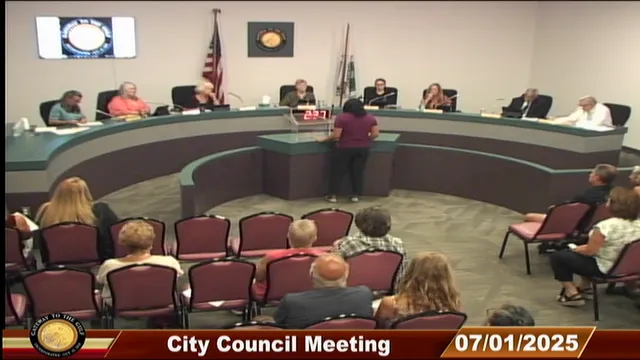
STREAMING COPY IN PREPARATION — RECORDING AVAILABLE FROM THE ORIGINAL SOURCE
Gulfport City Council Meeting - July 1, 2025
The Gulfport City Council met on July 1, 2025, for a lengthy session covering utility rate projections, senior center fundraising updates, a problematic building department evaluation process, and the proposed FY 2025-2026 budget. Key themes included recovery from recent hurricanes, infrastructure investments, and operational improvements.
Consent Calendar
- Item 6a: Approved meeting minutes from June 17, 2025.
- Item 6b: Approved Resolution No. 2025-53 authorizing annual maintenance of the Andrew's Technology UKG time & attendance system.
Public Comments & Testimony
- Albert Reisenberg (19th Ave S) supported conservation incentives for water, sewer, and garbage usage to save money and resources.
- David Bodenstead requested a ward-based discussion on senior center options and expressed interest in estate planning for city donations.
- Karen Muller (retired physical educator) described 20 years of teaching fitness at the senior center, emphasizing its vital role in health and socialization for 36-50+ participants per class. She urged building a new center.
- Zenid Merck (Manchester Building) shared how the senior center saved her from isolation post-COVID and hurricanes, warning that a closure for renovation would devastate her life.
- Laura Oldaney (5130 9th Ave S) asked about clearing storm drains and requested a public forum on hurricane response. She supported incentivizing less frequent trash service.
- Jennifer (representing Gulfport Senior Center Foundation as VP) stated the foundation raised over $250,000 for the building campaign and will support the city's direction, whether new build or renovation.
- Elizabeth Mulano (Italian American Society) described using the senior center for language classes with 185+ members, noting overcrowding and economic benefit to Gulfport businesses afterward. She supported an expanded center.
- Glenn Casanita (Tai Chi instructor) cited health benefits of Tai Chi for seniors (fall prevention, mobility) and argued the current crowded space limits participation.
- Courtney Pro Capus (Gulfport Landia) requested implementation of remote public comment (voicemail and written) within one month, citing stalled progress. She also informed council that Key West city commission voted to void its 287(g) agreement with ICE.
- Anita Frankhauser (Neighborly Care Network) reported creating two lunch seatings to accommodate 100 seniors daily, supporting a new senior center.
- John Coleen (Senior Center Foundation board) highlighted recent courtyard renovations and upcoming fundraising events, praising the center as the best in Pinellas County.
- Bev (Senior Center Foundation) cautioned that funds raised for a new building might need to be returned if the project changes scope.
- Amy Costa (Senior Center Foundation) encouraged community attendance at foundation events (golf, casino night, Night in Italy) to raise funds. She noted the center served as a central hurricane relief hub.
- Anonymous speaker complained about a homeless person taking over Trolley Park, citing unsanitary conditions despite city efforts. The city attorney acknowledged the difficulty of enforcement under state law.
Presentations
- Utility Rate Sufficiency Study – Andrew Burnham (Stantec) presented a three-year rate plan with 8% increases for fiscal years 2026-2027 and a 5% indexing adjustment thereafter. Key drivers: 60% of costs go to wholesale water/wastewater from St. Petersburg; sewer flow reductions from system improvements help control expenses. Example bills: a 2,000-gallon user would see an ~$8.30 monthly increase (including sanitation), a 4,000-gallon user ~$13. Gulfport's rates for 2,000 gallons ($72) are near the regional average; comparisons to other communities were provided. Councilmembers discussed conservation incentives, variable stormwater fees based on permeability, and pay-per-bag trash options.
- Senior Center Campaign Transition Plan – Rachel Cataldo (Senior Center Supervisor) presented a 30-page transition plan from Kinetic fundraising. Background: the center was built in 1983, serves 1,900+ active members and 30,000 annual guests, with 57% aged 65-79 and 28% over 80. A 2019 feasibility study led to a $16 million new building goal; to date $2.8 million committed (including $1.5M federal grant, $226K city restricted account, $250K+ foundation CDs). Cataldo stressed the need for clear council vision (new build vs. renovation) and strong public support to reassure donors. Councilmembers expressed support for the senior center but asked for cost/option analysis before committing to a path. They agreed to schedule a discussion item.
Discussion Items
- Results of RFQ for Building Department Permitting Process Evaluation – City Clerk announced the RFQ process had been tainted (bids improperly shared with a prospective bidder) and was officially canceled. The Mayor expressed disappointment and described visiting Reddington Shores to learn about their experience with SafeBuilt, which she found unsatisfactory due to poor communication. City Manager O'Reilly proposed a hybrid model: retain a city building official, dedicate one in-house plan reviewer for owner-builders, and contract plan review/inspections via a percentage of permit fees (rather than hourly). Council agreed to let the city manager implement improvements (customer service position, 5-10 day turnaround, resumed regular hours, AI website features) and revisit after hurricane season. They also noted Justin Shea's efforts to optimize BS&A software. A new RFP process would start; timeline extends to August 5th.
- Proposed FY 2025-2026 Operating/Capital/Recovery Budget Overview – City Manager O'Reilly presented a flat budget with 5% salary increases for all employees (including council per ordinance), $300K in lost revenue from utilities/sanitation/marina, and a 3.9% property value growth (better than initial 2.83%). Capital items include waterline replacement (funded via $1.3M state appropriation), AMI water meter technology, public safety vehicles, and deferral of some items. Council discussed potential millage rate increase (each mill ≈ $1.25M) and requested examples of impact on $200K, $500K, and $700K properties. Shannon Farrell gave a hurricane budget update: ~$7.6M spent, ~$6.9M reimbursed so far, with pending projects including casino, marina, beach, and Coast Guard building (which may need replacement due to asbestos and exceed 50% damage). Completed projects: most buildings, roads, parks (except dugouts in August).
Key Outcomes
- Consent Agenda: Approved.
- Ordinance 2025-03 (Tobacco in parks): First reading passed unanimously (5-0). Expands smoking prohibitions in parks (except cigars per state law). Excludes sidewalks.
- Ordinance 2025-04 (Green space definition): First reading passed unanimously (5-0). Amends zoning definition of green space; city attorney noted changes for second reading to require 100% permeability and address state law on synthetic turf (cannot ban but can regulate permeability).
- Resolution 2025-54 (Beach stabilization with Gator Dredging): Approved unanimously (5-0). Phase 1 involves 1,400 tons of sand and a small berm; concrete/asphalt work to be contracted separately.
- Resolution 2025-55 (LTD insurance renewal): Approved unanimously (5-0). Same rate as prior year.
- Resolution 2025-56 (Life/AD&D insurance renewal): Approved unanimously (5-0). Same rate.
- Resolution 2025-57 (Health insurance renewal): Approved unanimously (5-0). 1.5% rate increase with Florida Blue; three plan options unchanged.
- Building Department: RFQ canceled due to process violation. Council directed city manager to implement immediate improvements (customer service, 5-10 day turnaround, AI features, code alignment with county) and to issue a new RFP for plan review/inspection services on a percentage-of-fee basis, while retaining in-house building official. Revisit after hurricane season.
- Senior Center: Council agreed to schedule a discussion item soon and consider a workshop at the senior center for user input. No formal vote on direction.
- Budget: No formal action; council directed staff to provide millage rate impact examples. Budget adoption process continues with first reading in August.
- New Business: Councilmember Thanos requested a presentation on flood rating points; Councilmember Shaw suggested a resiliency intern; Councilmember Early noted work on remote public comment with city clerk; Mayor Love proposed a rain barrel program and removing glass panels at permitting counter for better customer service.
Meeting Transcript
Good evening. Am I on now? Oh, good. Okay. So welcome to the July first Gulport City Council meeting. Um as I always say, hold on, it's going to be a long one. If you happen to have your phone with you and it's turned on, please make sure you turn it off. If you feel the need to have a side conversation during the meeting, no problem, just walk outside, please. Franklin Roosevelt. Council Member Jackson here. Council Member Early. City Attorney Salzman. City Manager O'Reilly. All right. So tonight we're going to start off our meeting with two presentations. Our first presentation will be by Mr. Andrew Burnham from Stantech, and he will be talking to us about the utility rate sufficiency study. Thank you, Mayor, members of Council. Members of council, Andy Burnham with Stantec. I have a fairly brief presentation. I know you have a full agenda and lots to get through, so I'll be happy to keep it at a high level, but dive into as much detail as appropriate as you have questions and discussion warrants. So just wanted to start with a little bit of background information and kind of a rates refresher, if you will. So I've had the opportunity to assist the city with looking at the water, sewer, and stormwater rates for a few years now. And some of the recent history on rates, I think is relevant. So in 2023, we had an intentional review of the rate structure in Gulfport and looked at an opportunity to maybe address paying for what you use and modifying the structure to remove a minimum allowance from the fixed charge that had an impact to lower volume users of reducing their bill by not charging for usage that they weren't necessarily using each month. And so there was no not necessarily a rate increase at time, but actually a slight reduction in rates for low volume users through that rate structure initiative. But then also, as part of that, we were looking at multi-year financial planning and trying to make sure that the rates themselves generated enough revenue to cover your operating expenses, your capital needs, and one of your biggest expenses, the wholesale service for water treatment, as well as wastewater treatment and disposal from the city of St. Petersburg that we incur. And so we developed really a multi-year rate plan that had 8% increases in it for fiscal years 24 and 25, and a $1 increase on the monthly stormwater fee. But part of the practice within the community has been to really look at this annually, just to make sure that things are tracking as projected. Assumptions have to be made about anticipated volumes that we'll be sending to St. Pete or receiving for water service, and escalation factors for costs, such as capital improvements and operating costs. So just good financial practices to really look at this annually, develop plans, try to adhere to those plans, use them to inform your budgets, but obviously make course corrections if you need to to the extent that circumstances occur differently. But having a multi-year rate plan does provide that benefit of stability, certainty, and only having to have these conversations when necessary if things are going according to plan. And so this year's conversation is really oriented about that next three-year plan. We did the rate structure adjustments in 23, two adjustments to rates in 24 and 25 that I mentioned. Now we're trying to look at what is the future hold today, understanding current cost dynamics in terms of wholesale rate increases from St. Pete, our capital needs and funding sources for those needs, and just maintaining adequate reserve policies to mitigate our against any future risks or unforeseen circumstances. All trying to provide the highest level of service possible to businesses and residents within the community, but at the lowest possible cost, and trying to avoid rate spikes and trying to do prudent planning and having modest adjustments where possible so that we can again avoid unwanted increases to customers that are beyond what they can plan for or accommodate. So through this process, each year what we've done is we utilize a financial model, a computer model, or financial analysis and management system, and we kind of calibrate each year what we thought we would see, which is the green bars in the last plans in this chart to what we're seeing today in the blue bars. And it helps us understand some changes in circumstances and dynamics. But what we've seen actually since 2023 has been a fairly stable forecast. The level of revenues and expenses that we need has really been about the same. We're doing a good job forecasting as best we can St. Pete expenses and anticipated rate increases. Our capital needs have been pretty well defined. We're fortunate that this year we have the EPA Region 4 community grant to factor in to cover part of our priority two and priority three sewer system repairs, which has allowed us to avoid some additional borrowing, which is helping us a little bit on our reserves. But one of the fundamental components or requirements of rates is that they generate sufficient revenues to cover our expenses. So I always tend to look at that revenue versus expense chart and that black line, that cash coming in, it really has to equal that cash going out for those expenses because this is an enterprise system. And so if we have those expenditures for operations and capital and debt repayment requirements, the revenues of the system have to be sufficient to pay that on an annual basis.
openpublica.com