City Commission Workshop: FY 2026 Fiscal Strategy Kick-Off – March 4, 2025
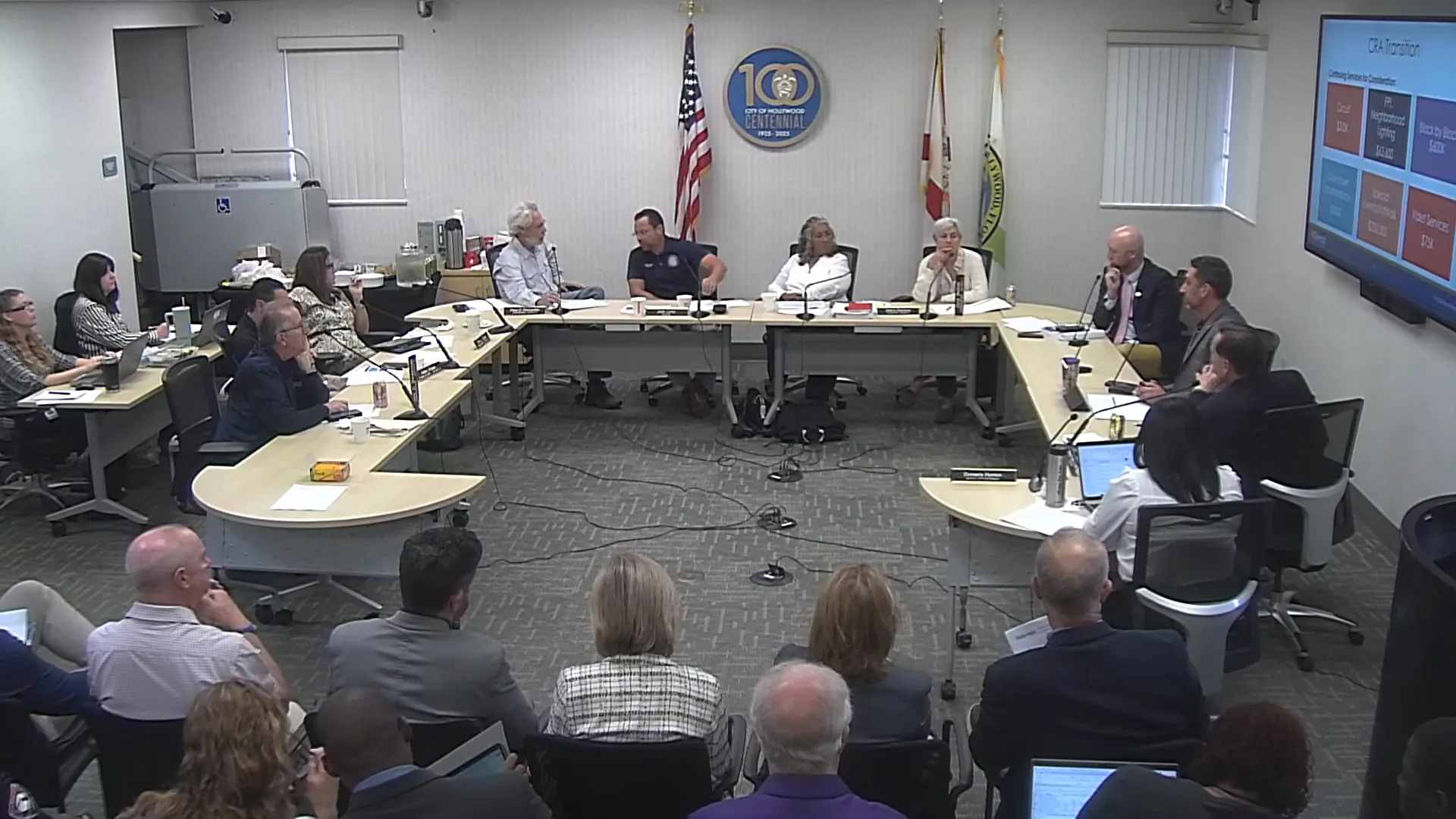
STREAMING COPY IN PREPARATION — RECORDING AVAILABLE FROM THE ORIGINAL SOURCE
City Commission Workshop: FY 2026 Fiscal Strategy Kick-Off
Note: The agenda and transcript indicate the meeting occurred on February 24, 2025, but the provided metadata states March 4, 2025. This summary uses the metadata date.
The City of Hollywood Commission held a workshop on March 4, 2025, to launch the FY 2026 budget development process. The meeting included a guest presentation on economic trends, a detailed fiscal review, discussion of the Community Redevelopment Agency (CRA) transition, and legislative updates. No formal votes were taken; the session was informational and preparatory for upcoming budget workshops.
Guest Speaker Presentation
- Mark Miller, Research Director at CBRE, presented on Broward County economic and commercial real estate trends. He noted that Broward County is at peak employment with unemployment below 3%, and 23,000 new office-sector jobs have been added since 2019, now comprising 28% of the employment base – a record high.
- Miller highlighted that South Florida saw $63 billion in net income migration from 2021–2022, with $9 billion in South Florida. However, Hollywood has seen limited new-to-market office leasing (400,000 sq ft since 2020) due to a lack of Class A product. A new office building catering to smaller tenants (1,500–2,000 sq ft) is under construction.
- He reported a 55% increase in consumer spending on shopping and food/beverage since 2015, and that 3,700 multifamily units have been built in Hollywood since 2000, nearly half in the last four years, mostly in the downtown area. Retail availability in the core corridor is limited to about six spaces.
- Commissioner Callari requested additional data on industrial real estate; Miller agreed to provide a follow-up report. Commissioner Hernandez raised concerns about outdoor storage zoning for industrial parcels, suggesting the city should be more open-minded to support small businesses. The Mayor encouraged staff to use market intelligence to guide zoning and development.
Fiscal and Economic Presentation
- City Manager George Keller opened, noting the city’s success in reducing the operating millage last year and the importance of maintaining fiscal discipline amid economic uncertainty. He warned that proposals to eliminate property tax would be “next to impossible” for the city since property tax is nearly half of total revenue, with two-thirds of the operating budget going to public safety.
- Jonathan Antista, Budget Director, reviewed FY 2024 performance measures: over 170,000 event attendees, 200,000 police calls for service, 17,000 building permit applications processed. He noted that FY 2025 taxable value grew 9.6% to $25.5 billion, slower than the 11% growth in prior years. The forecast assumes 3% annual growth in taxable value for conservatism.
- Antista presented a five-year general fund forecast showing expenditures potentially outpacing revenues by 2029 if growth slows. The forecast includes a 3% COLA, 6% health insurance increases, 5% pension increases, and 1% growth in other operating expenses. Commissioners discussed the need to distinguish core vs. enhancement expenses and to improve asset maintenance tracking.
- Commissioner Shuham praised the clarity of the forecast and asked about automating maintenance schedules for city assets. The City Manager noted plans to add a compliance officer in the budget office to improve operational efficiency.
CRA Transition Discussion
- Adam (staff) updated the commission on the transition of the Downtown and Beach CRAs. The Downtown CRA’s TIF (tax increment financing) will end September 30, 2025, with final county payments in December 2024. The Beach CRA sunset is June 25, 2027. Starting December 2025, the city will receive $3 million per year for five years from Broward County for CRA-related activities.
- The city’s contribution to the Downtown CRA is $8.7 million annually; after the CRA ends, that money will be available for city services. Eleven CRA maintenance employees have transferred to the city, and four others will continue providing enhanced services as city employees.
- Staff identified contractual services that may need to be continued: CIRC microtransit ($200,000), FPL neighborhood lighting ($63,000), Block by Block maintenance ($600,000), downtown maintenance ($300,000), Art Walk special events ($250,000), and valet services ($75,000). Policing is an additional $3 million. The city will also need to honor existing incentive agreements for four developments (Alta Hollywood, Block 57, Bread Building, Tropic) with annual costs ranging from $340,000 to $2 million, based on tax increment rebates.
- Commissioners emphasized the need to view the total $11.7 million (city $8.7M + county $3M) as a pool to fund CRA services and potentially supplement the general fund. Commissioner Hernandez wanted to see net taxable value after TIFF givebacks. Commissioner Shuham stressed maintaining service levels after the transition. Commissioner Clary noted the opportunity to extend enhanced services citywide.
Legislative Issues
- Adam reviewed several state bills affecting municipal revenue. Key concerns:
- House Bill 359 / HJR 357: Proposed $100,000 homestead exemption on taxable value, which would cost Hollywood an estimated $40 million in revenue (removing $5 billion from the tax roll).
- House Bill 301: Increase sovereign immunity caps from $200,000/$300,000 to $1 million/$3 million.
- Senate Bill 852: Study of eliminating all property taxes.
- House Bill 503: Freeze local business tax receipt revenue at current levels.
- Positive news: Septic sewer legislation (with Rep. Cassell and Sen. Pizzo) is near final, allowing the city to use sewer revenue for system expansion.
- Commissioners discussed the need to protect home rule and consider legal challenges. The Mayor asked for a memo on the city’s authority to impose surtaxes or tourist development taxes. Commissioner Clary suggested exploring a legal framework to defend against state preemptions.
Commission Priorities & Next Steps
- Commissioners were asked to submit written priorities for FY 2026. The budget office will also conduct a public survey and participate in the Broward League of Cities legislative meeting.
- Upcoming schedule:
- Capital workshop: Late May 2025
- Operating budget workshop: June 2025 (after preliminary tax roll received June 1)
- Set maximum millage: July 2, 2025
- First public hearing: September 15, 2025
- Second public hearing: September 25, 2025
- Vice Mayor Quintana praised Budget Director Antista for educating civic associations on the budget process, noting it helps residents understand the complexity of balancing priorities.
Key Outcomes
- No formal decisions were made; the workshop was a discussion to guide budget development.
- Staff will provide additional data on industrial real estate, asset maintenance schedules, and legal options for surtaxes.
- The commission will submit written priority lists, and a public survey will be launched.
- The city will continue to advocate in Tallahassee against legislation that reduces local revenue, and will support the septic sewer bill.
Meeting Transcript
All right, good morning, everyone. It is good to see everyone this Monday morning. It's not ordinary that we meet on a Monday. But it is a great way to kick off the day, kick off the year and kick off twenty twenty-six for its fiscal planning. Let me turn it over now to the city manager today is February twenty-fourth, twenty twenty-five. Thank you, Mayor, Vice Mayor and Commissioners, and to all the members of the public and staff who are attending. As the mayor indicated, uh, today is the fiscal year, next year, twenty twenty-six uh fiscal kick. If we could it's the unofficial start to the budget development process for next year. Um, but it's it's you know, it's really more than that too. It's an opportunity for us at the beginning of the development cycle to give uh kind of a feel for where we see things. Um, and then we're very much so want to hear from you in terms of your questions, your perspectives and your thoughts about priorities going forward. Um last year we were very fortunate to actually um you know and very much appreciate the support of the mayor and the commissioners in in actually accomplishing a decrease in the operating millage. And if we can pursue all the priorities we've got this year and balance all the cost and revenue issues and still accomplish um a rate increase uh again, that would be you know monumental because it last year it was uh for this current year was the first time it had happened in about a decade and a half. So we we very much appreciate being able to do that. Um we'll try to get through the presentation as quickly as we can if we can kind of do that in one chunk and then save as many of the questions and comments for the end. I think it would help with the flow. Uh there's a lot of things to look at. Um obviously conditions right now uh domestically and internationally are a little bit uncertain. Um things are um some things are kind of being questioned right now. You can even see a little bit of volatility in the stock market recently and some whispers starting to talk about slowdowns and inflationary concerns. Um but you know who knows where that goes over the long term. We've been able to uh over the past decade more than double the value of the tax base of the city, so all of our efforts collectively and being able to encourage that and make that happen with uh the private sector investment and and the public sector improvements have gone a long ways because the cost of running a city, uh a large full service city like this, and trying to meet all the the needs and desires of folks out there and catch up on the capital improvements and the infrastructure work that have been deferred for many decades. Um and and recover from financial urgency over a decade ago was quite a uh quite a task, but we're in a much better and different place than we were several years ago. So we'll look at some trends and and look at some of the forecasting. Of course, when you know the longer out you forecast, the more difficult it is, and and the less um the less accurate it tends to be because there are a lot of variables that'll pop up in the meantime. In the last couple of years, we've spent a lot of priority on public safety related issues and improvements, as well as storm water, some of the infrastructure improvements, some street lighting, um, those kind of things. Um obviously we're making some good progress in those areas. Um this year we want to give some emphasis to the uh what I call uh compliance issue in terms of um now that we're able to start digging down, whether it's in the permitting related issues or other operational issues, we start to drill down into the detailed hour by hour, day-by-day business procedures and practices. That's where you can really start uh realizing some changes in terms of efficiencies, time, and being able to be more productive and sometimes reduce costs in that same fashion too, because going forward um the uncertainty, speaking of uncertainties at the state when you hear proposals being put forth to uh eliminate property tax. Well, that would be a bit problematic because uh that's our largest revenue source, uh accounts for almost half of our total revenue. And uh when you've got two-thirds of your your operating budget that is going dedicated towards public safety with police, fire rescue, beach safety, emergency management, um, and then everything else has to live off of the other third, that would make it extremely difficult to keep the doors open, if not impossible to do certain things. So I wouldn't use the word disaster, but it would be next to impossible at times with certain things. So you'd see incredibly diminished service levels and conditions that I don't think a lot of people would like. That is um the uh having having said that um going forward um we obviously are um are experiencing kind of a renaissance period here in the city of Hollywood over the next couple of years when a lot of the uh the the other capital improvements um get finished and are in the ground, and then when you see what's in the pipeline in terms of the private sector improvements, it's um this city is truly going to find itself in a um in an opportunity and and poise to really launch into a different, a different place than it would have been imagined maybe a decade ago. Um the other thing that we want to mention and we highlight in this presentation is the the transition with the CRA and where we are with the downtown beach districts, uh the people, the services, and making sure that all of that, uh those enhanced levels of services improvements continue going in the future and being very transparent about where those dollars are and how that's how that's addressed too. So, with that, I'll I'll stop talking for now, turn it over to our our director, Jonathan Antista, and he'll go on from there. Thank you. Thank you, City Manager. Good morning, everybody, mayor, vice mayor, commissioners, directors, uh, members of the public who are here watching or listening at home. Welcome to our FY2026 fiscal kickoff. As the city manager said, this is the start of our of our budget development season, and we're proud to present some variety of information today looking at our past performance from FY2024, looking at where we where the budget stands for FY2025 today, and of course, then looking forward as we start to begin for FY2026. As part of our our fiscal kickoff, we like to bring in a guest speaker every year. This year we're pleased to welcome Mark Miller, who is a research director of field research and data intelligence at CBRE. CBRE is a global leader in commercial real estate and economic services. They work with the city already with our CMED department providing a variety of data and um consulting services as well as brokerage services. And we're pleased to welcome them today to provide some information to you all as we get started. Turn it over to Mark. Hello. Um, as he's mentioned, my name is Mark Miller. I work with CBRE.
openpublica.com