Howard County Hearing Examiner Meeting - ZB 1130M (Corridor Square, LLC) - February 25, 2026
STREAMING COPY IN PREPARATION — RECORDING AVAILABLE FROM THE ORIGINAL SOURCE
Howard County Hearing Examiner Meeting - ZB 1130M (Corridor Square, LLC) - February 25, 2026
The Howard County Hearing Examiner convened on February 25, 2026, at 10:00 AM in a hybrid format to hear Zoning Board Case ZB 1130M, a petition by Corridor Square, LLC to rezone approximately 3.91 acres from Transit Oriented Development (TOD) to B-2 (Business General) with a documented site plan for a motor vehicle fueling facility, convenience store, and car wash. The hearing included a preliminary motion to disqualify the Hearing Examiner and Zoning Counsel, testimony from expert witnesses for the petitioner, and public testimony from opponents. The hearing remains open, continuing to February 26, 2026, at 10:00 AM.
Preliminary Motion
- Joel Horwitz (Columbia resident) filed a motion to disqualify Hearing Examiner Joyce Nichols and Zoning Counsel Nathan Foreman, arguing their appointments violated the county charter (Section 405 and 216) because they were not approved by council resolution. Horwitz contended the positions lacked proper legal authority and that the hearing examiner’s role under Section 502 does not extend to zoning board matters. Petitioner’s attorney Chris DeCarlo opposed, calling it a collateral attack and noting the long-standing practice of contract hires under council rules. Zoning Counsel declined to add. The Hearing Examiner took the motion under advisement, stating it would be addressed in her report to the Zoning Board.
Petitioner’s Case
- Joseph Rutter (former Howard County Planning Director, 60 years experience): Testified that the 2013 comprehensive zoning was a mistake because the property lies 4,200 feet from the nearest MARC station (Dorsey), exceeding the 3,500-foot distance in the TOD purpose statement. He also noted lack of safe pedestrian connectivity (a 1.4-mile walk without continuous sidewalks). He argued the council intended to add a CR overlay (Commercial Revitalization) allowing B-2 uses but failed to do so, as shown in a July 22, 2013 work session transcript. He recommended B-2 with a documented site plan as appropriate, citing compatibility with the surrounding auto-oriented uses, the Route 1 Enterprise Zone, and the county’s general plan.
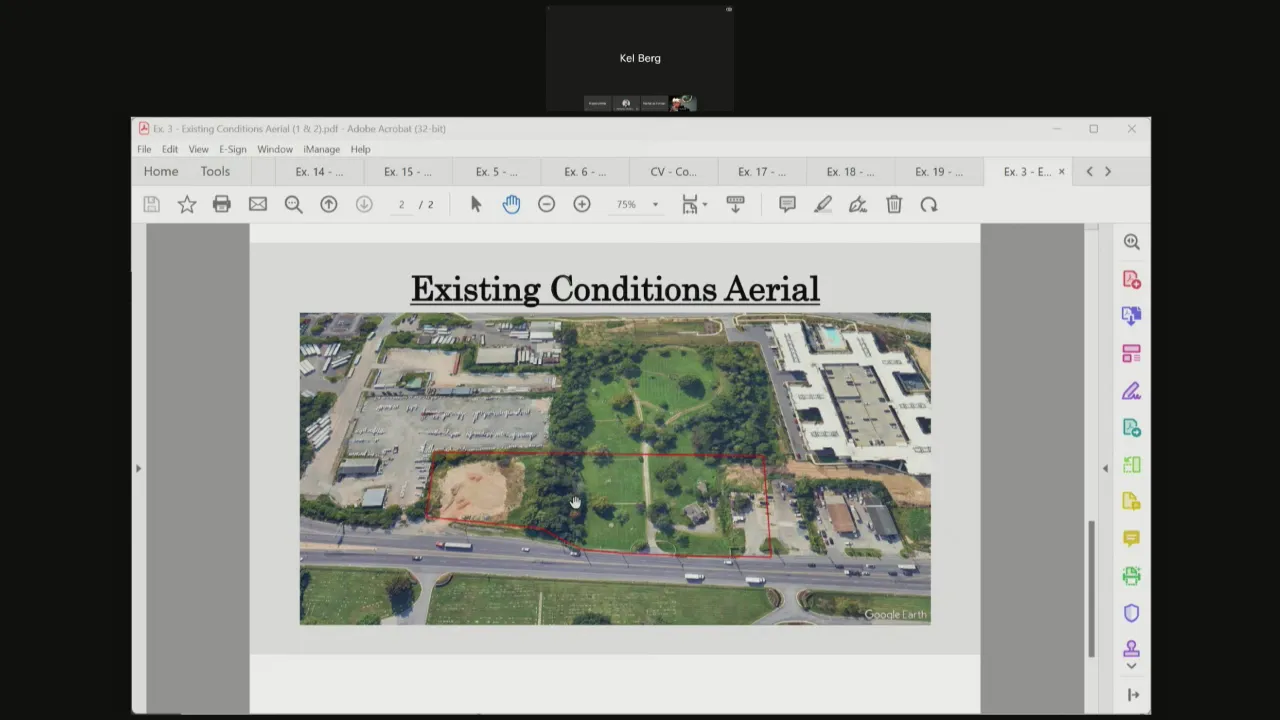
- Chris Malagari (civil engineer, 38 years): Designed the site plan. The proposal includes a 6,200 sq ft convenience store with six fueling pumps on the former Exxon site (0.46 acres) and a 5,000 sq ft car wash on a separate parcel (1.39 acres). The front portion of the Rosa Bonheur Memorial Park (2.06 acres) would be rezoned, with the remainder (approx. 4 acres) preserved via covenant. Improvements include a signalized full-access intersection on Route 1, a right-in-only access, widening Route 1 to a third lane, a median, detention basins for stormwater management, and a shared-use path. The car wash is set back 74 feet from the property line; a 10-foot drive aisle may require a setback reduction, which the petitioner believes is allowed under zoning regulations. No acoustic study was performed for the adjacent future residential development.
- Mickey Cornelius (traffic engineer, 42 years): Evaluated traffic impacts. The existing US 1/ MD 103 intersection operates near capacity, but planned improvements by Howard County (widening) and the petitioner (third lane, median, signal) will improve conditions and safety. The proposed signalized access reduces conflict points. The Maryland State Highway Administration approved the traffic study (exhibit 19). Pedestrian connectivity to the MARC station is not continuous; sidewalks exist on Dorsey Road but not on Deer Path. No transit bus stops were identified near the site.
Public Comments & Testimony
- Barry Walters (Elkridge resident, retired police officer): Opposed the rezoning, stating his deceased police dog Loki is buried in the front portion of the cemetery. He argued the cemetery is sacred, contains thousands of remains (including possibly human), and development would desecrate it. He questioned the developer’s commitment to preserving the remaining portion and cited deteriorated buildings on the site. He urged denial.
- Curtis Anthony Gray (Pasadena resident, 47-year cemetery visitor): Testified that his parents are buried at Rosa Bonheur and that he and his family own deeds. He vehemently opposed disinterment, calling it evil. He referenced a Congressional Medal of Honor recipient buried there and a dog belonging to President Truman. He stated the community maintains the cemetery and it should remain undisturbed.
- David Zinner (Columbia resident, Rosabon Air Society member): Opposed the rezoning, stating the petition ignores burial records, fails to show ground-penetrating radar results, and would destroy one-third of the cemetery. He questioned the relationship between Corridor Square LLC and Memorial LLC (cemetery owner). He noted the cemetery has county historic designation and is listed as a historic site.
- Candy Warden (Woodstock resident): As a member of the Rosabon Air Society, she testified that the cemetery has been a historic burial ground for 90 years, with estimates of 10,000 burials including pets of notable figures. She claimed 2,000 graves are in the rezoning area, based on her record-keeping. She cited the cost of disinterment and relocation, and concerns about health hazards from disturbed remains. She stated the developer reneged on promises regarding a previous adjacent development (apartments) to create a memorial for disinterred remains.
- John Pelton (Catonsville resident): Has three pets buried in the cemetery; two are definitely in the rezoning area. He expressed moral opposition to building a gas station on a cemetery and noted the financial burden (estimated $10,000) to move his pets, requiring him to delay his retirement. He stated that four other gas stations exist along Route 1 between MD 175 and MD 100.
Discussion Items
- The hearing centered on the “mistake in previous zoning” argument (1992 case precedent) for the piecemeal rezoning. The petitioner argued the 2013 TOD designation was a mistake due to distance from MARC station (4,200 feet vs. 3,500 feet) and lack of pedestrian connectivity. They also argued the council intended to impose a CR overlay but failed to do so, as evidenced by the July 22, 2013 work session transcript (exhibit 10). The Hearing Examiner admitted exhibits 9-11 but limited their use to corrective zoning, not the primary mistake argument.
- The Hearing Examiner asked for additional evidence: a 3,500-foot radius circle from the northernmost edge of the MARC parking property (not just the station building) and an updated walking distance from that point to the property. The petitioner’s engineer agreed to provide these.
- The Hearing Examiner also questioned the definition of “other public transit links” in the TOD purpose statement; the witness had no opinion.
- The petitioner’s case included expert testimony supporting B-2 as appropriate, citing compatibility with the Route 1 corridor, the Enterprise Zone designation, and the general plan. The petitioner emphasized that the documented site plan locks in the specific uses (gas station, car wash, convenience store) and conditions to preserve the remaining cemetery.
Key Outcomes
- The Hearing Examiner took the motion to disqualify under advisement, to be addressed in her report to the Zoning Board.
- The hearing was adjourned at 4:01 PM and will continue on February 26, 2026, at 10:00 AM for petitioner’s remaining witness (Mickey Cornelius) and any rebuttal. The public may still testify at that time (virtual participants must join the WebEx meeting, not just the live stream).
- No votes were cast; the Hearing Examiner will issue a recommendation to the Zoning Board after the hearing concludes.
Meeting Transcript
This webinar is being recorded and summarized. All right, good morning, everybody. It is approximately 10 o'clock on the 25th of February. We are here for a rezoning case, zoning board 1130. It is a request to rezone 1.91, excuse me, 3.91 acres of land from the transit-oriented development zone to the business general zone. It's a piecemeal rezoning request. Therefore, the burden of law is change in the character of the neighborhood or a mistake in the previous zoning. For the purposes of this particular hearing, it's the first time we've had a zoning board hearing in front of the hearing examiner. So it's going to be new to all of us. We have a new set of procedures. And I'd like to just go around the room so everybody understands who's here today. So Mr. Foreman, could you just introduce yourself and your position? Yes, good morning, everyone. My name is Nate Foreman, and I am the zoning counsel for Howard County. Mr. Carla? Good morning, everyone. My name is Chris DeCarlo. I am the attorney for the petitioner in this matter, Corridor Square LLC. Okay, and for the purposes of this hearing, I'm David Zinner, also from Rosalie Bonhear Society. All right, thank you, everybody. This is a hearing in which some people are attending in person and some are attending virtually. And so I'm gonna try to be cognizant of those who are virtual. So uh the procedures that we have indicate that the first thing that happens today is going to be the petitioner's opening statement. Mr. DeKarlo? Thank you, Madam Hearing Examiner. I do um I have a preliminary matter. I just like to Oh, I'm so sorry, I I am wrong. That's not the first thing that happens today. The first thing that happens today is we have uh a motion in front of us by Mr. Hurlowitz. If you want to come up to the speaker's podium and um argue your motion, uh Mr. Hurwitz has a motion to disqualify myself as zoning board hearing counsel and to disqualify Nathaniel Foreman as zoning counsel. So, Mr. Hurwitz, your petition. Uh good morning, Joel Horwitz, live in Columbia. So the petition is not personal to the persons. It's because this was the first zoning board hearing examiner matter. Um my position is that the hearing examiner's authority does not flow from the hearing authority under section 502 of the charter, because it's limited to boards of appeals topics. Therefore, you have to have another authority in the county charter, and the county charter is clear in section 405 that the county solicitor is the attorney for all the purposes, except that there's an exception in the charter. Um exceptions is 216, which gives the county council, which is the zoning board, the authority, the higher legal counsel if they do it by resolution. Um they did not do that. Um point out similar provision was recently enacted by the voters giving the same basic language to the inspector general. It's also higher legal counsel at their discretion. Um counsel basically fails to refute any of the arguments made regarding the county charter in their reply. They said that I misread or misinterpreted, but didn't say how they talk about the long-standing administrative practice that uh uh I should also back up zoning council. It's also I believe is it legal assistance to the county council and under 216 also needs to be approved by resolution. On top of that, the county code says that has to be approved by three votes, and the county council can only act in public to vote on a resolution.
openpublica.com