Howard County Council Meeting - April 20, 2026: Budget Presentation and Legislative Public Hearing
STREAMING COPY IN PREPARATION — RECORDING AVAILABLE FROM THE ORIGINAL SOURCE
Howard County Council Meeting - April 20, 2026: Budget Presentation and Legislative Public Hearing
The Howard County Council held a hybrid meeting on April 20, 2026, beginning with the presentation of the County Executive's FY2027 Proposed Budget, followed by a Legislative Public Hearing to receive testimony on several resolutions and bills. The budget presentation by County Executive Dr. Calvin Ball detailed a $2.5 billion operating budget and a $120.7 million capital budget, with no property or income tax increases. The subsequent public hearing included testimony on appointments, financial transfers, economic development incentives, zoning changes, and a payment-in-lieu-of-taxes (PILOT) agreement. No final votes were taken; a work session is scheduled for April 27 and a legislative session for May 4, 2026.
Consent Calendar
- No consent calendar was used; all items were heard individually.
Public Comments & Testimony
- Appointments: Seven individuals testified in support of their appointments to various boards and commissions: Brian Auger (Property Tax Assessment Appeal Board), Eileen Marshall (Animal Matters Hearing Board), Kimberly Brokaw, DVM (Animal Matters Hearing Board), Maryam Fathirad, PMP (Public Works Board), Dinah Yukich (LGBTQIA+ Commission), Dr. Meghana S. Ray (Board of Health), and Michael Cummins (Inspector General Advisory Board). All expressed commitment to public service and relevant expertise.
- Faulkner Ridge Center Funding (TAO2-FY2026 & CB22-2026): Dan Lubley, Executive Director of Capital Planning and Construction for HCPSS, testified in support of transferring $3.5 million from completed school projects to address a budget shortfall for the Faulkner Ridge Early Learning Center. He noted construction cost increases of 63% since FY2018 and that $2.4 million remains unfunded for FY2028. Rafi Healy, County Finance Director, also supported the legislation.
- MTA Application (CR49-2026): Clarence Dickerson, Office of Transportation Administrator, testified in support, seeking endorsement for the FY27 annual transportation plan to access federal and state grants for RTA bus and paratransit services.
- Feast & Fettle Financing (CR50-2026): Jennifer Jones, CEO of Howard County Economic Development Authority, testified in support, stating the company plans to create about 200 jobs and HCDA will provide a 10% match from existing funds. Stu Cohn (HCCA president) and Alan Schneider testified with questions, requesting more details on milestones, loan specifics, and job quality. They urged tabling for further review.
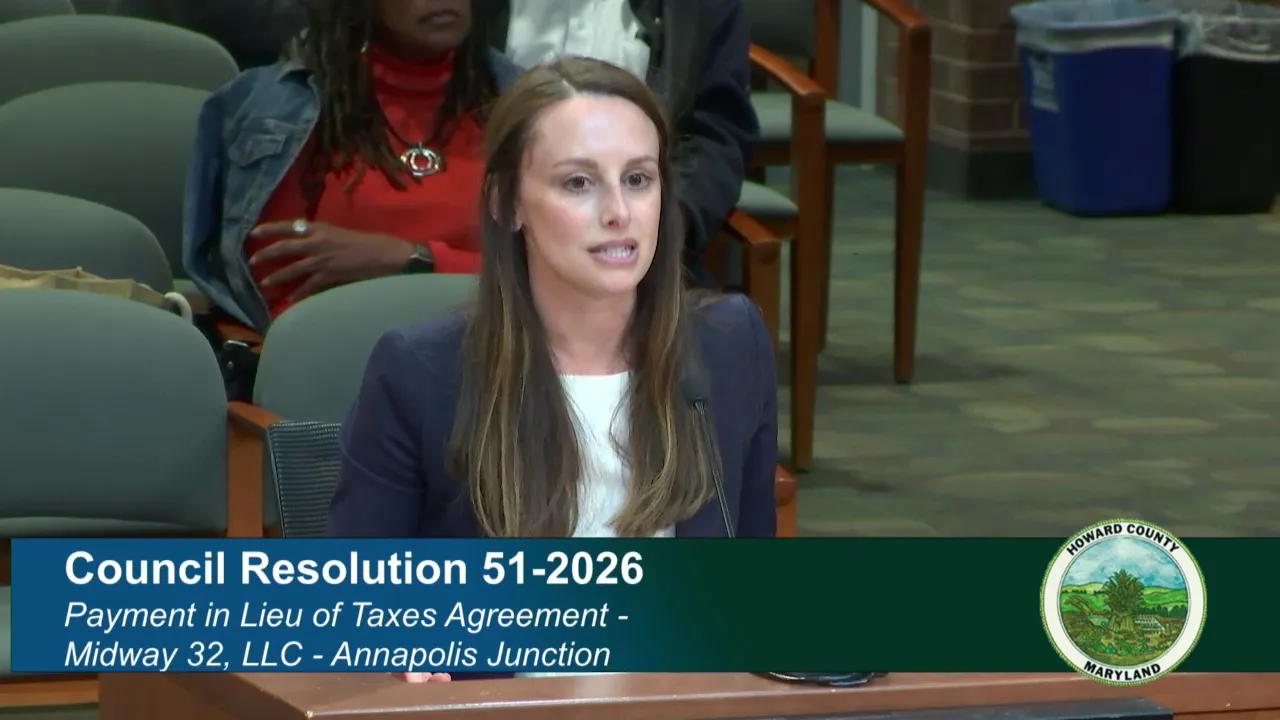
- Annapolis Junction PILOT (CR51-2026): Kelly Simoneau, Director of Housing and Community Development, testified in support, noting the developer will deliver 623 rental units with 95 affordable units (32 at 20% AMI, 32 at 40% AMI, 31 at 60% AMI). Mandy Heinel, attorney for the developer, emphasized the $200 million private investment and net tax revenue increase of over $12 million over the PILOT term. Stu Cohn raised concerns about infrastructure capacity and the absence of the approved PILOT agreement in the exhibit. Brent Loveless (PTAC legislative chair, speaking independently) questioned the omission of additional expenses for schools and services. Alan Schneider argued the county should not subsidize developers in a premier location. Councilmembers discussed student yield projections; Chair Jones suggested an amendment requiring post‑occupancy data reporting. Councilmember Jung noted the high cost of building an elementary school in the area, estimated at over $63 million, and expressed concern about impacts on school capacity.
- ZRA 221 – Adaptive Reuse of Motel/Hotel Sites (CB23-2026): Mandy Heinel testified in support, explaining the bill allows redevelopment of underutilized motel properties along Route 1 by applying CAC district standards and requiring affordable housing. She identified four parcels as immediate candidates. Brent Loveless testified against, arguing the corridor is being converted from commercial to residential without adequate resources for schools and infrastructure.
- ZRA 222 – Optional Design Projects (CB24-2026): Mandy Heinel testified in support, stating the bill expands access to an existing design‑review process for commercial properties under 10 acres along Route 1. She confirmed the petitioner owns 10052 Washington Boulevard but has no specific site plan yet. Brent Loveless testified against, calling the ZRA a zoning change that could alter commercial/residential balance and criticizing past incentives granted to the petitioner. Councilmember Jung questioned why DPZ was not proposing such tools.
Discussion Items
- Faulkner Ridge Center Funding: Councilmember Yungmann questioned the efficiency of issuing a $3.5 million bond; Mr. Healy explained bonds are issued once a year and pooled with other projects. Councilmember Rigby expressed concern that construction cost increases could delay the project if the remaining $2.4 million is not secured. Dan Lubley confirmed the contractor’s bid is locked and the project can proceed with current funds.
- Annapolis Junction PILOT: Vice Chair Rigby discussed student yield analysis and noted the low bedroom ratio at the project should produce few students. Councilmember Jung calculated the cost of a new elementary school at over $63 million, questioning whether the PILOT’s revenue would cover increased school costs. Chair Jones proposed an amendment to require the developer to report actual student yields after occupancy, to improve future decision‑making. Councilmember Jung cited past discrepancies in student projections at Robinson Overlook.
- ZRA 221 and ZRA 222: Councilmembers asked about density limits and the number of parcels affected. Mandy Heinel confirmed most motel parcels are under 1 acre, so density would be capped at 15 units per acre. For ZRA 222, Councilmember Jung expressed concern that the proposal should come from the Department of Planning and Zoning rather than a petitioner, but acknowledged the tool’s potential.
Key Outcomes
- No votes were taken on any agenda items during this meeting.
- The council will hold a work session on Monday, April 27, 2026 at 10:00 AM in the C. Vernon Gray Room to discuss the items heard.
- A legislative session for final consideration of certain legislation will be held on Monday, May 4, 2026 at 7:00 PM in the Banneker Room.
- Chair Jones indicated she plans to introduce an amendment to CR51-2026 requiring reporting on student yields from the Annapolis Junction development.
Meeting Transcript
This webinar is being recorded and summarized. Good evening, everyone. This is the annual presentation of the executive's budget to the county council. We have with us tonight the county executive, Dr. Calvin Ball, who will present his FY 2027 executive proposed budget. This evening is a hybrid meeting, which is being conducted in person and via WebEx teleconference. It is also available to the public through live stream on the County Council website and broadcast on Channels 44, the Verizon, and 1071 Comcast. At this time, I'm going to do a roll call of the Council members. Ms. Rigby. Here. Ms. Young. Here. Mr. Youngman. Here. Ms. Walsh would not be with us for the first portion this evening, but she will be with us for the public hearing later. And I am Opal Jones. We now welcomed, we now welcome the esteemed county executive, Dr. Calvin Ball. Good evening, Chairperson Dr. Jones, Vice Chair Rigby, and members of our county council. Tonight, I'm honored to present my proposed fiscal 2027 capital and operating budgets for Howard County. This presentation is a reflection of our values, our priorities, and our shared belief in what Howard County can and should be. This is also my final budget as your Howard County executive on the 20th anniversary of when I was first sworn in as an elected official in this very room. During the past eight years, we have worked together to make meaningful progress for our residents by strengthening our schools, improving public safety, expanding opportunity, protecting our environment, and building a community where people at every stage of life can thrive. And we have done so with purpose. This budget is about people. It's about protecting those in our care. It's about being good stewards of the taxpayer dollar. It's about fostering a community where everyone can thrive. These are investments that residents will see, feel, and rely upon every day. They are safer streets, stronger schools, flood protection for families and businesses, cleaner energy, and spaces where communities come together. An acknowledgement of significant infrastructure needs across our county and improving debt indicators attributed to several years of fiscal discipline. The proposed budget includes general obligation bond of 120.7 million dollars to support these critical investments. This approach reflects our continued commitment to responsible government by controlling debt service levels, diversifying funding streams, and ensuring taxpayers see the greatest possible return on every dollar invested. Building on this comprehensive capital plan tonight, I'm also pleased to release our FY27 operating budget. This budget provides critical ongoing support for public safety, public education, our health care system, housing opportunities, our nonprofit service providers, and more. Most importantly, we do all of this without raising property or income taxes on our residents or businesses. My total proposed FY27 operating budget of $2.5 billion represents a 6.6% increase from our FY26 budget, and the general fund, which supports most governmental services totals 1.7 billion dollars with a 6.8% growth from FY26. This relatively strong growth is primarily attributable to increases in certain revenues, including capital gains. While the overall fiscal outlook has improved from one year ago, federal uncertainty continues to loom, and many future impacts are still yet to be felt. We will continue to closely monitor federal and state actions and exercise fiscal prudence because progress is not measured by how much we spend, but how wisely we invest. And in Howard County, we remain committed to progress with purpose. If there is one place where progress must begin, it is with education. Because when we invest in education, we are investing in futures. We're investing in the child walking into kindergarten for the first time. The student discovering a career path at Howard Community College, the single parent returning to school to build a better life, and the resident who finds connection, learning, and opportunity at their local library branch.
openpublica.com