Howard County Board of Appeals Meeting – April 23, 2026: Appeal BA 827D (Speedfloor Mid Atlantic) Deliberation and Decision
STREAMING COPY IN PREPARATION — RECORDING AVAILABLE FROM THE ORIGINAL SOURCE
Howard County Board of Appeals Meeting – April 23, 2026
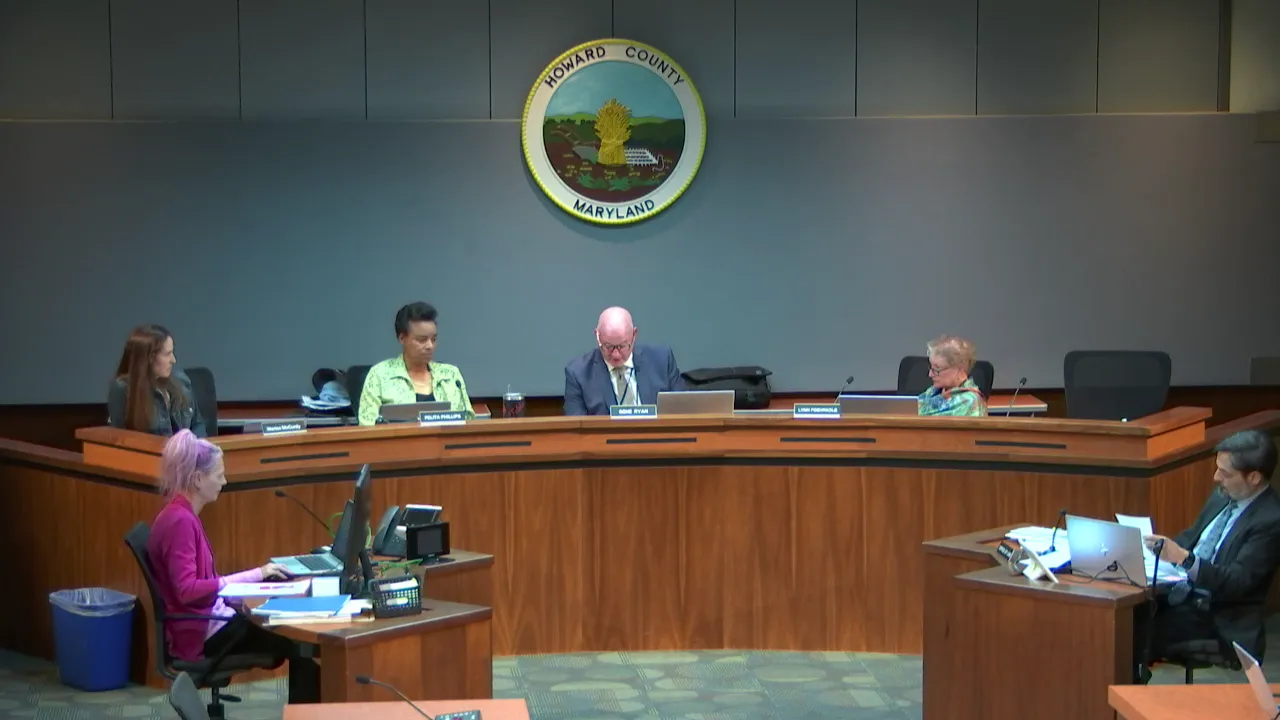
This meeting was a continuation of the hearing for case BA 827D, an administrative appeal filed by Speedfloor Mid-Atlantic LLC against the Department of Planning and Zoning (DPZ) regarding a denial of alternate compliance under Section 16.120B43 of the Subdivision and Land Development Regulations. The board deliberated after the petitioner had rested its case and presented closing arguments at the prior session. The meeting was held hybrid (in-person and via WebEx) and streamed online.
Consent Calendar
- The board unanimously approved the meeting minutes from April 16, 2026. Voting: Chair Ryan (approve), Ms. Fearcomp (approve), Ms. McCarty (approve), Ms. Phillips (approve), Ms. Harris (approve).
Discussion Items
- Framing of the Deliberation: Chair Ryan explained the two-step process for the appeal. Step 1: Determine whether DPZ’s decision was clearly erroneous, arbitrary, capricious, or contrary to law (burden on appellant by preponderance of the evidence). Step 2: If the board finds DPZ erred, it must evaluate whether a waiver under Section 16.104A1 is appropriate, applying four criteria.
- Board Deliberation – Step 1: Members expressed differing views. Ms. McCarty argued DPZ’s rationale (consistent encroachment issues from forest conservation easements on residential lots) was rational and the appellant had not met its burden. Ms. Phillips and Ms. Harris initially leaned toward finding DPZ’s decision arbitrary, citing the appellant’s offer of a split‑rail fence, HOA management, and the existence of similar easements across the street. Chair Ryan and Ms. Fearcomp also voiced concerns that DPZ’s letter did not address the appellant’s mitigation proposals. After discussion, the board voted 4‑1 to find that the appellant had met its burden (Chair Ryan: grant, Ms. Fearcomp: grant, Ms. McCarty: deny, Ms. Phillips: grant, Ms. Harris: grant).
- Board Deliberation – Step 2 (Waiver Criteria): The board then examined the four waiver criteria.
- Criterion 1 (Deprivation of rights commonly enjoyed): Most members agreed that strict compliance would deprive the appellant of rights others in similar areas enjoy (e.g., the property across the street). Ms. McCarty abstained. Outcome: affirmative.
- Criterion 2 (Uniqueness of property causing practical difficulty): Chair Ryan and Ms. Harris argued that the unique combination of stream buffers, floodplain, and wetland constraints prevented the appellant from using on‑site forest for conservation credit. Ms. McCarty abstained. Outcome: affirmative (4 yes, 0 no, 1 abstain).
- Criterion 3 (No special privilege): Members agreed that granting the waiver would not confer a special privilege, as other properties have similar on‑site forest conservation. Outcome: affirmative (4 yes, 0 no, 1 abstain).
- Criterion 4 (Not detrimental to public welfare): All members voting agreed the modification would not be detrimental; one noted that preserving trees near a highway (I‑95) provides environmental benefit. Outcome: affirmative (4 yes, 0 no, 1 abstain).
- Conditions: The board specified that the waiver is granted with conditions: the forest conservation area must be managed by a homeowners association (HOA), a split‑rail fence must be installed as a physical barrier, and signage as shown in Exhibit 4 must be posted. These conditions were included in the final vote.
Key Outcomes
- Approval of Minutes: Unanimous approval of April 16, 2026 minutes.
- Appeal Sustained: The board voted 4‑1 to find that DPZ’s denial was clearly erroneous, arbitrary, and capricious, thus the appellant met its burden (Step 1).
- Waiver Granted: The board voted 4‑0‑1 (McCarty abstaining from all subsequent votes) to grant the requested alternate compliance under Section 16.104A1, subject to the conditions that the forest conservation area be HOA‑managed, a split‑rail fence be installed, and signage be posted as depicted in the record.
- Direction on Fee Refund: Chair Ryan noted that under Board Rules 2.202F, the appellant is entitled to a refund of administrative hearing and filing fees. The appellant’s attorney raised a dispute regarding whether mandatory newspaper advertising costs are included. The county solicitor agreed to discuss the issue further with the board’s attorney, and the matter was left open for resolution without delaying the order.
- Future Waiver Issue: The appellant’s attorney also raised a potential requirement for an additional waiver regarding HOA ownership of forest conservation on infill developments. The board did not rule on this, but the county solicitor noted it would be addressed if a separate application is filed.
Meeting Transcript
This webinar is being recorded and summarized. Good evening. Today is April 23rd, 2026, and we're here for the continuance of matter BA827D, speed floor mid-Atlantic LLC. Before we resume our hearing, we have uh quick administrative matter. Uh members, you received uh minutes for the April 16th, 2026 meeting. Uh, any questions or comments? Seeing none, can I get a motion to approve the meeting minutes for April 16th, 2026? So moved. Uh first by Miss Feercomp. Can I get a second, please? I second. A second by Miss Phillips. Madam Minister, please call the roll. Chair Ryan. Approve. Miss Fearcom approved. Miss McCarty. Approved. Miss Phillips. Approved. And Miss Harris. Great. Oh, I jumped the gun on that one, sorry. Great. Uh the motion carries, and the meeting minutes are approved for April 16th, 2026. Moving on to the matter before us tonight. So we are here. We uh the petitioner rested his case, uh, gave closing arguments, so we're here to continue into the deliberation phase. So before the board begins deliberation, I just want to briefly explain the task before us, uh, particularly for members that may be listening at home. Uh this is administrative and appeal filed by Speed Floor Mid-Atlantic LLC from a decision of the Department of Planning Zoning, denying a request for alternate compliance to section 16.120B43 of the subdivision of land development regulations. Under section 2.210 of the board uh of the board's rules of procedure, this is a de novo appeal. That means the board's decision must be based on the evidence and testimony in the record before the board. At the same time, the burden is on the appellate to demonstrate that the action taken by DPZ was clearly erroneous, arbitrary, or capricious, or contrary to law. The pres uh the provision at issue is section 16.120 B43. It's party it's part of the county's quote usable design requirements for residential lots. In general terms, it requires that lots be designed so they're not encumbered by environmentally sensitive features such as steep slopes, floodplains, wetlands, steep buffers, and forest con easements uh within the building envelope, subject to certain setback allowances, typically requiring those features to be located 35 feet from a building. DPZ denied and requested alternate uh I'm sorry, denied the requested alternate compliance finding, among other things that the applicant had not demonstrated an unnecessary hardship or practical difficulty that the request would not satisfy the criteria for a waiver under section 16.104 and that granting the request could undermine the purpose of the regulation. Accordingly, our deliberation proceeds in two ways, two steps rather. First, under section 2.21042, we must evaluate if DPZ's decision and uh must evaluate their decision and determine whether based on the record before us the decision was clearly erroneous, arbitrary, or capricious, or contrary to law. In doing so, we could serve the reasons given by DPZ and assess those reasons against the evidence in the record. If we determine that DPZ's decision meets that standard, the appeal must be denied. If however we determine the DPZ's decision cannot be sustained, then we will proceed to step two. At that point, the board must determine what relief, if any, is appropriate. This requires us to apply the waiver criteria under section 16.104A1, including whether strict compliance would result in practical difficulty or unreasonable hardship, where the property is unique characteristics, whether the relief would confer a special privilege, and whether it would be detrimental to public welfare. Throughout this process, the board's decision must be grounded in the evidence in the record and applicable provisions of the county code, and we are required to explain the reasons for our decision. I offer the explanation so that all parties and members of the public understand the framework that the board is required to follow as we begin our deliberations. So any questions before we begin? Mr. Cook, any thoughts before we begin? No, sir.
openpublica.com