Howard County Council FY2027 Budget Work Session #1 – April 29, 2026
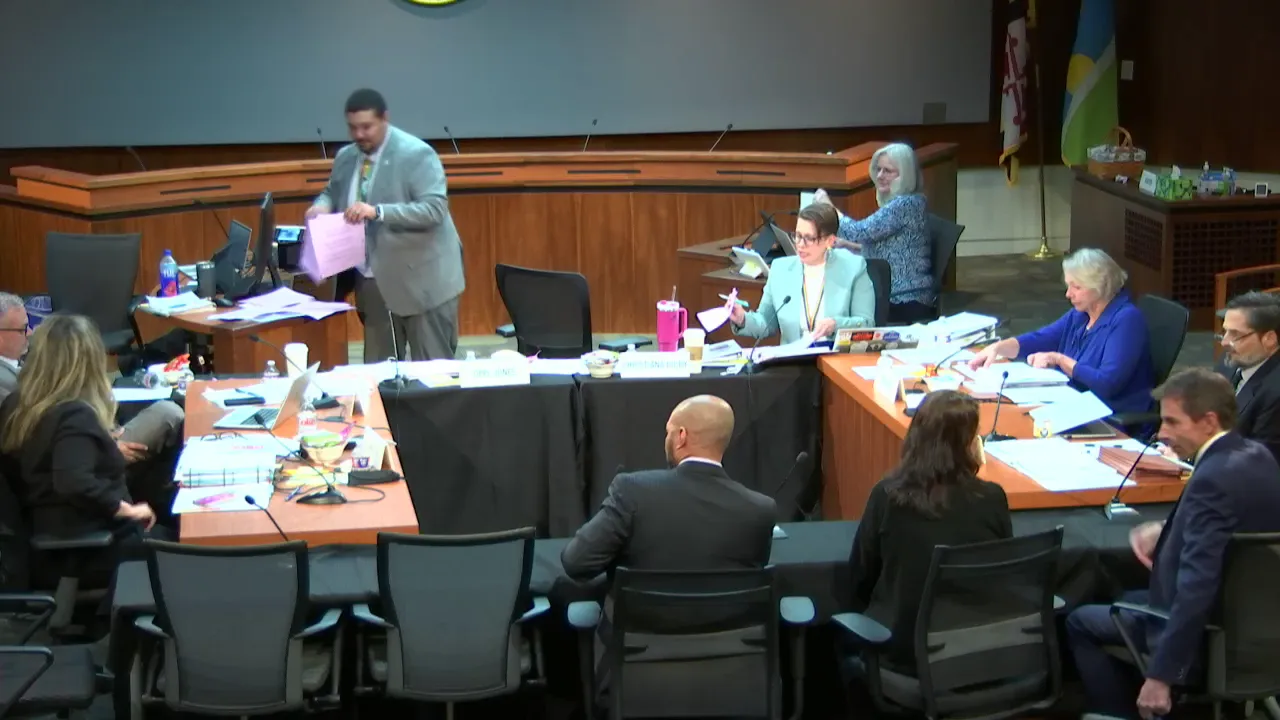
STREAMING COPY IN PREPARATION — RECORDING AVAILABLE FROM THE ORIGINAL SOURCE
Howard County Council CIP and Operating Budget Work Session #1 – April 29, 2026
The Howard County Council held its first FY2027 operating and capital budget work session on April 29, 2026, from 10:00 a.m. to approximately 4:30 p.m. The session covered revenue overview, education funding for HCPSS, Howard Community College, and the Howard County Library System, as well as operating budgets for the State’s Attorney, Board of Elections, and the new Inspector General’s office. Discussions highlighted a proposed $1.6 billion general fund budget, a $67 million budget gap closed without tax increases, significant revenue volatility, and long-term sustainability concerns. No formal votes were taken; the session was informational and will continue on May 11 and May 15, 2026.
Revenue Overview
- County Administrator Dr. Holly Sun presented a $1.6 billion FY27 general fund budget, closing a $67 million gap using multiple strategies including a $3 million transfer from the fleet fund, updated income tax projections (11.6% growth over FY26 budget, but only 2.4% over current year estimate), and $41 million in reductions from other agencies.
- Key revenue drivers: property tax (slowing but positive), income tax (highly volatile, driven by capital gains and one-time factors), and interest income (declining with federal rate cuts).
- Risks include potential federal layoffs (over 11% of county residents are direct federal employees), state tax law changes, and uncertain economic outlook. The state’s March revenue forecast projects 0% growth in FY27.
- Use of pay-go (one-time funds) is $106 million, primarily for school capital projects. The county’s recurring revenue growth of $116 million is allocated 66% to schools, followed by public safety and community services.
- Councilmembers expressed concerns about structural deficits, the need for sustainable revenue growth, and the importance of diversifying the tax base through housing and commercial development.
Education – Howard County Public Schools (HCPSS)
- Superintendent Bill Barnes and Board Chair Antonia Watts presented the board’s FY27 operating and capital budget request. The county executive proposed funding 99.3% of the request, leaving a $6.2 million gap that the school system plans to close using fund balance ($9.2 million total one-time funds), reducing dependency on reserves from previous years.
- Discussion focused on the Blueprint for Maryland’s Future implementation, rising special education and multilingual learner costs, declining enrollment, and the need to redirect resources from non-Blueprint programs (e.g., GT, strings) to meet mandates.
- Councilmembers questioned the use of fund balance, long-term projections showing significant future funding gaps (e.g., $75 million increase needed in FY28), and the impact of Blueprint’s unfunded mandates. Superintendent Barnes emphasized that increased funding alone is not the solution; the system is undergoing strategic transformation.
- Capital budget: $98 million from the county, with a focus on deferred maintenance (growing $30-40 million annually), new Elementary School 43 (addressing overcrowding at a Title I school), and maximizing state Built to Learn funds before 2031 expiration. A sufficiency study will be completed in fall 2026 to inform future priorities.
- On block scheduling: Superintendent noted it was discussed but shelved after strong staff opposition; it remains a potential future conversation to improve student opportunity and manage class sizes.
Education – Howard Community College (HCC)
- President Dr. Daria Willis and team presented the FY27 request: $47.2 million operating (3% increase) and $3 million capital. Key initiatives include the workforce development and trade center (opening fall 2026), the mathematics and athletics complex (already hosting events), and expanded programs.
- State aid increased by $1 million, but future state funding caps are a concern. Enrollment has grown 8.2% over five years.
- Discussion covered contract with CampusWorks ($2.2 million annually, stepping down), a compensation study for full-time employees (excluding adjuncts, due October 2026), and a $3,500 one-time bonus for all employees in FY25.
- Councilmembers asked about administrative positions, legal spending, and the percentage of budget increases allocated to compensation (currently $2.3 million set aside for all employees, with negotiations ongoing for unionized faculty).
Education – Howard County Library System (HCLS)
- Library leadership presented the operating budget (county funding of $29.2 million, up 7%) supporting wage increases, negotiated agreements, and collection needs. Highlights include early childhood programs, teen engagement, and community connection initiatives.
- Capital project: New Central Library in downtown Columbia – updated budget of $129 million (down 10% from prior estimate), with 38% from external sources (state grants, federal funding, philanthropy). The project targets a fall 2029 construction start, with land purchase in spring 2027.
- Councilmembers questioned project cost realism, operational costs ($600,000 estimate for building maintenance, to be updated), parking arrangements, and the design-build approach for cost control. Director of General Services addressed safety concerns at Savage Branch, stating no hazardous chemical found after extensive testing; carbon monoxide detectors will be integrated into HVAC.
Legislative/Judicial/IG – State’s Attorney
- State’s Attorney Rich Gibson presented a $15.6 million budget for 95 employees. Priority initiatives include reclassifying five victim-witness assistants (funded), adding paralegals for body-worn camera review (half funded) and juvenile unit (not funded), and planning a mental health court for 2027.
- Body-worn camera unit currently has 12 staff and reviewed 11,456 hours of footage in FY25; workload pressures necessitate additional resources. The office handles approximately 11,000 cases annually.
Legislative/Judicial/IG – Board of Elections
- Director Guy Mickley (appearing virtually) reported on FY27 budget, which covers the gubernatorial general election. Key items: 56 polling places, 1,100 election judges, and planned replacement of all voting equipment by 2028 (paid in three installments starting FY27). Unfunded mandates from the state (equipment leasing) comprise about a quarter of the budget.
Legislative/Judicial/IG – Inspector General
- New Inspector General Missy Madigan presented her first budget, with 96% of expenses in salaries for four positions (reclassified administrative assistant to investigator). Total FY27 request is $601,869.
- She reported receiving 52 complaints in her first four months, developing policies, a website, and a case management system. She requested read-only access to county data systems and use of salary savings to purchase a $46,000 fleet vehicle.
- Councilmembers emphasized the importance of full and unrestricted access to records per the enabling legislation, expressing concern about delays in obtaining such access. The Office of Law indicated a data use agreement is nearly complete.
Key Outcomes
- No formal votes were taken. The work session was informational, with follow-up questions and additional discussion scheduled for May 11 and May 15, 2026.
- The council decided to defer remaining agenda items (Sheriff’s Office, County Council/Auditor, other judicial departments) to the May 15 spillover session.
- Councilmembers directed staff to investigate the Inspector General’s need for system access and to expedite agreements.
- The council expects updated revenue projections and more detailed capital project information from the county administration and school system before final budget adoption.
Meeting Transcript
Webinar is being recorded and summarized. Good morning, everyone. This is the council's first FY2027 operating budget work session. Today's work session will also include the FY 2027 capital budget for Howard County Public Schools. Howard County Howard Community College. It actually says, okay. So whenever I say Howard Community College, or whenever I say Howard County Community College, it has been my mistake. This time the my script says Howard County Community College. So for you dragons out there, do not blame me. It is behind the scenes. I will apologize on their behalf, but I was reading the script, and it says Howard County Community College, which is what is not called, it's called Howard Community College. So that was the first in eight years. All right, let's start again. Today's work session will also include the FY 2027 capital budget for Howard County Public Schools, Howard Community College, and Howard County Libraries. The proceeding this morning is a hybrid meeting, which is being conducted in person and via WebEx teleconference. The public may view through live stream available through the county council website. At this time, I'm gonna do a roll call for the council members. Ms. Young. Here. Ms. Walsh. Here. Ms. Rigby and Mr. Youngman will be joining us shortly, and I am Opal Jones. Our agenda today includes the following capital and operating project categories. Revenue overview, capital and operating for Howard County Public Schools, Capital and Operating for Howard Community College, Capital and Operating for Howard County Libraries, and operating for County Council, State's Attorney, Sheriff's Office, Board of Elections, and Inspector General. We will now proceed with our agenda. We're going to start with revenue. Give us a brief highlight, uh two, three minutes of what's going on, what's been happening lately, and we'll get into our question and answers. Thank you, and good morning, Council Tierra and Council members. Uh Holly, some administrator for the county. Um I have a brief uh PowerPoint. Can you bring it on the screen? Uh I actually include more information than I need to talk about there. Some are just for reference, so I'll try to go over that quickly. Yeah. All right. Uh, I do want to take the moment to thank my staff. Some are with us today, and some are actually or um watching online that they have been working extremely hard and together with all the department, our partners to put together this proposed budget. I really want to thank them, but also everybody who have been working very hard together uh to make it work. So next slide was just showing the proposed budget total, uh, which is uh 1.6 billion dollars um for the general fund for proposed 27. That's about 7.6% growth there. It does close and anticipate originally six 67 million budget gap, um, as you know from the SAC report a couple of months ago, and able to support all strategic priority without raising taxes or compromise critical services. And that is thanks to next page that multiple strategies are where we're able to implement in collaboration with all our stakeholders, and I really want to thank everybody again for working closely with us on that. So, first uh part of that we did make some uh revenue adjustment from original projection. Part of that is that we were able to transfer about three million dollars from our fleet fund, which is internal service fund by uh reducing or I should say delaying some of the vehicle replacement on that. Um it's not necessarily a sustainable strategy, um, but because we really need to maximize our support to our general fund and our critical needs there, that's we decide to do. Uh, I would say that um I want to congratulate our other partners like the school system, they were able to maintain very healthy fund balance in those um, you know, internal service fund, the benefit fund tech founder said well, we actually not able to do that, but we're able to find um some flexibility in fleet fund.
openpublica.com