Huntington Beach Planning Commission Meeting – April 26, 2022
STREAMING COPY IN PREPARATION — RECORDING AVAILABLE FROM THE ORIGINAL SOURCE
Huntington Beach Planning Commission Meeting – April 26, 2022
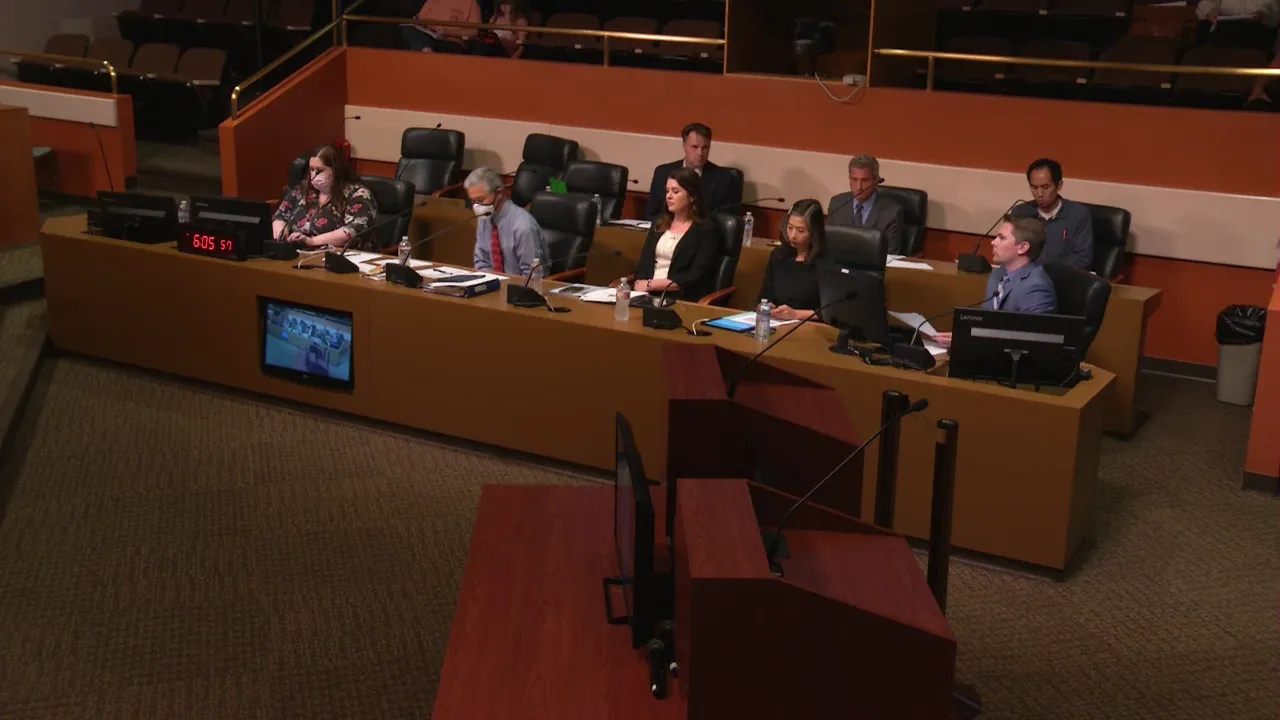
On April 26, 2022, the Huntington Beach Planning Commission held a study session at 5:00 PM and a regular meeting at 6:00 PM in the Council Chambers. The study session provided an overview of the State Density Bonus Law, while the regular meeting addressed a General Plan Conformance determination for the Capital Improvements Program (CIP) and two public hearings: a request to remove an undergrounding utility condition for a 7‑Eleven gas station and a variance-heavy redevelopment proposal for a residence on Bayview Drive. The Commission approved the CIP, denied the 7‑Eleven condition removal, and continued the residence proposal to allow further design revisions.
Study Session: State Density Bonus Law
- Staff presented key provisions of the State Density Bonus Law, a state mandate (enacted 1979) that entitles developers to density increases and other benefits as a matter of right when they include affordable housing.
- The City’s existing density bonus ordinance (Section 230.14) requires updating to align with current state law, which now forbids requiring a conditional use permit for density bonuses.
- Eligibility for a density bonus is based on a sliding scale tied to the percentage of affordable units (e.g., 10% moderate‑income units yields a 5% density bonus, rounded up to the nearest whole unit).
- Additional benefits include regulatory concessions/incentives (max. four, must result in actual cost reductions) and unlimited waivers of development standards that would physically preclude construction. Reduced parking ratios are also allowed (e.g., 1 space per studio/one‑bedroom unit).
- Staff noted that two upcoming townhome projects (May 10, 2022) will be density bonus projects, both targeting moderate‑income levels.
- Commissioners asked about timing for a zoning code update (staff: after the Housing Element is completed) and requested a guidebook on the law.
Public Comments (General)
- No members of the public spoke during the general public comment period.
Non‑Public Hearing Item: General Plan Conformance No. 22‑001 (Capital Improvements Program FY 2022/2023)
- Staff presented the CIP, a list of proposed projects for the next fiscal year, and confirmed that the Public Works Commission had recommended approval.
- Commissioner Ray inquired about specific projects: the Central Library Fountain repair (cost overrun led to council denial; project re‑evaluation planned), diesel generators at Civic Center (needed for emergency backup despite solar panels), arterial beautification (potential candidate: Banning Avenue), and downtown reconfiguration (using ARPA funds for mobility improvements, including Main Street).
- Commissioner Rodriguez asked about Edison Park reconfiguration; staff clarified it does not include Brookfield’s lighting upgrades (a separate school district project).
- The Commission unanimously approved the CIP (5‑0, Chair Perkins absent).
Public Hearing: Entitlement Plan Amendment No. 22‑003 (7‑Eleven Gas Station, 16171 Beach Boulevard)
- The applicant sought to remove Condition of Approval No. 6(b) from the original Conditional Use Permit (2019), which required undergrounding all overhead utilities along the westerly property line.
- Staff reported that similar projects are required to underground or pay in‑lieu fees. The applicant cited financial hardship: approximately $500,000 already spent on undergrounding, with an estimated total cost of $650,000–$700,000 (or up to $1.1 million if all ancillary work is included). The property owner and contractor testified that costs have escalated due to COVID delays, soil contamination, water table issues, and Edison design changes.
- Public speakers (neighboring veterinarian, property owner, contractor) supported the amendment, arguing that the visual impact is minimal and that an in‑lieu fee would be more cost‑effective. The property owner noted that the fee fund currently has only $600,000, insufficient for comprehensive undergrounding.
- Commissioners debated: some favored denial (citing the precedent of relieving an applicant of a committed condition), while others supported an in‑lieu fee option. The motion to deny the amendment passed 5‑1 (Commissioner Scandura dissenting). The decision is appealable to the City Council within 10 days.
Public Hearing: Coastal Development Permit No. 2021‑019 / Conditional Use Permit No. 2021‑020 / Variance No. 2021‑002 (Skylar Residence, 16850 Bayview Drive)
- The applicant proposed demolishing an existing 493‑sq.‑ft. residence and building a three‑story, 2,850‑sq.‑ft. home with an attached garage, requesting 8 variances (e.g., reduced front setback to 5 ft., 64.7% lot coverage, elimination of front‑yard tree requirement, third‑story deck outside roof volume).
- Staff recommended denial, finding the project inconsistent with zoning and the General Plan, and that the variances would constitute a special privilege.
- The applicant (owner Ashley Skyler) argued that the lot is substandard (2,283 sq. ft.) and that the RL zoning standards (designed for 6,000‑sq.‑ft. lots) are inappropriate. The architect noted that strict compliance yields only 2,261 sq. ft. of livable space, forcing an “upside‑down” layout. A neighbor and a long‑time resident supported the project, noting the street’s historic character and the need for redevelopment.
- Commissioners expressed sympathy but noted that the variances were too extensive. They discussed the possibility of a continuance to allow the applicant to work with staff on a revised design.
- The Commission voted 5‑1 (Commissioner Mandic dissenting) to continue the item for up to 90 days, with the applicant’s consent to extend the permit streamlining deadline. The applicant agreed to the extension.
Key Outcomes
- General Plan Conformance No. 22‑001: Approved 5‑0 (unanimous). The CIP for FY 2022/2023 is found consistent with the General Plan.
- Entitlement Plan Amendment No. 22‑003 (7‑Eleven): Denied 5‑1 (Scandura dissenting). The applicant must proceed with the original undergrounding condition; the decision is appealable to the City Council.
- Skylar Residence (Variance/CUP/CDP): Continued 5‑1 (Mandic dissenting) for up to 90 days to allow the applicant to revise the project in consultation with staff. The item is not appealable due to the continuance.
- Next Meeting: The next regular Planning Commission meeting is scheduled for Tuesday, May 10, 2022, at 6:00 PM, with two townhome density‑bonus projects on the agenda.
Meeting Transcript
Planning Commission meeting to order. May we have roll call, please? Yes. Commissioner Adam. Here. Commissioner Mandik. Here. Vice Chair Costa Galvan. Here. Chair Perkins is absent. Commissioner Scandura? Here. Commissioner Rodriguez? Here. Commissioner Ray? Here. Okay. We have a quorum. Do we have anyone signed up for a study session public comments? We have no public comments. Okay. Next on the agenda is our study session item, which is state density bonus law. Staff, may we have a presentation, please? Thank you, Commissioners. So we wanted to give you an overview on the state density bonus law. And the reason being is we have a couple of projects coming up at the May meeting, the first meeting in May, a couple of townhome projects that are actually density bonus projects. So I wanted to make sure you guys have a quick overview. So density bonus is a state mandate initially enacted in 1979. And currently a developer meeting the requirements of state law is entitled to receive a density bonus in other benefits as a matter of right. And so this is pretty different than what's in our ordinance right now. We have an affordable housing density bonus ordinance in Section 230.14, but it requires updating. For instance, that ordinance still requires a conditional use permit for density bonus or waivers and development standards, and that's no longer inconsistent with state law. So for purposes of state law, a density bonus means a density increase over the otherwise maximum allowable gross residential density for a property. Sorry, guys. So what makes a project eligible for a density bonus? Well, basically it's a housing development that incorporates some affordable housing, and there are multiple ways to qualify for density bonus. You may recall that we have a an affordable housing requirement, 10% affordable housing requirement. So meeting the city's affordable housing requirement, for instance, under the third bullet under B on the slide for a for sale project would qualify that project for a density bonus. But there are other categories as shown on here that could qualify project for density bonus as well. And the amount of density bonus is based on a sliding scale. So I have a an excerpt here from a chart. And you can see if you look at the first column, it tells you the amount of affordable housing that's proposed with the project. And if you look at the last row, 10%, which is our inclusionary housing, affordable housing requirement. If you provided that 10% and you're providing moderate uh income units, if you look at the fourth column, it'll tell you that you will get a 5% density bonus. So looking at an example, if you have a track map uh for a 30-unit condo, and you're proposing the 10% inclusionary housing at moderate income, you would get a 5% density bonus. So you would take the 30 base units that are proposed, multiply that 5%, and you would get 1.5 additional units. But under state state law, that is rounded up to two units. So basically, what started out as a 30-unit project will now become a 32-unit project. In addition to density bonus, there are other provisions as well that uh facilitate the development of uh housing. The first is uh in relation to regulatory concessions and incentives, and these basically have to result in actual and identifiable cost reductions.
openpublica.com