Huntington Beach Planning Commission Meeting - May 10, 2022
STREAMING COPY IN PREPARATION — RECORDING AVAILABLE FROM THE ORIGINAL SOURCE
Huntington Beach Planning Commission Meeting - May 10, 2022
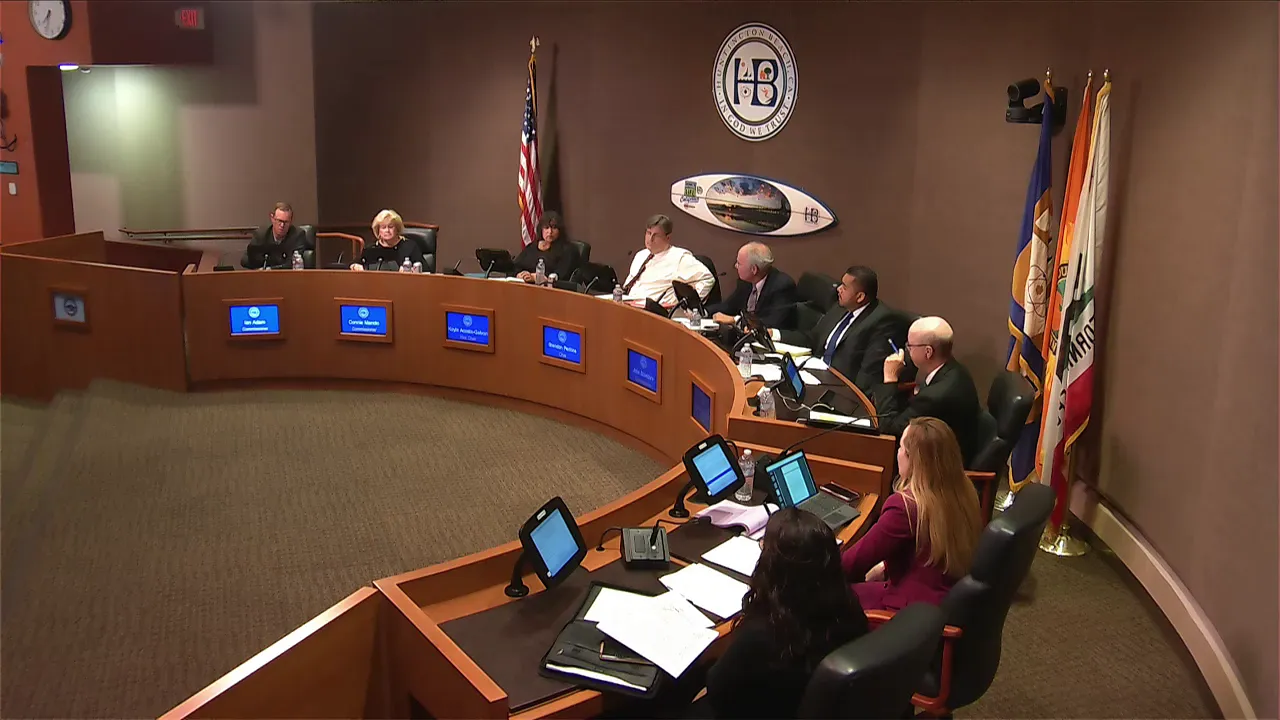
The Huntington Beach Planning Commission met on May 10, 2022, with a study session at 4:30 PM and a regular meeting at 6:00 PM. The commission received a presentation on state housing legislation, approved a general plan conformance for a city-owned parcel, continued one housing project, and approved another with conditions.
Study Session: State Housing Legislation
- Kathy Head of Caesar Marshton and Associates presented an overview of key state housing laws, including SB 35, SB 330, SB 8, and SB 9, focusing on their impact on Huntington Beach. She emphasized stricter timelines, objective standards, limited hearings (max five), density bonus requirements, and reduced local discretion. She noted that R1 zoning is increasingly under pressure and that the state is moving toward more prescriptive requirements.
- Commissioners asked questions about job-housing matching, SB9 lot split rules, density bonus mechanics, and the distinction between objective and subjective design standards. Staff noted that a local SB9 ordinance would be presented at the May 24 meeting.
Consent Calendar
- No consent calendar items were listed.
Public Comments & Testimony
- Deborah Thopham spoke during public comments, requesting that the city provide clearer timelines (calendar vs. business days) and more time for residents to comment on large projects.
- During the Olson Townhomes public hearing, multiple residents spoke:
- Supporters (Sheila Ellison, Ann Innes, Joy Dell, Lorraine Wijgin) praised the project's design, potential to beautify the area, and economic benefits.
- Opponents and concerned residents (Lisa Cordemarsh, Deborah Topham, Jeremy Tamisa, Gloria Rodriguez, Sharon Cauzer, Cesar Morales) raised issues including traffic safety, parking overflow, density, privacy, waivers, and the RL-to-RM zoning change. Many requested more community outreach and specific conditions like right-turn-only access and maintaining setbacks.
Discussion Items
General Plan Conformance No. 22-002 (Disposition of City-Owned Parcel)
- Staff presented a request to approve the sale of a .08-acre surplus parcel between Holly Lane and Main Street, which contains a utility easement. The adjacent property owner wants to purchase it for a future residential community. Staff recommended approval, citing conformity with General Plan goals.
- The commission voted unanimously to approve the conformance, with a CEQA exemption under Section 15061(b)(3).
Holly Triangle Townhomes (GPA 20-003, ZTA 20-003, TTM 19118, CUP 20-025, EA 20-003)
- Staff recommended a continuance to the May 24 meeting; the applicant agreed. The commission voted unanimously to continue the item.
Olson Townhomes (GPA 21-002, ZMA 21-001, TTM 19157, CUP 21-004, MND 21-003)
- The project, located at 8371-8461 Talbert Avenue, requested a General Plan Amendment from RL to RM, a Zoning Map Amendment, a Tentative Tract Map for 34 attached townhomes on 2.07 acres, a CUP for the townhomes and a retaining wall, and a Mitigated Negative Declaration.
- The applicant invoked the state density bonus (10% affordable units) for an additional 5% density bonus, resulting in 34 units (2 extra). Waivers were requested for open space dimensions, transformer placement in the Talbert setback, and reduced setback at the corner of Talbert and Newland.
- The applicant, John Reekston of Olson Company, presented details, cited 165 doors knocked and 62 community conversations, and expressed willingness to accept conditions such as right-turn-only on Newland and a trellis for privacy.
- Public testimony was extensive, with residents split between support and concerns about traffic, parking, privacy, and density.
- Commissioners deliberated and took straw votes on proposed conditions:
- Removing automatic gates: failed.
- Incorporating historical recognition of the La Cravin family: passed unanimously.
- Adding a two-foot trellis atop the six-foot rear wall (total 8 feet): passed.
- Restricting Newland access to right-turn in/out only: passed.
- Not imposing an additional undergrounding requirement on Newland: passed (allowing the proposed in-lieu fee).
- The final motion to approve the project with these modifications carried unanimously.
Key Outcomes
- Approved General Plan Conformance No. 22-002 (Resolution 1722) with CEQA exemption.
- Continued Holly Triangle Townhomes to the May 24, 2022 meeting.
- Approved Olson Townhomes with conditions: historical recognition, an 8-foot total rear wall (6-foot wall + 2-foot trellis), and right-turn-only access on Newland. The commission also recommended approval of the MND, GPA, and ZMA to the City Council.
- Next meeting scheduled for May 24, 2022.
Meeting Transcript
He is sponsored by the Sunset Beach Women's Club. We've been in existence. He's going to be late. Commissioner Mandick. Here. Vice Chair Costa Goldline. Here. Chair Burkins? Commissioner Scandura is going to be late. And Commissioner Rodriguez. Here. Commissioner Ray? Here. Okay, we have a quorum. Okay. Do we have anyone signed up for study session public comments? We have no public comments. Okay, in that case, we will move on to the agenda item for the study session, which is the state housing legislation. Do we have a staff report? Yes, we do. We have uh tonight we have Kathy Head, president of Caesar Marshton and Associates to give the presentation. Kathy. Good evening, Planning Commissioners. As mentioned, I'm Kathy Head, so some of you know me, I think. So I'm here tonight just to go over some of the major housing legislation that impacts you as a as a city and as a planning commission. And then after I run through my presentation, then I'm available for questions on anything and everything. So what I wanted to start with was SB 35. And SB35 got a ton of press when it was adopted in 2017. It was sort of considered the major housing legislation of that year. It actually doesn't have that much of an impact on the city of Huntington Beach in all likelihood, but I want to just run through the requirements of it. It will likely come up with strictly affordable housing projects primarily for you. But it was the precursor to other legislation that then came afterwards. So the threshold standards to whether a city is required to adhere to SB 35 were that not enough building permits had been issued to satisfy RENA obligations by category by income category. Almost no jurisdiction in California has met that requirement. So really most jurisdictions in California are subject to the threshold standard. And I don't believe it's happened here. But those are the two threshold standards. And so if somebody comes to you in a private market transaction and wants to do 50% low-income units, then possibly SB 35 would apply. And then through a finite period of time, the legislation also requires that skilled and trained labor be used. So the requirements of SB 35 placed on a developer are are also onerous before those requirements are triggered. So it's just something to keep in mind that if it comes up, you're subject to it. Exclusions from SB 35 are any coastal or wetlands, properties, anything that's been covenant affordable or it's historic, or anything that's been occupied by a tenant in the last 10 years. So if a project's being proposed in any of those situations, then SB 35 does not apply. So I think the key here is having gone through this exercise a number of times. So anything that doesn't pertain to the city of Huntington Beach, I've left out of the explanation. So key in in SB330 is our two concepts, timing and objective standards. Those are the two things that you need to think about in terms of development residential development proposals that come your way timing of approval and the imposition of objective standards. So what the state has done is said you, the city are required to create an application that provides the objective standards to which any residential development would be subject. If you don't as a city do that, then a developer or an applicant can come to the city and use an application the housing and community development department of the state of California has created, and that application has been created, so it exists. So until an application is created in the city, then it and then a developer could come with the HCD application and submit it to you.
openpublica.com