City Council IT Strategy Presentation and Discussion - July 15, 2025
STREAMING COPY IN PREPARATION — RECORDING AVAILABLE FROM THE ORIGINAL SOURCE
City Council IT Strategy Presentation - July 15, 2025
The City Council held a work session to receive a presentation from IT Director Carter Smith on the city's information technology strategies, including purchasing, life cycle management, asset inventory, and upcoming projects. The presentation aimed to educate council members on IT philosophies and provide baseline information for future decision-making.
Presentation on IT Purchasing Strategy
- IT Director Carter Smith explained the shift from fair market value leases to lease-purchase models, which allow the city to own equipment at the end of the lease through a dollar buyout, providing flexibility and spreading large costs over 4-7 years.
- Smaller purchases (e.g., monitors, keyboards) are made outright to avoid interest payments.
- A regular review schedule is planned to identify large purchases at least two years in advance, with a five-year plan.
Life Cycle Strategy
- Life cycles were established in 2018 based on industry norms: desktops/laptops (4 years), server arrays (5 years), firewalls/networking (7-10 years), business copiers (5 years). Switches are extended to 9-10 years with manufacturer support.
- An asset management system (Fresh Service) is being populated to track life cycles, end-of-life dates, and associated tickets, ensuring continuity through staff changes.
- Software life cycles are more complex; a review of the document management system (Laserfish, purchased 2002) was overdue and will be performed.
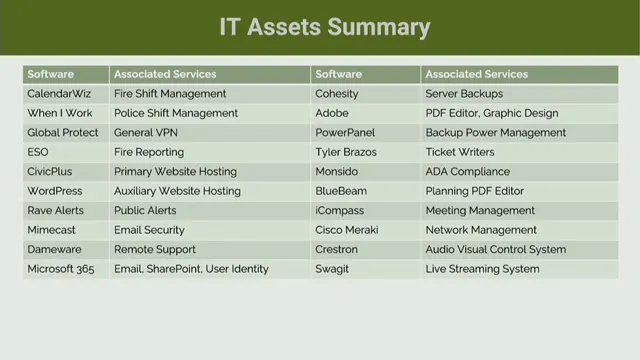
Asset Summary and Software Review
- Hardware assets: Dell server arrays (9, but only 2 online; to be decommissioned by October), Nutanix server arrays (6), switches, access points, security cameras, point-to-point radios, etc.
- Software: Many platforms, including ICS Athena (to be replaced at nearly $1 million), Civic Plus, Laserfish, Neogov, etc. Council discussed consolidation opportunities, noting the need for a comprehensive ERP system.
- Council member Ken Oldman noted that IT strategy changes have been costly; Mayor expressed concern about frequent migrations between on-premise and cloud, emphasizing the high cost of transitions.
Upcoming Projects
- Completed: lightning strike repairs, software refresh for streaming, Dell hardware refresh, business copiers refresh.
- In progress: park restroom cameras and access control (not in restrooms), city cell phones for staff, UPS battery replacements, GIS map updates, Laserfish update, SCADA internet failover.
- FY26 planned: website redesign (MercuryTX.org) with Civic Plus, consolidation of secondary websites (waterinfo, EDC, etc.), offboarding Watch Guard servers, internet circuit upgrade to 2 Gbps, Motorola Flex deployment, user account management redesign, asset management completion.
Key Outcomes
- No formal votes were taken; the presentation was informational.
- IT staff will continue with the lease-purchase model and regular asset reviews.
- Council directed staff to maintain stability and avoid frequent, costly transitions.
- The city will proceed with planning for a new ERP system in the coming years, pending cost and research.
Meeting Transcript
441 time over to the Secretary for Will Call and Certification. Mayor Proton Elizabeth Abraham? Here. Deputy Mayor Purchin Janet Butler. Council member place to Scott Smith. Council member place three, Andrew Ch. Councilmember Place 4, Ken Oldman. Council member place five, Laura Dale. Here. Can you ask certify the presence of the call? Thank you. Our presentation, item 3A, information technology strategies. Alright, Mayor, tonight we have our IT director, Carter Smith here. He's gonna give you a presentation on IT strategy. This is a result of some conversation that we had a few months ago when some IT um equipment came before you all for approval. So we wanted to take the opportunity to tell you why we do things the way we do it, what our strategies are, what our philosophies are from uh purchasing and replacement, um, and then get into a little bit about what our assets are. I want you to keep in mind this is kind of a 30,000 foot view. If you guys want to dive deeper, we can absolutely dive deeper. Um, but this is what we would call a preliminary conversation to educate you guys and give you some baseline information, and if we need to, like I say, go further, we can. Carter? Thank you. Uh start off. We uh today we'll be going over, as Aretha said, the purchasing strategy, our life cycle strategy, and a general summary of all of our assets, uh larger assets, anyways. Uh back in we went through and uh did a uh evaluation of how we used to go about purchasing larger items, and uh going back to 2010 up to 2017, we would largely use tax notes, uh CIP funds, and uh fair market value leases uh to uh for purchasing all of our larger um all of our larger equipment. And uh in 2018, uh when I had some discussions with uh my predecessor uh over what his philosophy was, and he largely used again tax notes, CIP, added in some general funds for purchasing smaller items, and move to a lease purchase model uh for purchasing larger equipment. And the big difference between the the between the two that caused them to move to that kind of model was that the fair market value, whenever you go into that kind of lease, uh you don't really own any of the equipment. At the end of the lease, uh you're given the option to either immediately return it or you can purchase it for whatever the current market value is, whether that's $300 for a thousand dollar piece of equipment or fifty dollars. Whereas the lease purchase model allows you to do a dollar buyout at the end, you now own it. And so if you need some flexibility due to uh whether that's budget constraints or due to personnel resources, you just can't do the refresh that year. Uh you can you can hold on to the equipment. You now own uh and a large goal of his uh behind uh uh keeping to the leases rather than trying to purchase equipment outright every single budget cycle is the leases allow us to spread out these larger costs that over our $100,000, $75,000, or some of them were up to three to five hundred thousand dollars. Uh spread them out over the course of four to seven years and not have uh the periodically of IT budget just absolutely peaking, and then you get a lot of questions over as to why it peaked. It just makes it a little bit easier to plan out and uh plan for future purchases. So uh we've largely kept that same kind of model. Uh we recently did the the Dell hardware lease that we brought up to council earlier this year, and uh just uh a short little while ago we brought up the uh the business copier lease as well. So these are for larger equipment orders. We're continuing to use the lease purchase model. Uh this includes things such as server arrays for hosting all of our servers, uh a bulk computer and laptop purchases whenever we're replacing all of our computers, and uh things such as our business copiers, just to name a few of our larger assets. Um this also helps us avoid having different models spread out through all the departments as we would have if we buy them periodically, and it that makes it easier for support and making sure that everything's under warranty. Um we are planning on uh a regular review schedule of all of our equipment life cycles under this model uh that will uh uh allow us to identify large purchases at least two years in advance, preferably have a five-year plan for uh reviewing all these leases and what's going to be coming off so that we're aware of what future purchases we need to make and how we need to plan out our budget. For smaller orders, we've begun working on kind of a more of a case by case basis, as was such with the access points, which kind of go between they're kind of an awkward moment between the large and the small orders, uh TVs, conferencing equipment, uh monitors, and such. The smaller smaller orders that uh typically have or typically have either longer life cycles, such as monitors, or kind of are more like consumables, such as keyboards and mice. Uh purchasing outright does help us avoid the lease interest payments. And so trying to try to avoid that with smaller uh smaller orders seemed uh seemed prudent. Um questions with the IT purchasing strategy. That's kind of generally what we were working for. Um going over our life cycle strategy. Uh we did find that in 2009 uh we had a council committee that was looked over all of our IT assets and made um recommendations as to what we need to replace, determinations as to what we needed to replace, and uh uh and it gave staff that uh that direction. And so that kind of was our 2009, 2017 governed our what assets we had and when we replaced everything. In 2018, uh one of my predecessors uh came in and established a life cycle guideline that was based off of uh current industry norms and manufacturer life recommendations, and so this establishes more of a regular cycle of okay when we purchase computers, the the manufacturer recommends we replace at this point.
openpublica.com