Metropolitan Development Commission Meeting – September 21, 2022
STREAMING COPY IN PREPARATION — RECORDING AVAILABLE FROM THE ORIGINAL SOURCE
Metropolitan Development Commission Meeting – September 21, 2022
The Metropolitan Development Commission met on September 21, 2022, to receive the annual Tax Increment Financing (TIF) presentation, approve a resolution for property conveyance, act on several continuance requests, and hear two rezoning petitions. The meeting included public testimony from remonstrators and city councilors.
Consent Calendar
- Approval of Minutes (September 7, 2022): Motion to approve passed. Commissioner Ash recused herself as she was not present at the prior meeting.
- Resolution 2022 R034 (Property Conveyance to Intend Indiana Inc.): Authorized the conveyance of two properties. Passed 6-0 with one recusal (Commissioner Ash recused? The record shows six votes and one recusal, but roll call includes Ash voting on later items; likely another commissioner recused. The transcript states "you'll need to recuse yourself from this vote" but does not identify the recused commissioner.)
- No Appeals Docket: Eleven petitions recommended for approval were read into the record and approved unanimously (7-0).
Public Comments & Testimony
- Brian Zeller (attorney and adjoining landowner) opposed the continuance of 2022 ZON 051 and 2022 VARO 3, arguing that the developer had not negotiated in good faith and that many remonstrators had taken time off work to attend. He requested the commission acknowledge the large turnout.
- City Councilor Zach Adamson (District 17) supported the remonstrators, expressing concern that the developer was not negotiating in good faith and noting the burden on residents who had attended multiple hearings.
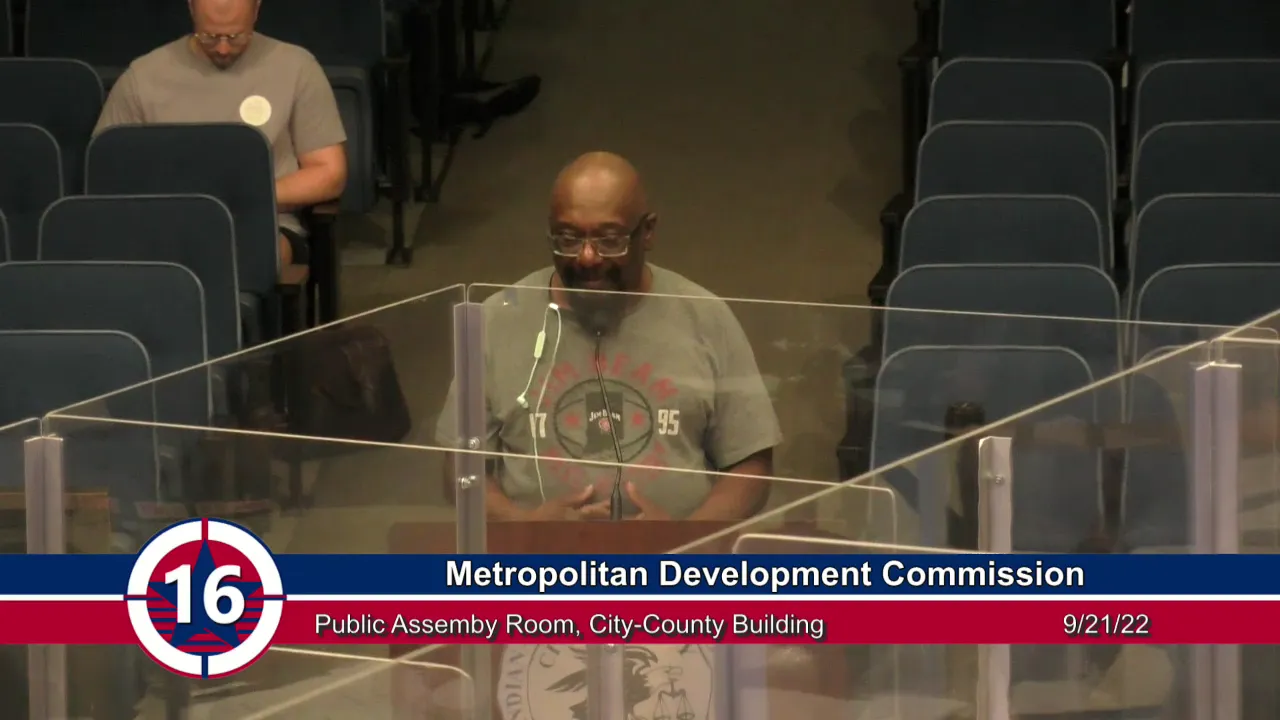
- Vernon Compton (remonstrator, Martindale Brightwood) testified against the Arsenal Avenue development, citing excessive density, safety issues in a school zone, and violations of development standards.
Discussion Items
- Annual TIF Presentation: Rusty Carr (Deputy Director, Department of Metropolitan Development) and Lucas Anderson (Office of Finance and Management) presented the required annual update on TIF districts. They explained the purpose of TIF, highlighted fiscal year 2021 financial activity (revenues of ~$130.7 million, expenses of ~$152.6 million), and noted that expenditures require commission approval. The presentation concluded with no questions from the commission.
- Continuance Requests:
- 2022 ZON 051 & 2022 VARO 3 (11 South Meridian): Petitioner Joe Calder requested a continuance to November 2, 2022, at the request of the district councilor and to facilitate further negotiations. Remonstrator's attorney Brian Zeller objected, citing late notice and lack of good faith. The commission granted the continuance (6-1).
- 2022 VAC 002 (Marie Clark): Granted to October 19, 2022, to allow ongoing discussions between the petitioner and Indianapolis Cultural Trail (7-0).
- 2022 CZN 830 & 2022 CAP 830 (7320 East Hand Avenue): Granted to October 5, 2022, pending receipt of executed commitments (7-0).
- 2022 ZON 083 (1754 South Lawndale Avenue): Granted to October 5, 2022, due to lack of commitments (7-0).
- Hearing on 2022 CZN 837 & 2022 CVR 837 (1450 East 16th Street / 1607 North Arsenal Avenue): Petitioner Brian Birch (Neon Architecture) sought rezoning from C5 to D8 and variances to develop eight townhomes on a vacant 0.31-acre site. Remonstrator Vernon Compton opposed, citing excess density, safety in a school zone, and seven code violations. Staff recommended approval with conditions (including a sidewalk and tree retention). The commission approved the petition 7-0.
- Hearing on 2022 ZON 082 (8018 West Washington Street): Petitioner Will Gooden (High Spirits Development LLC) requested a PUD rezoning of 13.7 acres for a mixed-use development with 227 multifamily units, 30 townhomes, and 6,000 sq ft of commercial space. No remonstrators appeared. Staff recommended approval, noting the site's location and the project's environmental sensitivity. The commission approved 6-0 (Commissioner Schumacher had left).
Key Outcomes
- Minutes approved with one recusal.
- Resolution 2022 R034 passed 6-0 (one recusal).
- Continuances granted:
- 2022 ZON 051 & 2022 VARO 3 → November 2, 2022 (6-1).
- 2022 VAC 002 → October 19, 2022 (7-0).
- 2022 CZN 830 & 2022 CAP 830 → October 5, 2022 (7-0).
- 2022 ZON 083 → October 5, 2022 (7-0).
- No appeals docket approved (11 petitions, 7-0).
- 2022 CZN 837 & 2022 CVR 837 approved with staff conditions (7-0).
- 2022 ZON 082 approved (6-0).
Meeting Transcript
What do you think? No, you're gonna field that. Ladies and gentlemen, may I have your attention, please? Welcome to the September twenty-first, two thousand and two Metropolitan Development Commission public meeting. As we begin, Mr. Levin, can you come to the podium please? Counselor, would you lead us in the Pledge of Allegiance? All rise. I pledge allegiance to the flag of the United States of America. And to the Republic for which it stands. Under God. Thank you, Councillor. You've had uh provided to you previously the minutes of September seventh, two thousand twenty-two. Are there any additions or deletions to those minutes? Hearing none, I'll accept the emotion to approve. So move. Thank you. I have a second, Commissioner Robinson. Second. Thank you. All those in favor signify by saying aye. Aye. Aye. Commissioner Ash, I will show you as recused since you were not at that meeting. Moving forward. Rusty, would you come forward and put into the record our state requirement on TIFF information, please? Yes, Mr. President, thank you. Um as alluded to we are required uh by state statute to present uh the uh TIFF information annually to the Metropolitan Development Commission, and it is laid out in this um statute you can see here uh on the screen and thirty-six seven twenty-five eight. This uh I won't read this in full, but this lays out uh what we would be pres what we will be presenting here um before you and again, my name is Rusty Carr and I serve as Deputy Director for the Department of Metropolitan Development. Next slide, Lucas. So we wanted to start with a very high level of uh tax increment financing theory, uh, which is that TIFF is a tool to help overcome redevelopment obstacles that cannot really be overcome through normal operations or the the private market. And so the TIFF is the use of new property taxes generated by a development to help pay for the cost of overcoming said obstacle. Traditionally this comes in the form of various things, but but a good example is environmental remediation in a lot of ways. Again, this is all laid out in state code under NA Code 36715.1, but essentially the staff of uh DMD in consultation with the community drafts a redevelopment plan and a boundary for a TIFF area. We would then bring that plan in a resolution to the Metropolitan Development Commission. If that resolution were so approved, it would move to the city county council. Uh and if it was approved at the city council level, it would then come back to the MDC for a final confirmatory resolution. And we like to include this slide as a really nice visual indicator of how a TIFF district works. Um the uh the axis on your left, the Y axis there is the appraisal value and the time here on the on the X, and this really shows the relationship between uh the growth in a TIFF over time and where that funding goes. So the gray area you see is the base property tax value that goes to the taxing units. When a development is proposed and goes up and has assessed value, you can see in the yellow area that is the TIF uh value that is captured in a separate fund that is used to pay the cost of redevelopment. Uh and then when a TIFF is um terminated at the end of 25 years, you can see that all of the value of the TIFF goes back to the base units, including schools, uh libraries, and even the city itself. Overall, uh in long term, and this really continues the work that DMD and Mayor Hogsett have done over the past um several years, and that is really looking at the TIFFs to further our public infrastructure, um, work on environmental uh issues relative to major site development, uh, relative, you know, again, again, catalytic redevelopment, major project site uh development, getting uh sites ready and primed for redevelopment, uh, as well as workforce development and certainly a housing strategy, which we are going um you know very firm on given our external conditions and working to include affordable housing uh as we see new housing across the city. And then I will turn it over to Lucas Anderson to run through the TIFF budgets. Good afternoon, Commissioners. Lucas Anderson with OFM. As annually required under statute, two items that I'll be speaking to are the annual TIF budgets and impact to local taxing units. I will be speaking specifically to fiscal year 2021 activities, as this is the most recently completed fiscal year that has been submitted to the Department of Local Government Finance or DLGF. I will first be speaking to the TIFF budgets.
openpublica.com