Indianapolis Airport Authority 2026 Budget Discussion – June 20, 2025
STREAMING COPY IN PREPARATION — RECORDING AVAILABLE FROM THE ORIGINAL SOURCE
Indianapolis Airport Authority 2026 Budget Discussion – June 20, 2025
The Indianapolis Airport Authority (IAA) Finance, Audit, and Compliance Committee met on June 20, 2025, at 1:30 PM to review and recommend the proposed 2026 operating and capital budgets. Staff presented a conservative budget approach anticipating potential economic disruption, with a focus on maintaining financial discipline, investing in employees, and using the capital program as an economic stimulus tool. The committee voted to recommend the budgets to the full board. Additionally, the committee received an update on the internal audit plan and celebrated a recent credit upgrade from Fitch.
Public Comments & Testimony
- No public testimony was heard during this meeting.
Discussion Items
2026 Operating Budget Presentation (Robert and Elias)
- Staff adopted a "conservative estimate" approach due to global and domestic economic uncertainty. Key assumptions: passenger growth of 1.7% historically was cut in half to 0.85% for 2026; a 3% reduction in passengers anticipated in Q3 and 4% in Q4. The operating appropriation recommended is $247.4 million (including a $6.9 million placeholder for potential future increases), while the staff's internal budget is $240.5 million. The $6.9 million represents the difference between a "business as usual" budget and the conservative budget; the board would need to approve additional appropriations later if economic conditions allow.
- Total operating expenses are nearly flat compared to the 2025 budget (0.5% increase of $699,000). Key expense drivers: $4.4 million increase in people costs (merit increases, health benefits, market adjustments, and 4.5 new FTEs). Offsetting reductions came from professional fees (-$1.8M), training (-$0.4M), printing/advertising (-$0.3M), contractual services (-$2.2M), utilities (-$1.1M), and capital expenditures (-$1.0M).
- Debt service for 2026 is projected at $105 million, with a debt service coverage ratio of 1.72x (target 1.25x). The increase is primarily due to parking garage and runway projects funded by Customer Facility Charges.
- Passenger forecast: 2024 actual 5.25M (all-time high); 2025 forecast 5.09M; 2026 budget 5.17M (0.85% growth). Cargo continues to decline, with 2026 budget at 4.31M landed weight versus 4.81M in 2025 budget.
2026 Capital Budget Presentation (Jared and Rebecca)
- Proposed 2026 capital appropriation of $330 million ($310M in project costs + $5M carryover + $15M for potential acceleration). The five-year capital plan totals $1.04 billion.
- Staff presented three scenarios: regular budget, accelerated (an additional $82M in 2027 for six major projects, leveraging 91% local spend and a 2.2x economic multiplier), and decelerated (reduction of $20M each year via delaying 47 projects). The appropriation includes $15M for potential acceleration, subject to board approval.
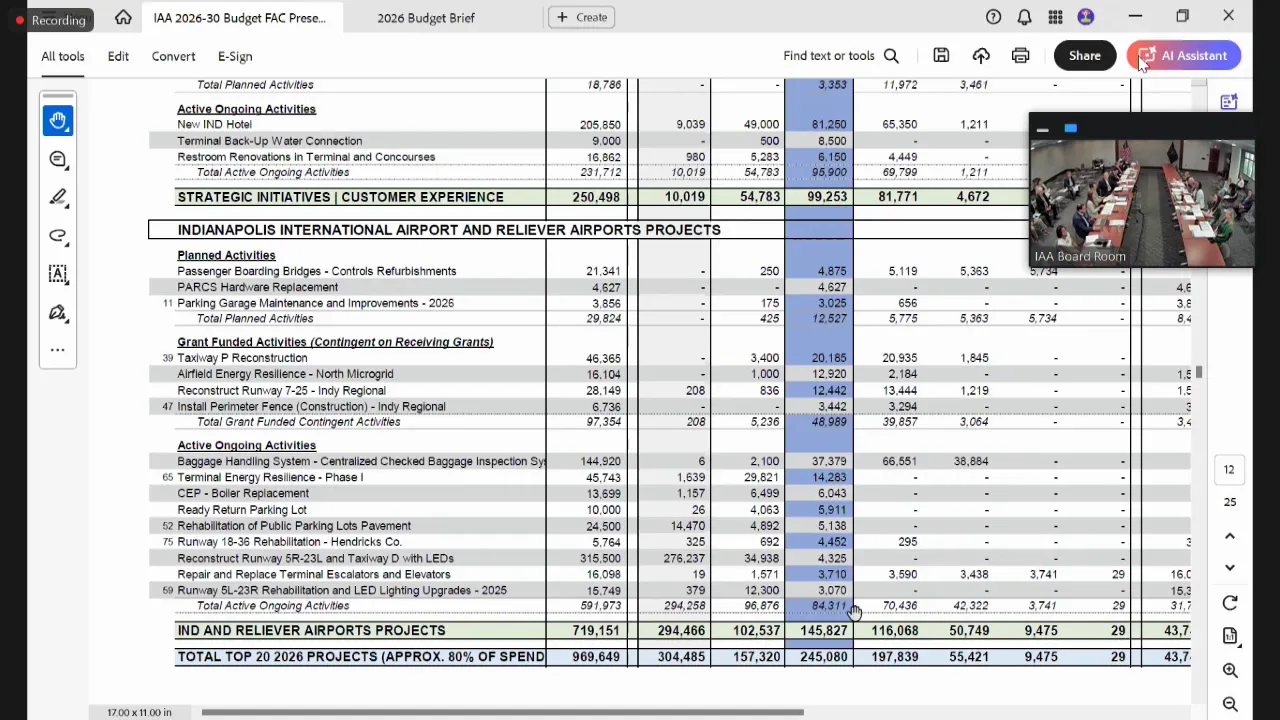
- Top 20 projects represent 80% of 2026 spend ($245M). Major projects: New IND hotel ($129M debt), baggage handling system recapitalization ($145M total), economy lot B expansion (1,800 spaces), terminal energy resilience, and runway/taxiway reconstructions. Grant funding is $67M (22% of 2026 budget), with a high success rate (largest grant among medium hubs in 2023).
Credit Upgrade and Debt Issuance Update (Robert)
- Fitch upgraded IAA's credit rating one notch, now matching Moody's at Aa3/AA-? (exact rating not stated). The upgrade resulted from stress tests showing financial resilience. A recent $159 million bond issuance funded five projects and refunded 2015 debt, saving $4.6 million NPV.
Internal Audit Plan Progress (Maria)
- Routine review of community partnership coding found six minor coding errors; a reminder was issued to P-card holders. Other audits are proceeding per plan.
Key Outcomes
- Motion: Committee moved to recommend the 2026 operating budget ($240.5M internal budget/$247.4M appropriation) and capital budget ($330M appropriation) to the full board. The motion passed unanimously (voice vote).
- Next Step: The budgets will be presented to the full board at the July meeting for approval.
- Directive: Staff will return with a more detailed breakdown of debt-funded projects (e.g., hotel) and continue to refine grant contingency projections.
- Recognition: The committee acknowledged the team's work in achieving the credit upgrade and preparing a disciplined, conservative budget.
Meeting Transcript
All right. Motion's been adopted. Next item is the 2026 budget. We start with the presentation by you, Robert. I I do want to say this that this is incredibly important in terms of the board functions, the budget, the point all budgets that we approve are incredibly important. So ask uh for more than a short presentation by Robert, right? Because it's so important that we have eyes on the details of this budget. So thank you. I saw a lemon merge on pleased with it, but I don't think we should spend some time on it, Robert. Yes. So making sure that we didn't have the echo, great. Um so the uh there will be two different aspects of what we discussed today. And again, remember we're discussing the maximum appropriation. That's ultimately what gets voted on by the board in August. The details though of the two appropriations, this is the operating appropriation that has all operating expense and debt service. And so that's what this first presentation will be. The next agenda item will be Jared Rebecca going through the capital improvement fund appropriation. That's the capital budget. Um as we start, I get to tell you that uh uh and you have a piece of paper in front of you. Um needed to change something after I sent it to you on Monday night. So uh what we realized is the thing I originally sent, and it was this page, but it was more summarized. It uh was not as easy to understand uh what the approach that uh we are presenting related to the operating budget, and that approach is we are planning for potential economic disruption. So that right now the discussion we're having is we just don't know. There seems to be a lot of tensions, world tensions, United States tensions, uh uncertainty economically. Uh airlines uh after the beginning of April kind of started to step back and not provide forward guidance due to economic uncertainty. Um that caused us to all stip but step back. Mario's directive to all the senior staff was to approach this budget with budgetary discipline and heightened discipline. We always look at it, um, but we have taken a different approach. That is a conservative estimate of what uh could happen with activity. By activity, I mean passenger levels. So um we've made our best estimate from different sources, looking at what airlines were saying in March, they were saying things stop. Um and taking that, looking at it and comparing to what's uh scheduled for seats in the market today. So seats, that's a economic driver. If there's available flight uh flights and seats to uh for passengers to be in, well, that's an opportunity. Doesn't mean that uh they will be taken advantage of. So um definition of seats. Seats would be a uh scheduled flight. Literally literally the same definition, seats in the market. The amount the the the uh available reserves that are flying out. No, no, no, don't get the available seats. Okay. So if you have a 737 and old type and you get 152 seats flying out, it's 15. Right. So we add up all that capacity, and that's a seat. Not gold seats capacity. That's not utility, that's not utilization. Right. Okay. So if it's utilized and or not utilized, that's load factor, right? That's what they that's what the airlines call it.
openpublica.com