Vision Zero Task Force Kickoff Meeting - October 23, 2024
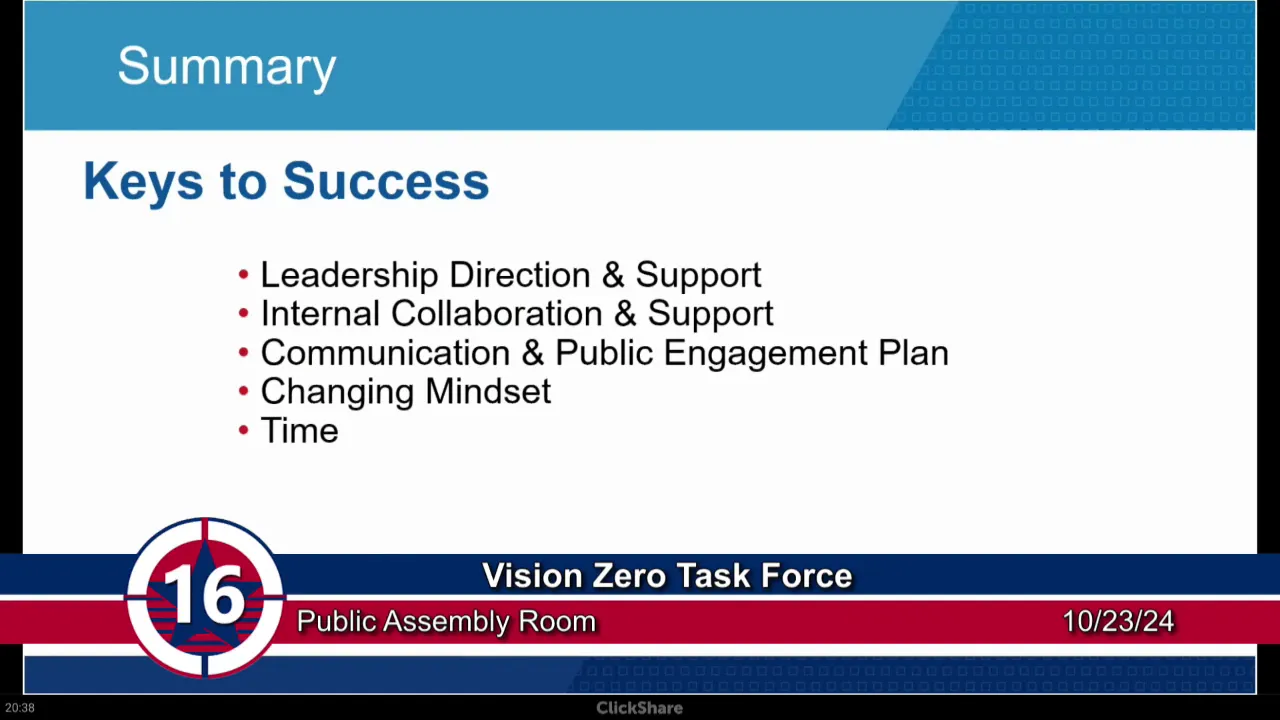
STREAMING COPY IN PREPARATION — RECORDING AVAILABLE FROM THE ORIGINAL SOURCE
Vision Zero Task Force Kickoff Meeting - October 23, 2024
The first meeting of the Indianapolis-Marion County Vision Zero Task Force was held on October 23, 2024, at 4:00 p.m. in the Public Assembly Room of the City-County Building. Chair John Barth (City-County Councilor, District 7) convened the meeting, which focused on introductions, an overview of the task force's charge, and a presentation on the Vision Zero concept. The meeting was a kickoff to begin developing the Vision Zero Action Plan, with a goal of eliminating all traffic-related fatalities and serious injuries on city streets by 2035.
Task Force Introductions
- All 15 task force members introduced themselves, including: Councilors Andy Nielsen (District 14) and Derrick Cahill (District 23); Brandon Hergett (Director of DPW, mayor-appointed); Abby Hanson (soon-to-be Controller, mayor-appointed); Megan Vukasich (Director of DMD, mayor-appointed); Abby Brands (Director of DBNS, mayor-appointed); Chief Ernest Malone (Indianapolis Fire Department, mayor-appointed); Aaron Vogel (COO, Indianapolis Public Transportation Corporation, mayor-appointed); Damon Richards (recreational cyclist representative, council-appointed); Lucas Sneekamp (Deputy Prosecutor, Marion County Prosecutor's Office, council-appointed); Addison Pollock (Director of Community Engagement, AARP Indiana, representing older adults, council-appointed); and Taylor Feierstein (Walk and Bike Program Coordinator, Health by Design, representing advocacy community, council-appointed).
Discussion Items
- Overview of Task Force and Next Steps – Chair John Barth outlined the task force's mission: to create a Vision Zero Action Plan by July 1, 2025, prior to the annual budget process. The plan will be updated annually and will be fed into the budget to ensure accountability. Barth emphasized the need for a multidisciplinary approach and noted challenges including infrastructure funding deficits and police officer shortages. A Vision Zero Administrator will be hired early 2025 to coordinate the work.
- Vision Zero Concept Presentation – Maria Cantrell of Burgess & Niple (B&N) presented an overview of Vision Zero and the Safe System Approach. She emphasized shifting from reducing accidents to eliminating fatalities, shared responsibility, and proactive safety. Cantrell highlighted the importance of speed management, street design, and cultural change (e.g., comparing acceptance of smoking to traffic safety). She noted that B&N will conduct peer city comparisons (Columbus, Charlotte, Denver) and gather resource data from each task force member's agency. A draft plan is expected by summer 2025.
- Task Force Comments – Councilor Nielsen thanked attendees and noted the process is a marathon, not a sprint. Councilor Cahill highlighted ongoing efforts like Prop 283 (councillor discretionary funding for Vision Zero projects), federal Safe Streets and Roads for All grants (nearly $20 million for pedestrian infrastructure), and INDOT funds. Director Hergett (DPW) thanked the council for patience and emphasized that the task force will allow for better communication and leveraging of federal resources.
Key Outcomes
- No votes or formal decisions were taken; the meeting was informational and organizational.
- The next task force meeting is scheduled for December 2024, where B&N will present findings from peer city analysis and other preparatory work.
- Each task force member was asked to identify a contact person from their agency to assist B&N with data collection and resource benchmarking.
- The task force affirmed the goal of having a draft Vision Zero Action Plan by summer 2025, aligned with the city's budget cycle.
Meeting Transcript
All right, well, good afternoon. We have a quorum of Vision Zero Task Force members. So we'll go ahead and kick off the first meeting. We will have all the task force members introduce themselves here in a minute. But let me just start by saying I'm John Barth. I'm a member of the City County Council representing District 7. I appreciate the president's confidence in me and allowing me to chair this brand new task force that has a very important charge that we need to accomplish. So I'd like to thank him. I'd like to thank the Indianapolis City County Council for supporting the vision behind Vision Zero and the structure of it, which you are seeing now today. Developing the Vision Zero ordinance that was passed and signed into law. And now as I say in my in my day job, we are widening the circle to include a lot more people to be involved in this. And I'll talk about that here in a minute as to why the circle is being widened and why that's so important. So today's meeting is really a kickoff meeting. It's aimed at introducing the mission of the task force, discussing the next steps, introducing the task force members to each other. In many cases, they're they're meeting each other for the first time, and introducing the task force members to the broader community. I do want to note that the planning process is the most important thing that we're gonna do. We're gonna create the uh action plan associated with the Vision Zero task force, and that's what these folks on the task force are gonna be doing. Um be doing that work in public and um really seeking out and um desiring the input from the public. That's gonna come especially as we dig into this and start having more work product. And I will describe to you here in a minute um what the work product is, or actually our our friends uh uh from our consultants will describe to you uh the work that they're doing now and what comes next. And that process will be very intentional in getting a lot of feedback, not only from this multi um disciplinary team, but also broadly um from folks across the city. Um so let me just some of this stuff I'm gonna say now is um a lot of the people here today are really passionate about this issue, and you you know what we're doing. Um, but uh some folks are gonna be brand new to this. Um and in fact, some people on the task force uh are newer to this concept um than others, uh, so they won't know a huge amount about it yet or or a minimal amount. So part of what we're doing today is really getting everybody to the same place and understanding um both the the task in front of us and what the concept in the vision of vision zero is. So um bear with us if if you're already an expert on vision zero, because we have some work to do to make sure we have everybody um caught up in it the same place. So a few comments to start. Vision zero is a global initiative aimed at eliminating all traffic-related fatalities in serious injuries while ensuring safe, equitable mobility for everyone. This was launched originally in Europe in the 90s. It shifts the focus from uh merely reducing accidents to creating a transportation system where no life loss of life is acceptable. A key component of Vision Zero is shared responsibility. Success requires collaboration across all levels of government and communities, from engineers and planners, designing safer streets to law enforcement, ensuring traffic laws are followed, uh, to public health workers promoting uh safety education. Every department in the city has a responsibility to contribute to the culture of safety. And the responsibility extends beyond the city county council in the government enterprise. Advocates, community leaders, and neighbors all play a role in this effort by meaningfully engaging in what would be a long process. This unified approach prioritizes vulnerable road users, such as pedestrians, cyclists, those with mobility impairments, and focuses on designing streets that reduce conflicts with motor vehicles. Many U.S. cities, including Columbus, Ohio, who I have, and I know anyone who paid attention to the lengthy process to get here knows that Councilor Nielsen and I really engaged pretty thoroughly with some leaders in Columbus. And we're lucky, and you'll you'll meet later to have a consultant who has meaningful and long-term experience with the Columbus experience. But uh I had the opportunity to spend time in in Columbus, Ohio, and plus virtual calls to really learn how they've done their work, and it's been uh impressive. And one of the things that has really um jumped out of me uh from meeting them was just how the the culture of Vision Zero seems to have really taken hold in city government in Columbus and how they had a real um focused um method of designing the the action plan, implementing the action plan and thinking it through very carefully. And so that those um that is being uh somewhat of a true north for me because I think what they have accomplished is meaningful and significant and impressive. Um by joining this movement, we are committing to work together to create a safer, more livable city and to meet the ambitious goal we have of eliminating all fatal and serious crashes on city streets by uh 2035, which was established in proposal 224. I do want to restate that this is a multidisciplinary, multi-department, multi-agency process, and we have to get it right. Uh the prioritization that comes with it is part of how we will make sure that we are moving deliberately and intentionally towards the goal of in 2035 from Marion County. Um I do want to just restate that again because part of what we're doing with Vision Zero is getting this across city, across disciplined team, plus the input of the community to really think hard about what this action plan is and how we're going to execute it. Part of what really matters is the implementation and the prioritization. And I think that's uh a challenge sometimes because we're have to we'll have to make some tough choices about what comes first and what we prioritize first. Um we can't pretend that we don't have uh significant and uh ongoing, hopefully to be resolved in in this or upcoming um sessions of the General Assembly, but we 100% have a uh deficit when it comes to equity uh as far as funding for infrastructure uh in Indianapolis is something we've dealt with and struggled with for a long time. But by really thinking hard and partnering um internally and externally and coming up with those priorities, we we will start chipping away at this problem and get to our goal by 2035.
openpublica.com