Joplin City Council Work Session: Proposition Action, Retreat Follow-Up, Neighborhood Revitalization, Parks Update - March 10, 2025
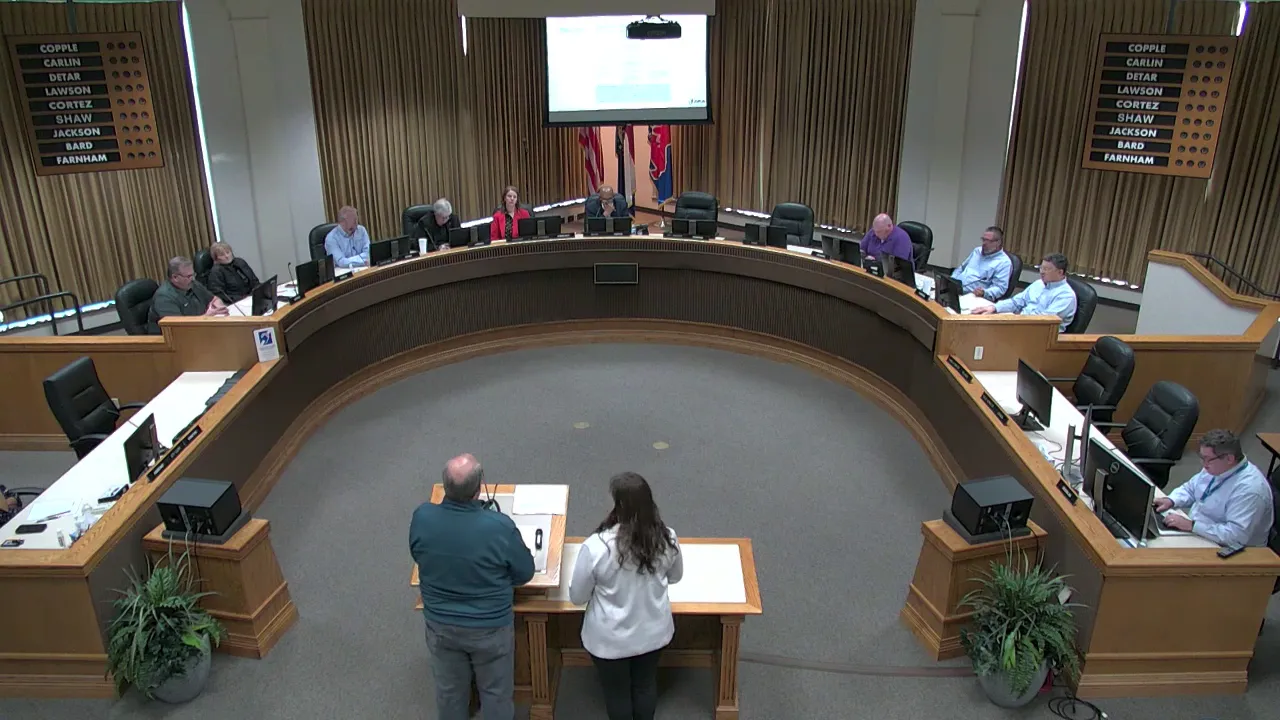
STREAMING COPY IN PREPARATION — RECORDING AVAILABLE FROM THE ORIGINAL SOURCE
Joplin City Council Work Session - March 10, 2025
The Joplin City Council held an informal work session on March 10, 2025, covering four major agenda items: an update from the Proposition Action Committee, a follow-up on the December council retreat, community revitalization and declining neighborhoods, and a parks and infrastructure update. No formal votes were taken; the session focused on reports, discussion, and direction for staff.
Proposition Action Committee Update
- Rob O'Brien and Kim Cox, co-chairs of the oversight committee, presented a progress report on the use tax-funded action plans. Of 45 action plans, 13 (30%) are complete. Revenue from the use tax has totaled approximately $17 million since implementation, significantly exceeding the initial estimate of $3.7 million per year. One-time expenditures total $2.3 million, ongoing expenditures $7.7 million, and committed projects $7.5 million, leaving about $2 million unallocated.
- Six action plans remain unstarted. Council member Jackson asked about the "habitual offender identification" system; staff indicated it is part of police technology and deferred to the police chief for details.
Council Retreat Follow-Up
- City Manager Nick Edwards presented the final report from the December retreat. Council members ranked crime/safety and economic development as top priorities. Council members Coppel, Jackson, and Farn expressed strong concern about staff salaries and retention, especially with the new state minimum wage law. Coppel suggested using unallocated use tax funds as a "war chest" for pay restructuring, and Jackson proposed cutting 10% from capital projects to fund salaries. No decisions were made; staff will develop action plans.
Community Revitalization and Declining Neighborhoods
- Troy Bolander presented a neighborhood assessment covering 7,000 structures in four census tracts. Results: 29% had property maintenance code violations, 15% minor nuisance violations, and a portion needed posting or demolition. Programs include J-HAP (down payment assistance, 87 homes completed), J-HARP2 (repairs, $460,000 spent), a demolition program (15 homes demolished, 18 in progress), and neighborhood revitalization (16 new homes built, $555,000 in incentives).
- Finance Director Leslie Haas discussed vacant lot inventory, a land bank update, and plans to reestablish a county lot transfer program with Jasper and Newton Counties. Council members requested stronger enforcement of vacant building fees and a faster process for securing dangerous properties. Staff will review code changes and explore administrative abatement.
Parks and Infrastructure Updates
- Dan Johnson reported on capital improvement projects: Connecticut widening complete, 20th Street construction starting spring, Willow Branch in design, Pennsylvania Avenue Viaduct public meetings upcoming, Fourth and Murphy intersection improvements nearing completion, and multiple stormwater and sewer projects underway. He noted a six-month delay in getting manhole lids with the city logo but insisted on using them.
- Paul Bloomberg presented park projects: Dover outdoor recreation area (groundbreaking Feb 24, completion spring 2026), Ework Splash Park (bid April 28, completion spring 2026), park beautification signage, playground enhancements ($1.3 million), park ranger program (three rangers, two trucks, third arriving May), and pool staffing (40 lifeguards certified, 130 applications). Council discussed homeless concerns in the Fourth and Murphy culvert; staff said signage and lighting would be added.
Key Outcomes
- No formal votes or resolutions were passed. Staff received direction to: continue use tax oversight, develop a staff pay plan, review vacant building fees and enforcement processes, reestablish county lot transfer programs, and proceed with park and infrastructure projects as scheduled. Council members highlighted the need for proactive monitoring of homeless encampments in new park trails.
Meeting Transcript
Good evening, everyone, and welcome to the March 10th work session for the Joplin City Council. We have four items on our agenda this evening. And um let's get started. Our first item is update from Proposition Action Committee. City Manager Nick Edwards. Good evening, Mayor and Council. I'm simply going to do an introduction. I want to introduce our uh chairs for uh proposition action, the oversight committee that council appointed to oversee uh the follow-through on the use tax items, our action plans. Uh Rob O'Brien and Kim Cox as co-chairs. Uh, they're gonna walk you through uh PowerPoint on the latest and greatest from uh the committee. That's my new friend Kim Cox, who I just met for the first time about oh three minutes ago, and my old friend Rob O'Brien. Good evening all. How are you? It's a pleasure to be here with you this evening. Uh we appreciate the opportunity to bring you up to date on the uh progress of proposition action. Uh before we get started, I would uh uh remind you that uh we have uh 15 people who are the oversight committee that you appointed uh to watch proposition action. Uh that was a request of the citizens as we campaigned uh during that period of time. And uh many of them are here this evening. I'd like to have them stand up, members of proposition action committee. So not everyone could make it, but you can see there's a good turnout because they we are very interested uh in this and in the progress of uh making sure we meet what was promised to the citizens of Joplin. This is a bit of background. Uh the manager's uh listening tour uh was in fall of 2020. Um that um there were a number of suggestions, comments, ideas that were brought forward uh that came to uh the city council retreat in November of 2020. Uh hard to believe that's a little over four years ago now. Um this body uh adopted the action plans in May of 2021 and decided to put that in front of the voters uh for uh uh a vote that occurred in November of 2021. Uh many of you might recall we had a couple of uh unsuccessful attempts uh to implement the use tax uh prior to that, but uh but the voters saw the merit of uh proposition action and all of the opportunities that are presented for the city of Joplin, and they did approve that. As we mentioned, uh there was uh feedback from the citizens during that time uh for uh citizen oversight, and so uh our oversight committee, many again who are sitting here, uh began in January of 2022. So uh the use tax was use tax revenues uh were pledged to implement the action plans that was determined by this body in uh the process. Um there were a number of action plans that were brought forward. There are more than 45 on the table. Um the uh ability to receive ARPA funding uh and other grant opportunities is greatly extended. Uh fortunately, uh the opportunities the city has had uh to do a number of things. So uh to date, 13 of the 45 action plans are complete, or about 30 percent. So in a relatively short period of time, given really what uh lift it is to begin programs and processes. Uh that's a uh a real plus, we believe for the community. And some of that, as we we mentioned, was really uh adding staff capacity. The city of Joplin was down on staff capacity. Um some of you may recall we had um uh greatly expanded staff post-tornado because of all of the recovery uh and all of the dollars that were flowing into the community at that point, and then as those dollars rent out and those staff cutbacks begin in line with that. We actually found ourselves uh behind the curve. And so putting uh additional staffing capacity uh was was very critical. Revenue to date and uh talk about for a minute. Revenue to date, and talk about for a minute, you know, when we campaigned for this as a community, and many of these folks were on the campaign committee as well. There is a lot of talk about what would this do. A lot of consideration with the council as well. What can this generate for the for the community? And there were a number of other communities looked at, including their experiences, what had happened with them, and on a on really a fairly conservative basis, it was considered that uh this new tax would generate about 3.7 million dollars, 3.7 million dollars. That was the estimate that was what the campaign was was driven on. In the very first fiscal year of 2022, which was a short year, recall we actually implemented this in January, was not November. That was when the vote was. So it began in January, and so it was a shortened fiscal year, 10 months.
openpublica.com