City Council Informal Work Session: Budget, Time & Attendance, Health Department - May 5, 2025
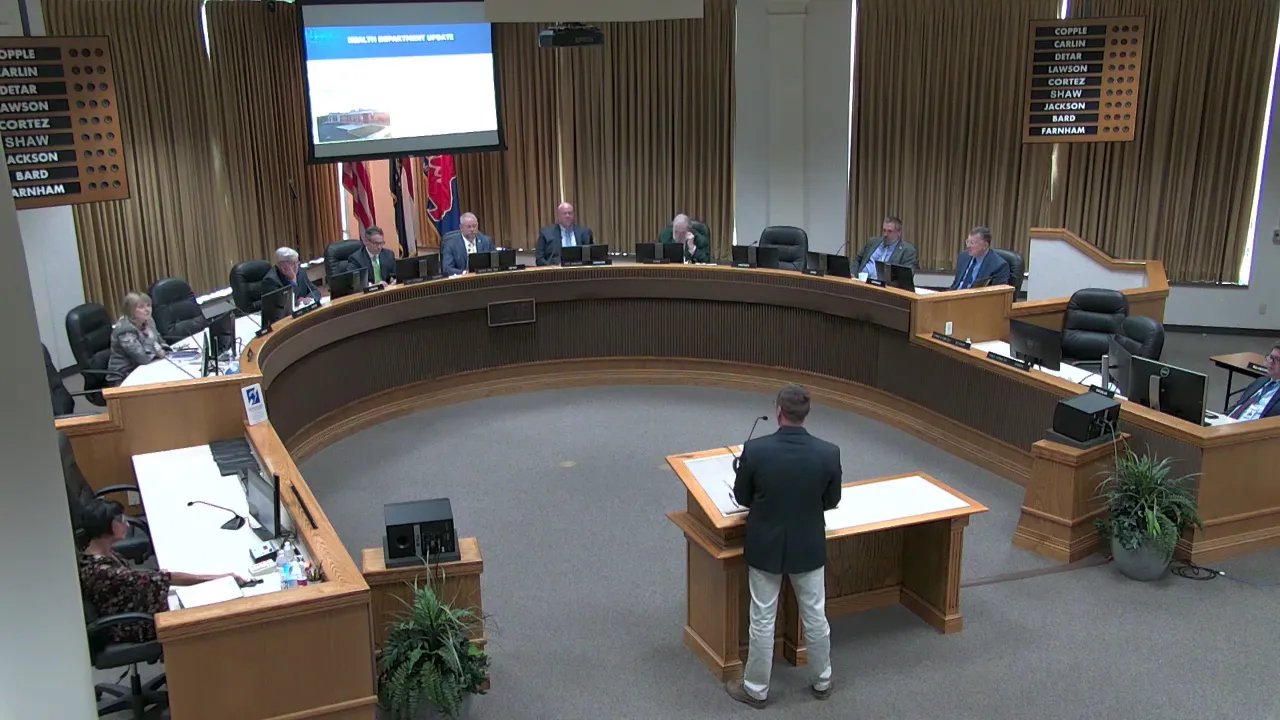
STREAMING COPY IN PREPARATION — RECORDING AVAILABLE FROM THE ORIGINAL SOURCE
City Council Informal Work Session: Budget Process Changes, Time & Attendance System, and Health Department Update - May 5, 2025
The city council held an informal work session on May 5, 2025, receiving three detailed presentations. Leslie (Finance) presented a restructured annual budget process emphasizing earlier council input on key initiatives. An update on the electronic time and attendance system implementation was provided, including progress with a pilot group and pending technical integrations. Ryan, Health Director, gave an overview of the health department's history, divisions, and current initiatives.
Discussion Items
Budget Process Changes
- Leslie explained that the previous budget process started with compiling payroll and revenue, then departments submitted expenditure budgets in May, followed by meetings focusing on operational line items, and later separate meetings for key initiatives. This process did not align city council goals with the budget and created extra work.
- The new process starts in April by updating current key initiatives and setting new ones for the next year. Meetings between department heads, city manager, and Leslie in April discuss these initiatives, which will be presented to council on May 12th for early input. The budget will then be built around council's priorities.
- The priority order for funding: current services (staffing, operations, step increases), then replacement of needed existing capital and inflation adjustments, and finally new items. Leslie noted there is typically no surplus in the general fund operational budget, so new requests must be evaluated in the context of overall financial sustainability.
- The proposed schedule: department heads finished key initiatives by April 16th; meetings with city manager occurred the week of April 21st; council work session on May 12th; department budget submissions by May 30th; finance department meetings June 16th-24th; estimate of needs due August 4th; first budget work session August 11th; public hearing August 18th; public hearing for property tax rate August 25th; budget work sessions September 22nd-23rd (possibly 24th); budget adoption on October 20th.
- Council members Ms. Carlin and others commended Leslie for the streamlined process that allows earlier feedback. No questions were asked.
Time and Attendance System
- Leslie provided an update on implementing an electronic time and attendance system (TCP) to replace paper timesheets. The system records hours worked and leave time, automatically importing into the payroll system (Central Square).
- The finance department served as the pilot group, starting clocking in and out on September 27th. The pilot revealed issues such as access restrictions, ensuring non-exempt supervisors cannot approve their own time, handling missed punches, exceptions, comp time elections, rounding, and technical issues with email notifications for leave requests.
- Two critical data transfers between TCP and Central Square: downloading hours from TCP to Central Square, and uploading new employees and accrual information from Central Square to TCP. The download function became operational in January 2025, allowing the finance department to go fully live in March 2025, discontinuing paper timesheets.
- The upload function (for new employees and accruals) required additional programming coordination and is not yet fully automatic. It works manually but the automatic piece is nearly complete. Once that is resolved, other departments can be trained and brought on.
- Leslie reported that the city has approximately 800 real employees (not FTEs) to train. Training materials are being developed, and training is expected to begin by September-October 2025, with departments onboarding step-by-step.
- Council comments expressed understanding of the complexities and appreciation for taking the time to ensure accurate paychecks.
Health Department Update
- Ryan gave a presentation on the health department, which dates back to 1889 (initially focused on milk inspections). Key functions by division: Environmental Health (food inspections, lodging, daycare, mosquito fogging, education, food safety classes); Animal Control (strays, dangerous animals, bites, nuisance, trapping, wildlife complaints, spay/neuter financial assistance); Medical Services (vaccinations, communicable disease investigations, pregnancy testing, STI, TB, hepatitis C, CPR, education); WIC (grant-funded, income-based supplemental food and education for pregnant women, postpartum, infants, children under five, lactation support); Emergency Preparedness (grant-funded, one person, develops emergency response plans and works with hospitals); Worksite Wellness (new, one person, designs wellness programs across city departments); Administrative (director, birth/death records, contract management, billing).
- All positions were filled at the time the presentation was prepared, but currently two WIC positions are open. Staff years of service range from 54 years (administrative assistant Mary White) to new hires, providing a mix of institutional knowledge and new energy.
- Current initiatives are all in progress or completed. Recent major tasks: environmental health inspection software update, starting hepatitis C testing, H5N1 response (now shifted to measles), finalization and dissemination of community health needs assessment and gap analysis project (grant-funded), and general grant and contract management.
- Ryan indicated that more in-depth updates will be provided at the upcoming meeting. Council thanked Ryan and the health department for their work.
Key Outcomes
- No formal votes or decisions were taken. The council received information and expressed appreciation for the presentations.
- Next steps: The budget process will continue with a council work session on May 12th to discuss key initiatives.
- The time and attendance system implementation will proceed with completing the automatic upload function, then training and piloting other departments starting in September-October 2025.
- The health department will provide further updates and continues to manage current initiatives and open positions.
Meeting Transcript
Leslie, you ready? Get us get us started off with the first two. Thanks. Good evening, Mayor. Council. So we we've changed the budget process for this year. And you may ask why are we changing? The budget process in general is somewhat of an exercise in dreaming. You know, what new services can the city provide? How can we do things differently? However, just like household budgets, the city doesn't have enough resources to do everything that everyone wants to do. So it comes down to priorities. And so this change is all about prioritizing differently and aligning our work plans with city council's priorities for the community. So remember the the key to the budget is to use it as an operations plan and manage workloads. So the way that it did work before this year, budget always runs April to October. So we always started in the finance department compiling the payroll budget and the revenue budget. And then usually in May, the departments would compile and enter their expenditure budgets for estimated actuals and their next year's requests, including requests for new operational and capital items. And then in June, department heads and supervisors met with the finance department. These meetings focused on operational line items for estimated actuals and budget requests, as well as needed replacement of existing capital. So essentially, what we were developing was the base budget. And then we would have a second set of meetings between the city manager, department heads, and myself. And these meetings focused more on key initiatives, new requests for personnel, operational and capital items. This was in July at that point, and so if proposed key initiatives needed updated, it was essentially too late to update the budget request properly, and it also did not allow for advanced input by you all. And then step increases and inflation adjustments were contemplated last. So you can see how things were being prioritized. So this process did not properly align the city council's goals and the action plans with the budget process. It did not match the funding priorities of the city, did not allow departments to properly focus on needed replacement items and new items. Instead, they were trying to budget their utilities and things like that. So it created extra and unnecessary work for the departments and for my staff. So we're gonna try something new this year. Again, we'll still start in April. Still takes six months, no matter how we slice the pie. And so we will actually start the process updating our current key initiatives that we're working on this year, and then setting new ones for next year. And then we actually held meetings in April between the department head, city manager, and myself to discuss uh the status of the current uh key initiatives and the new ones that we want to put before you for next year, and we'll actually present that to you on May 12th at the work session. And so at that point, City Council will have an opportunity to discuss the key initiatives at the beginning of the budget process rather than the end, and again, this the key initiatives are that's our work plan for next year. So that allows you to to weigh in on the work plan, and then we can build our budgets around that. So then by the end of May, uh the finance department will build the payroll budget, the revenue budget, we will do the base budget for estimated actuals and the base budget for next year. Departments will be now focusing between April and May. They'll focus on their key initiatives, uh replacement of existing capital items that needs to happen next year, uh new requests for personnel, operational items, and capital items, which should be related to key initiatives, and then capital projects. They won't be keying in that information in our software system, they'll be doing that in Excel form so that we can discuss those items. We'll still have uh the finance department meetings with departments and supervisors to discuss the base budget. So departments will still have the opportunity uh to make changes to the base budget, have discussion, and then we'll we'll finalize that in June. We'll also talk about the replacement of existing capital that's needed along with the new requests. And then a new step is that those new requests will be presented to the management team for discussion in June, and then we'll hold our normal meetings with the city manager in July and hopefully finalize the proposed budget because we have to get that printed and to you all in August. So again, this is all about changing the focus of our priorities. So this is how the priorities will be in order. Funding current services, so current staffing and operations, step increases, and really the next two go together. So it's replacement of needed existing capital and inflation adjustments before anything new will be considered. So new things will be will be last. So as you know, there's typically no surplus in the general fund uh operational budget, and so we need to prioritize.
openpublica.com